 TurtleGit for Mac
Git Synchronization parity
The literal reference identity family connects selected branch bytes to outgoing comparisons, tracking configuration, checkout and transport when macOS Git filename precomposition is enabled. Its acceptance scope is recorded separately from full dialog parity.
The incoming/outgoing commit-list family connects conditional SVN columns, source parsing, independent saved layouts, confirmed content-fit reset and configured font metrics. Native menus retain their selected results and source side, while root feedback and metadata workers drain through closure. Shift comparisons receive the owning preferences. The Debug app and four native case/engine checks pass after a fixture-only source correction; actual evidence retains that failure, configured-font captures and remaining installed/physical/signed/source gates.
The reference and tag result family now uses fixed source columns, native fonts, eight-character hashes, source sorting and header widths, window-local filters and captured menus. Log selects the clicked revision; Shift comparison and first-hop Log/Compare/RefLog preferences survive routing. Tag deletion retains its snapshot and remote through owned confirmation and retirement. The Debug build and six native case/engine checks pass; four light/dark captures were reviewed. Evidence keeps physical, signed, authenticated transport and complete source gates open.
The incoming and outgoing file-list family replaces
both Changelists with native source-restricted comparison/clipboard tables,
independent saved columns, sorting and owned reset. Exact historical paths,
native activation and stale action guards have a grouped checkpoint with both Git
engines. This remains a partial review of IDD_SYNC; physical, signed and complete
dialog acceptance remain open.
The connected Synchronization/SVN entry family adds all five source command routes, Sync sequence placement, owning preferences and preserved SVN questions/options across competing requests. Existing native forms, original icons and backend workflows remain the consumers. Batch evidence separates focused execution from public transport, physical, signed and complete dialog acceptance.
Baseline: 7338078f8ddd924b8cddee35f512f2286072136d, SyncDlg.cpp
(FetchOutList, ShowInCommits), its inline AddDiffFileList in SyncDlg.h,
and Git.cpp::IsFastForward/GetCommitDiffList, plus BranchCombox.h.
A partial native window now exposes the outgoing projection. This is not a
completed Synchronization dialog.
Comparison backend
GitRepository.synchronizationOutgoing returns a pinned, read-only projection of
the local and remote-tracking revisions. Equal revisions produce Up to date with
no outgoing comparison. A missing remote branch produces the source unknown
branch state. The source's slash/backslash URL heuristic is retained: a typed URL
or path is unknown without contacting the server, even with Force enabled.
For a fast-forward push, the outgoing Log range is remote..local and the file comparison is remote to local. Divergence without Force produces the blocked state. Force keeps the remote..local Log range but compares files from the merge base to local. The full history is requested, bypassing Log's ordinary 200-row limit. File comparisons enable the source default 50-percent copy detection and retain original paths. Existing other comparison callers keep their defaults.
An unusual pinned-source behavior is preserved: no merge base leaves a zero CGitHash; GetCommitDiffList interprets zero as the working-copy revision. Forced unrelated histories therefore keep outgoing commits and use working tree to local for their file comparison. A forced behind branch can have zero outgoing commits while still enabling Email Patch, just as the source does.
synchronizationIncoming compares the captured pre-operation revision with the
actual completed revision (HEAD after Pull, fetched upstream after Fetch), returning
that pinned comparison and old..new history. Equal revisions return empty lists.
Resolving hashes uses stdout independently of diagnostic output. Input NULs and
pre-cancelled operations are rejected; the token is forwarded through Git reads.
The snapshots do not authorize transport operations.
Transport backend
SynchronizationTransportOptions and its immutable plan cover Pull, Fetch,
Fetch & Rebase, Fetch All, Remote Update, Prune, Push, Push Tags and Push Notes.
Pull, Fetch, Fetch All, Remote Update and Prune are wired to the native window.
Fetch & Rebase owns its source choices and separate progress. Push, Push tags
and Push notes now have native split actions and owned Shift Push options;
project pre/post-push hooks remain pending.
The source CLI rules are preserved: matching pull tracking omits an explicit
branch; configured Pull rebase performs Fetch and defers the native rebase
handoff. Branch-specific rebase overrides the global setting, including Git's
numeric and valueless boolean forms. merges requests preserved merges.
Existing tracking refs give Fetch a branch:remotes/remote/branch refspec;
missing refs and typed URLs use the selected branch alone. Fetch All omits the
branch for the selected remote. Remote Update uses git remote update; Prune
uses the selected remote. Git still applies its configured remote-update groups.
Push Tags includes both --tags and the selected branch refspec. Push Notes
uses git notes get-ref and ignores the destination-branch field. FETCH_HEAD
prefill uses exactly one for-merge line, preserving the source's FixBranchName
rule. An empty resulting source with a destination is a deletion refspec; the
executor requires separate explicit deletion authorization. NULs in fields or
metadata-derived arguments are rejected.
Pull requires explicit authorization before a planned branch switch. Git 2.39
rejects the pinned upstream's newer checkout --end-of-options syntax, so the
macOS adapter uses switch --no-guess -- branch for local branches and
switch --detach -- revision otherwise. Source old-HEAD metadata remains in the
original plan. Execution checks the repository identity and the Pull HEAD/branch
before work and again after asynchronous authentication. Cancellation reaches
metadata reads, checkout, authentication and transport; output uses the shared
stdout/stderr stream protocol. Fetch-for-Rebase pins the completed target hash;
if that read fails, a separate error retains the successful transport result.
Pull preflight predicts the selected branch's attachment, and detached targets skip
the native Fetch-for-Rebase interception. Pull resolves FETCH_HEAD as a normal
revision; Push alone uses the source unique-for-merge FixBranchName rule. After an
approved checkout and asynchronous key preparation, execution uses the actual
current branch's rebase setting and current pull configuration. This preserves
post-checkout hook and key-preparation configuration changes. The original plan
keeps its pre-checkout old HEAD for incoming results. rebaseMode and
executedArguments on the result report the command actually executed; owners
must use that mode for their native handoff rather than the earlier prediction.
The backend also exposes synchronizationPullCheckout and a continuation overload
of synchronize. The checkout step returns its own streamed command result and
an opaque checkpoint containing the original plan and the actual post-hook
HEAD/branch fingerprint. A native owner can present separate checkout progress,
then ask tracking questions and capture reference metadata before starting
transport. Continuation rejects a different repository actor or changed
HEAD/attachment and never repeats checkout, including when a hook selected
another branch. The existing combined executor remains available. The native
Pull owner now uses this checkpoint across its separate checkout progress and
tracking prompt.
Three additional Core tests exercise continuation after a branch-changing hook with a different original baseline, streaming checkout output, no transport before continuation, rejection of unapproved/cancelled checkout and foreign or stale continuation, a no-switch Pull, and checkout blocked by uncommitted work. The blocked checkout preserves the worktree, index and prior FETCH_HEAD and returns no continuation checkpoint.
The native owner still needs Push project hooks, full conflict/reference menus, the remaining source controls and complete post-action menus. Native revision-expression prefill, metadata snapshot ordering after key loading and broader repository modes also require further source parity work. No signed or authenticated network acceptance claim follows from the local command tests.
Native outgoing window
The TurtleGit menu opens a retained per-repository Git Synchronization window. Local Branch, editable Remote Branch and Remote URL, Force, Outgoing Commits and Outgoing Changes follow the source group order. Branch defaults use pull tracking configuration independently of pushRemote/pushDefault/pushbranch. Selecting a local branch reloads its tracking defaults. A detached HEAD still exposes the local branch catalog so the user can select a branch. The local selector and remote choices retain byte-distinct Unicode names rather than normalizing them.
The outgoing native table draws the existing colored graph before hash/message/ author/date columns. The changed-files tab shows Path, Extension, Status, Added and Deleted, using original status artwork and appearance-aware status colors, with original-icon comparison and unified-diff actions against the pinned snapshot. Show Log and Commit use the captured repository and access lease. Refresh replaces the outgoing snapshot and clears obsolete selection.
Each reload cancels its predecessor and checks identity before publishing. Close invalidates owned reads; active comparison children and dirty editors guard ordinary close. App Store reads require the retained repository grant. Quit confirmation fences controls and comparison requests. Physical interaction, complete source columns/context menus and displayed theme acceptance are pending.
Native Fetch transport
The Fetch split control exposes Fetch, Fetch All, Remote Update and Cleanup stale remote branches with original icons. The Command Log tab retains streamed output in the shared selectable native text view, including its Copy/Copy All icon menu and completion styling. Percentage/work text uses the shared Git output parser. The Auto-load SSH key control captures a private transport coordinator per operation; its passphrase sheet belongs to the synchronization window.
Controls and ordinary close are fenced while transport runs. Cancel honors ConfirmKillProcess and uses a one-shot request identity; a reply after completion or forced owner closure cannot cancel another request. Closing the owner cancels its token, suppresses later publication and closes owned confirmation UI. Completion refreshes the outgoing projection and the repository's other views, including after cancellation or failure because Git may already have updated references. Fetch does not populate incoming HEAD tabs. These four actions do not run Pull/Push tracking questions or Push project hooks.
The Pull split control remembers its implemented selection per repository, using the source entry indexes. Shift options routing, Compare Tags and the other split controls remain to be ported. This does not establish complete native Synchronization parity or authenticated network/physical/signed acceptance.
Native Pull workflow
Pull captures the repository, selected fields, cancellation token and original HEAD before any question. A selected branch change asks Switch/Abort and opens separate owned checkout progress. Successful checkout closes that progress automatically; failure retains selectable output until Close and prevents transport. Cancellation honors ConfirmKillProcess. Forced owner closure cancels checkout, dismisses its owned alert/progress and suppresses later publication.
For a typed non-URL remote and nonempty branch, a missing tracking branch asks Yes/No/Cancel. Do not show again persists AskSetTrackedBranch=false even on Cancel, as upstream does. Yes writes local remote/merge configuration for the selected branch; No proceeds without writing it. Tracking is read after checkout. The guarded checkpoint resumes transport without switching again.
Ordinary successful Pull fills pinned Incoming Commits with its graph and Incoming Changes from original HEAD to completed HEAD. Equal hashes select Ref changes and show an empty incoming log as Up to date. Failed transport checks conflicts using a fresh cancellable read, selecting Conflicts or Command Log. Conflict rows route Resolve to the captured repository. Incoming comparisons have an independent owner and inherit close, dirty-document and Quit guards.
Configured Pull rebase executes Fetch, then uses the actual returned mode and pinned target to open the existing Rebase controller as a sheet, with auto-start and preserve-merges as appropriate. Its repository factory configures existing conflict, commit-selection and completion actions. Incoming HEAD is read after the child closes. An existing Rebase window is not reused for this operation, and a modeless activation cannot replace an owned sheet's dismissal callback. Forced parent closure detaches a busy Rebase to its retained repository owner, or closes an idle child. Full physical child-dialog acceptance remains pending.
Native Fetch & Rebase
The Pull split control exposes source entry 2, Fetch & Rebase, and remembers it per repository. Successful transport pins the fetched target. The source unchanged-remote check compares that target with the pre-fetch remote hash, independently of current HEAD. No shows incoming results against the fetched target without changing HEAD. Yes continues to the fast-forward check. The shared prompt uses the source response values and suppression preference keys.
A fast-forward offers Merge/Rebase/Abort with Rebase as the default. Merge opens
separate owned progress for git merge --ff-only -- PINNED_TARGET. Its Core
state captures actual HEAD and branch attachment, and validates the same actor,
HEAD and branch before executing. Planning is read-only; later remote-ref movement
does not change the target. Equal HEAD/target remains a valid fast-forward.
Failure retains progress output until Close. Incoming HEAD and reference results
are read after the progress closes, including failed merge. Abort preserves
successful Fetch/reference results and does not fill incoming tabs.
Rebase opens the owned child without auto-start or preserve-merges. Divergence opens it directly, without the standalone Fetch dialog's extra up-to-date prompt. Incoming HEAD is read after dismissal. Configured Pull continues to request auto-start and its actual preserve-merges setting. Checkout and Merge share the same bounded selectable progress output, cancellation and force-close handling. Full Merge post-actions and physical prompt/button acceptance remain pending.
Reference-change results
The reference backend captures all refs into maps keyed by exact UTF-8 identity,
including symbolic remote aliases and annotated tags. Annotated tags retain the
source ^{} friendly name and immediate tag target; nested tags are not silently
peeled through every tag layer. Git's object header atom
provides that target without a separate process for every tag.
Comparison keeps full old/new hashes and first-line commit messages. New, deleted,
forward and rewind counts, divergent newer/older/equal committer times, unchanged
and unknown non-commit states follow GitRefCompareList. Backend metadata is
cached per object. Native results use the seven source columns, original reference
type tiles, header sorting and a persisted Hide unchanged refs header checkbox.
Row menus contain original icons for old/new Log, Compare and Reflog. Log/Compare
use captured hashes rather than resolving moving names.
The owner captures refs before transport, then reads results with a fresh token so a cancelled Git command can still report changes it already made. Forced close cancels the currently owned metadata read and suppresses later publication. Non-integrating completion selects Ref changes after success, failure or ordinary cancellation, as the source CLI flow does; Command Log remains available. Empty filtered results show No differences found. Result-read failure retains the successful/failed transport output separately. Native factory handlers retain the repository and access lease.
Windows logical-sort policy, complete configured short-hash/column settings, bisect short-name terms, Shift alternate Compare, actual downstream receiver acceptance, large-repository performance, invalid UTF-8 refs, external writers, physical input and signed/network acceptance remain to be checked. This is a partial reference-result port rather than complete Synchronization parity.
Verification scope
Five real-Git tests cover equal/ahead/missing/URL states, incoming and unchanged results, pinned snapshots after a tracking reference moves, divergence/Force, merge-base file scope, the unrelated working-copy fallback, copy identity, 205 outgoing commits, cancellation and invalid inputs. Staged/unstaged contents, raw index and refs are preserved by the covered comparison cases. A sixth test covers pull tracking versus push overrides, source ref-name stripping, missing tracking configuration, detached HEAD, cancellation and byte-distinct packed refs.
The existing 15 revision-comparison regressions run alongside the new tests to check the shared options change. Their fixtures use system Git; the five new tests explicitly select the requested Git executable. No full-suite, transport, physical-input or signed-runtime acceptance claim follows from them. The separate native verification covers only the outgoing window controls/table/snapshot lifecycle; see the native QA record.
Ten additional transport tests, alongside the six comparison/branch tests, pass with system Git 2.50.1, Git 2.39.5 and packaged Git 2.55.0. They execute against private local bare repositories and cover refspecs, force, tags/notes, checkout authorization, FETCH_HEAD deletion refusal, asynchronous authentication cancellation and pinned Rebase targets. Both unsigned build configurations and their bundle audits pass. This does not verify native transport controls, real network authentication, the full test suite or signed distribution; see the transport QA record.
The extended native receiver verifies the four Fetch actions against private local servers using system and packaged Git, selectable command output, unchanged HEAD and raw index, failed Fetch, pruning scope, cancellation choices, completed-request late replies and forced-owner closure. Cancellation uses a controlled executable shim; confirmation decisions are injected. SSH/network authentication and physical input remain untested. See the native Fetch QA record.
Two reference tests pass on system Git 2.50.1, Git 2.39.5 and packaged Git 2.55.0. The extended native receiver passes on system and packaged Git, including all seven columns, actual icon menu dispatch to captured callbacks, Hide unchanged persistence, failed/cancelled result selection and chained-operation ownership. Both unsigned builds and bundle audits pass. Full-suite, downstream child windows, rendered pixels, real network and signed acceptance remain unverified; see the reference-result QA record.
Five additional Pull preflight tests cover approved checkout hooks changing configuration/attachment, asynchronous key-preparation configuration changes, detached FETCH_HEAD/qualified refs and empty rebase branch validation after checkout. All 23 synchronization tests pass on each of the three Git versions. The existing native receiver passes against rebuilt Core on system and packaged Git; both unsigned builds and bundle audits pass. This is backend preparation for the pending native Pull workflow; see the Pull preflight QA record.
The separate-checkout checkpoint adds three tests. All 26 synchronization tests pass on system Git 2.50.1, Git 2.39.5 and packaged Git 2.55.0. The existing native receiver passes against rebuilt Core on system and packaged Git, and both unsigned builds and bundle audits pass. The checkout API was backend-only at that checkpoint; the native Pull workflow described above was added later. See the separate checkout QA record.
The extended native Pull receiver passes on system Git 2.50.1 and packaged Git 2.55.0. It exercises actual separate checkout progress, the original incoming baseline and graph/files tables, tracking Yes/No/Cancel suppression, branch Abort, conflicts, failed-checkout Close and forced running-checkout cleanup with late duplicate cancellation replies. The preserve-merges handoff is tested with an injected completion callback; actual production Rebase child/replay acceptance remains pending. Both unsigned configurations and bundle audits pass. Core source is unchanged from the separate-checkout record; the full suite was not rerun. Hidden bitmap captures omitted SwiftUI labels and were rejected for publication. See the native Pull QA record.
Fetch & Rebase adds two Core tests; all 28 synchronization tests pass on system Git 2.50.1, Git 2.39.5 and packaged Git 2.55.0. The extended native receiver passes on system and packaged Git, including actual separate Merge progress, unchanged No/suppression with ahead HEAD, Abort, real owned Rebase controller fast-forward and divergent replay, stale Merge refusal and pinned incoming results. Prompt answers and Start/Close actions are injected; the child is opened in the callback with the actual controller, not through the production RepositoryModel factory. The temporary receiver embeds its framework rpath for the sequence-editor role. System Git also completes a private two-commit replay using the actual Debug app sequence editor without DYLD overrides. Both unsigned builds and bundle audits pass. Full-suite, physical/rendered, full factory/completion and signed acceptance remain unverified. See the Fetch & Rebase QA record.
Remaining full port
- Complete progress-phase arrangement and full history autocomplete/interaction acceptance. Tabs below the result grid, shared Force/SSH row and status/Close/Help footer now follow the source layout; full column and interaction parity remain partial. Owned branch choosers and Manage are implemented; physical acceptance is pending.
- Complete incoming/conflict/reference/outgoing column interactions, sorting and context menus. Actions, reference labels, conditional Bug-ID and shared dates now have focused native evidence; full visual/interaction parity remains partial.
- Project hooks, full completion actions, Shift alternative Compare behavior, authenticated/encrypted-key network acceptance and remaining transport variants.
- Physical keyboard/pointer/VoiceOver and production app/Finder workflow acceptance, including retained results, child ownership and cross-launch saved state.
- Configured similarity thresholds beyond the pinned default, libgit2 route equivalence, external writers and signed sandbox grants.
- Bare-repository app entry (currently disabled), signed Finder/App Store/distribution acceptance and complete application parity.
Shift options routing
The Pull split control now samples Shift for the main button and menu commands.
Shift+Pull and Shift+Fetch open the full existing native options dialogs as owned
sheets. Other split entries remember their selection and return without starting
work, matching CSyncDlg::OnBnClickedButtonPull at the pinned source revision.
synchronizationOptionsPlan skips direct-transport rebase validation and returns
no executable command. Both synchronize overloads reject an options-only plan.
Pull first performs the existing approved branch checkout and tracking question.
The owner captures the original HEAD and references, prepares configured keys,
and waits for the options dialog to close before refreshing results. Full Pull
uses its own defaults. Full Fetch receives a named remote only; a typed URL in
Synchronization does not override the full Fetch defaults.
The options dialog owns its own progress, configuration and post-actions through
the existing application Fetch interaction configuration. After dismissal,
Synchronization reads reference changes and conflicts, then compares the
original HEAD against current HEAD when no conflicts exist, including Shift+Fetch
and a cancelled options dialog. Conflict results use the source resolve hint and
its MergeConflictsNeedsCommit suppression preference for both direct and
options-based Pull. Closing the owner forcibly invalidates and closes
the options dialog and its progress; late continuation results cannot update the
closed Synchronization model. Authenticated server, rendered/physical interactions
and signed sandbox acceptance remain pending. Because macOS uses private SSH
agents per operation, options transport also prepares its own configured agent;
this does not inherit a shared Pageant process as Windows does.
At checkpoint 5b472dd, full-options Rebase closed Fetch before a modeless
Rebase callback, allowing incoming results to refresh too early. Synchronization
now installs an awaited owned-Rebase callback. It suspends the Fetch progress
and options sheets without invalidating their pending completion, opens Rebase
through the existing owned factory, then finishes the Fetch/options workflow
when Rebase dismisses. Original HEAD and the fetched target are retained.
Automatic Pull forwards auto-start and Preserve Merges; manual Fetch does not
auto-start. An opening failure closes suspended windows and propagates the
handoff error to Synchronization while preserving fetched reference changes.
The outgoing refresh retains that error; a normal manual Refresh clears it.
The standalone Fetch route retains its existing deferred callback when no owned
callback is installed. Full application factory/post-action acceptance, including
Push/Mail completion chains and the upstream TortoiseGit-specific stale-lock
marker prompt, remains pending. The marker prompt checks tgitrebase.active;
it must not be replaced by a generic Git active-Rebase test.
Verification at code checkpoint 5b472dd: 29 synchronization tests passed on
system Git 2.50.1, Git 2.39.5 and packaged Git 2.55.0. The hidden native receiver
passed on system and packaged Git, including real options/progress and forced
running-Fetch cleanup. Debug and App Store unsigned builds, both bundle audits,
pin validation and site generation passed. The full suite was not rerun.
The dated Shift options record
retains exact source/log hashes and the earlier full-options Rebase completion gap.
Verification at code checkpoint 84d55b5: the expanded native receiver passed
on system and packaged Git, including automatic Preserve Merges, real divergent
manual replay, cancellation, retained opening error/manual Refresh, suspended
window cleanup on failure/force-close and duplicate late dismissals. Both unsigned
builds and bundle audits, source pin validation and site generation passed.
Core/test source hashes are unchanged from the preceding 29-test-per-engine
checkpoint; Core tests and the full suite were not rerun in this GUI phase.
See the owned Rebase record
for exact source/log hashes and remaining acceptance work.
Compare Tags backend
synchronizationTags implements the pinned CGitTagCompareList::Fill data
model using Git CLI remote advertisement rather than Windows libgit2. Rows
include raw annotated objects and ^{} target entries,
with Same/Differ/Only local/Only remote states. Local nested annotation targets
remain one-level git_tag_target equivalents; remote advertisements retain
Git's recursive peeled target. Thus an equal nested tag object can have a
Different friendly row, as in the source. Commit messages are looked up only
in the local object database; absent remote objects, tags and non-commit objects
have empty messages. Comparing does not fetch objects or alter refs/index/config.
Default remoteTags consumers still omit peeled advertisement rows.
The immutable snapshot owns its repository actor and selected remote.
synchronizeTag normalizes a friendly row to the tag and implements non-force
Fetch, force Push, confirmed local deletion and confirmed remote deletion.
Local deletion uses an expected-object update-ref guard; actions that depend on
local tag state reject stale changes before and after asynchronous key loading.
Remote Push retains source force behavior; no server lease is added. Ref commands
disable macOS argument precomposition to preserve exact UTF-8 names.
At the backend checkpoint, the native Compare Tags entry, six-column table, sort/hide state, icon menus, owned progress and result refresh remained pending. Backend results are not a certification of native control parity. Broader symbolic tags, short-name ambiguity, SHA-256 repositories, remote authentication, hook/race and signed/rendered/physical acceptance also remain to be audited.
Verification at code checkpoint daf20c0: 34 focused tests passed on
system Git 2.50.1, Git 2.39.5 and packaged Git 2.55.0. Three new tests exercise
real tag advertisement and mutations, nested objects, read preservation,
confirmation, exact Unicode names, stale snapshots and cancellation. Existing
native Synchronization regressions passed six groups on system and packaged
Git with the rebuilt framework. Debug and App Store unsigned builds, both bundle
audits, pin validation and site generation passed. The full suite was not rerun;
there is no Compare Tags UI acceptance in this backend phase. See the
backend verification record
for exact source/log hashes and remaining work.
Native Compare Tags integration
The source Pull split entry at index 6 now opens a dedicated Compare Tags tab. Its selection is remembered; Shift remembers the entry without starting work, as for the other source entries above index 1. Loading owns a cancellable native sheet, with repository-access checks and a captured remote. The tab has Tag, Status, Local hash, Local message, Remote hash and Remote message columns. Hashes display the pinned source's eight-character length with full-hash tooltips. Names/messages use macOS natural ordering by default; header clicks select a column/direction, and SortTagsReversed starts with descending tag names. Windows Explorer's NoStrCmpLogical policy maps to a local preference. Exact-name row identity is retained even when the platform collation treats names equally.
The header's Hide unchanged state initializes from TagCompareHideEqual and stays in the window, matching the source header handler, which does not write that registry value. Row menus offer local/remote Log, Compare revisions, Fetch, Push, Delete local tag and Delete tag on remote according to source side presence/difference rules. They use original artwork, including Commit for the source tag Push icon, and honor the application context-icon setting. Native Log and Compare route full selected hashes; displayed-prefix ambiguity is not introduced into commands. Log selects the requested revision through the production RepositoryModel callback.
Both deletion paths require a Yes/No answer for the normalized underlying tag and captured remote. Fetch and Push own a separate output/progress sheet. Its Close button completes the command handoff in manual mode; successful commands with no post-actions also honor AutoCloseGitProgress modes 1 and 2. The table refills after dismissal, including a failed/cancelled Fetch or Push. Failed remote deletion returns without refill, as in source. Local deletion and its refill have no progress window. Remote deletion and its refill use one compact native progress sheet. Successful deletions refill. Repository log/status views are notified after a command returns, since failure can still have changed refs. Root force-close cancels the active operation, closes owned progress/key prompts and fences late publication. Editing branch/remote controls returns to the outgoing view and discards the old tag snapshot; Refresh in tag mode loads tags again.
This remains partial parity. Physical/accessibility and rendered light/dark acceptance, authenticated remotes, command-line close-on-end overrides and cancellation/finish races, Shift alternative Compare routing, prefix-collision behavior, Windows-versus-Mac collation edge cases and wider symbolic/SHA-256/hook/external-writer scenarios are still pending. No new screenshots or dialog certification are claimed.
Verification at code checkpoint 6408cc5: seven hidden native check
groups passed on system Git 2.50.1 and packaged Git 2.55.0. The added tag group
exercises actual menu actions, real tag transport/deletion, source sort/hide
behavior, failed-command refill, preserved HEAD/index/config and forced parent
cleanup during loading/writing. Debug and App Store unsigned builds, both bundle
audits, inventory pin validation and site generation passed. Core/test hashes
match the backend record; Core tests and the full suite were not rerun in this
GUI phase. See the native verification record
for scope, source/log hashes, corrected fixture attempts and remaining work.
Compare Tags source progress presentation
The first native checkpoint used the common output sheet for every mutation. The source handlers distinguish them: Delete local tag calls DeleteRef and Fill without a progress dialog; Delete tag on remote holds its compact system dialog through DeleteRemoteRefs and Fill; Fetch/Push use CProgressDlg. The native port now keeps these same phases. Compact sheets have no output pane or progress bar, are not resizable, and do not reuse the saved regular ProgressDlg geometry.
Local deletion executes the guarded backend directly after confirmation. Its remote advertisement refill uses the captured SSH factory without introducing a command/loading sheet. Remote deletion performs its write and refill inside one owned compact sheet, reusing the operation's SSH coordinator. Command failure skips refill and preserves the previous snapshot. Successful deletion followed by a failed refill clears the table and reports the read error. Loading and remote-deletion errors close compact progress before presenting an owned native error alert; force-closing the owner ends that alert and fences late completion.
Tag Fetch/Push now capture AutoCloseGitProgress when the output controller is created. Manual mode retains output for Close; no-options and no-errors modes close successful commands because these source tag handlers have no post-actions. Failed commands retain output in every mode. A pending cancellation confirmation still delays automatic close until answered. Existing checkout/merge automatic close behavior is retained. The tag menu now uses the source caption Compare with previous revision, and deletion confirmations use the source quoted-tag question with the captured remote shown for remote deletion.
Rendered appearance, physical keyboard/mouse/accessibility, authentication, command-line close-on-end overrides, cancellation/finish races, Shift alternative Compare routing and wider object/ref/configuration cases remain pending.
At code checkpoint e1b1f97, all seven hidden native Synchronization groups
passed separately on system Git 2.50.1 and packaged Git 2.55.0. The extended tag
fixture checks inline local deletion, one compact remote deletion/refill,
rejected deletion preserving the old rows and reporting an error, manual and
automatic output closing, loading error handoff, and force-closing the actual
owned native error alert. Its rejection hook is explicitly pinned in the remote
receive command because the system local receiver read the client hook
configuration before entering the server. The temporary receive configuration
is removed before the unchanged-client-config assertion.
The first full invocation passed all system groups but then supplied a missing Debug-bundle Git path; the corrected separate packaged invocation passed. Core and test hashes still match the earlier backend record; no full suite was rerun. See progress presentation verification.
The unsigned Debug and App Store configurations built successfully; both bundle audits, pinned-inventory checks and the website build passed. Post-run process inspection found no test receiver/app/compiler processes. These checks verify packaging, including the Finder extension and upstream icons, but do not establish signed Finder registration, sandbox activation or App Store acceptance.
Native Push split actions
The source Push button has three entries: Push, Push tags and Push notes. The native footer now exposes those same choices with original icons and restores source selection indexes 0/1/2. Normal actions capture local branch, remote URL, destination and Force, stream into Command Log, read changed refs and refresh outgoing results without checking out a branch or creating an incoming history. Push tags retains the source combination of all tags plus the selected branch refspec. Push notes uses Git's configured notes ref and ignores the destination.
Ordinary named-remote Push asks the existing Yes/No/Cancel tracking question when the selected local branch has no tracked branch. Empty destination falls back to the selected local branch. Yes writes remote/merge, No keeps Git config, Cancel prevents transport; suppression is shared with Pull. Tags, notes and typed URLs do not ask. Normal selection is persisted after accepted preflight. Remote removal additionally requires an owned Yes/No confirmation before authorizing the backend deletion; the pinned Windows Sync handler does not show this extra question. Native project pre/post-push hooks now use the shared hook session; see the October 14 transport-hook checkpoint below.
Shift+Push opens the full native Push options as an owned sheet with the source local-branch preset; it does not preflight the Sync remote or overwrite the saved split selection. Its own progress remains owned until Close, then Sync refreshes refs/outgoing results. Production refresh and post-action routing reuse the same configuration as standalone Push. Shift on Push tags/notes changes the displayed selection but runs no command and writes no selection preference. Closing the root invalidates and closes options/progress and cancels owned processes.
Full project hooks, authenticated network operations, physical/rendered/VoiceOver acceptance, signed sandbox/Finder handoffs and complete Synchronization parity remain pending. Hidden native checks are evidence for their exercised workflows, not certification of the whole dialog.
Push verification uses its own preference suite, so a preceding Pull test's tracking-suppression choice cannot affect the expected Push question. The fixture also cancels an injected pending Shift options handoff before opening the real owned sheet again; cancellation state resets on completion/new invocation. Root invalidation clears transport/cancellation flags while cancelling the token and closing all owned children.
The updated root window was captured and visually inspected in light/dark at
1050×660 and minimum 860×500 content sizes. The initial hidden-view cache omitted
SwiftUI layers; those images were discarded. Final captures use Core Graphics
on one actual native preview window, including window chrome, which closes after
all four captures. Duplicate split-control arrows were removed using the native
Menu arrow. Labels/actions fit at minimum size; later table columns require
horizontal scrolling. The two default-size captures are published on the site.
These captures establish this default root layout only, not menu/prompt/progress
rendering, keyboard/VoiceOver or complete source visual parity. Upstream's
Sync manual and pinned
doc/images/en/GitSync.png were consulted; the missing controls and graph/actions/
refs/metadata column differences remain explicit backlog items. Shift source
resolution for FETCH_HEAD and broader special refs also needs further review.
At code checkpoint e11f595, the final full native run passed eight groups on
both system Git 2.50.1 and packaged Git 2.55.0. Only cosmetic split-menu labels
changed after that workflow run; fresh Debug build and final root captures
verified their rendering. Both unsigned configurations, bundle audits, pin checks
and website build pass. Core hashes match the prior backend record, without a
new Core/full-suite run. See Push verification and limits.
Submodule split follow-up (October 11, 2026)
The native Synchronization footer now has Submodule Update, Submodule Init and
Submodule Sync, using the existing original Update/Add/Sync artwork. The pinned
CSyncDlg::OnBnClickedButtonSubmodule handler is the reference: normal Update
runs git submodule update --init --recursive, with --force only when checked;
Init runs git submodule init; Sync runs git submodule sync --recursive.
These commands ignore the dialog's remote/branch fields, retain Git's configured
update mode and leave Command Log selected without refilling Sync's result tabs.
The normal selected action is saved per repository.
Shift Update and Shift Init route to the existing standalone full Update dialog; Shift Sync routes to standalone Sync. The production callbacks capture the repository and access lease. As in the upstream separate-process launch, these routes do not put Sync into a busy state or save its split selection. Standalone Sync retains its own source non-recursive command; it is distinct from this button's recursive normal action.
New real nested-repository Core checks cover Init without checkout, recursive
pinned child checkout and URL synchronization, dirty-work refusal/Force,
configured update=none, bare/unsafe metadata refusal and pre-cancellation.
The native fixture also exercises completion, saved selection, Shift routes and
forced-owner process cleanup. At code checkpoint 6d02bce, the four new Core tests pass on system Git; the
38 focused Synchronization tests pass on Git 2.39.5 and packaged Git 2.55.0.
The focused native Submodule group passes on both system and packaged engines.
Both unsigned builds, bundle audits, inventory and website checks pass. Full
nine-group native regression, actual standalone Shift child lifetimes and new
button layout captures remain pending. The published root screenshots retain
the earlier Push checkpoint. See verification and limits.
This addition does not certify the whole dialog.
Submodule lifecycle and layout follow-up (October 11, 2026)
The full Synchronization native receiver now passes nine groups on both system Git 2.50.1 and packaged Git 2.55.0. In addition to the earlier direct-command checks, Shift Init opens an actual standalone Update options controller with saved settings, which survives closing Synchronization. Submitting it opens actual standalone Update progress and completes successfully. A running standalone Sync likewise survives its parent closing; closing its own window reaps the Git process and prevents a late completion callback. These are real controllers with fixture-injected callbacks/private preferences. The production RepositoryModel routing is compiled and inspected, but its complete workspace callbacks are not driven end-to-end by this receiver.
After that workflow run, the only application change was presentation of the history graph column: it starts compact and expands to fit rendered lane widths. Fresh Debug compilation and real native captures cover that change. The capture fixture now includes a branch and merge, displaying colored lanes. All four captures (light/dark, default/minimum size) were inspected; actions fit and the graph is visible. The default-size captures replace the site images. Later metadata columns still require horizontal scrolling at smaller widths.
The source screenshot still has action/ref/bug columns, two action rows and other controls absent from this partial port. Displayed split menus, physical keyboard/VoiceOver interaction and signed sandbox/Finder acceptance remain pending. The Core and test hashes match the preceding Submodule checkpoint; no new Core/full-suite run is claimed for this lifecycle/presentation follow-up.
At code checkpoint 18a07c1, both unsigned builds, bundle audits, inventory
and website checks pass. See lifecycle and layout verification.
Stash split follow-up (October 11, 2026)
The native footer now uses two action rows, with Stash changes/Pop/Apply beside
Show log and Commit, following the pinned SyncDlg arrangement. Normal commands
are git stash save, git stash pop and git stash apply. They ignore remote
and Force fields and do not use the full Save dialog's optional message,
untracked/all or follow-up settings. Whole-project Save retains Git's internal
magic pathspec semantics so tracked work is actually cleaned; untracked files
remain. Apply retains the stash. Pop drops it only after successful application;
neither requests index restoration.
The commands leave outgoing/reference results unchanged and hide incoming results. Failed Pop/Apply checks actual unmerged entries and selects Conflicts only when they exist; otherwise Command Log remains selected. Conflict-check errors retain the original command output and append the inspection error. Shift Save routes to the existing standalone Save dialog for the captured repository/access lease. Shift Pop/Apply do nothing. Source does not save a Stash split index, so reopening starts with Save.
Three real-repository Core tests pass on system Git 2.50.1, Git 2.39.5 and packaged Git 2.55.0. The focused native Stash receiver passes on system and packaged engines, including conflict-tab selection, Shift routes/no-ops, closed-owner fencing and forced process reaping. Actual Shift Save child lifetimes and the full ten-group native regression remain pending. No full-suite claim is made. Four root captures were inspected: original colored icons, compact merge graph and both footer rows fit in both themes/default and minimum sizes. The default captures replace the site images; menus/progress/conflicts are not certified by these root captures. Full source controls/columns, workspace callbacks, physical/VoiceOver and signed acceptance remain pending.
At code checkpoint 1afffb2, both unsigned builds, bundle audits, inventory
and website checks pass. See Stash verification and limits.
Stash standalone lifetime follow-up (October 11, 2026)
The standalone Stash Save options window now owns cancellation and closure of its progress sheet when forcibly closed. Previously, invalidating options did not cancel its active progress model or close the attached sheet. Progress now refuses late results/completion actions after invalidation, and the options model refuses late completion/confirmation callbacks. Ordinary completion and its selected post-action still finish before releasing the options window. Closing Synchronization leaves the separately launched Save window alive.
The options controller accepts private preferences for verification and passes them into its progress model and untracked-warning suppression. Production callers retain their standard preferences. Hidden options also keep their progress sheet hidden. The expanded receiver opens actual Shift Save options, closes Sync, submits a captured message, exercises a completion action, and force-closes a separately blocked options/progress pair to check process reaping, sheet detachment and absence of late replies. It also injects command/status failures to check that conflict-inspection errors preserve original command output and leave Command Log selected. Production workspace callbacks and physical/signed acceptance remain separate.
At code checkpoint e57e137, all ten Synchronization groups and the existing
Stash Save model checks pass on both system and packaged engines. Both unsigned
builds, bundle audits, inventory and website checks pass. The backend's before/
after refs/stash reads still need cancellation-token propagation and separate
process-reaping checks; this phase checks the blocked main stash command only.
See verification and limits.
Stash reference-read cancellation follow-up (October 11, 2026)
Stash Save now passes its cancellation token into both before/after
refs/stash inspections and checks cancellation after each optional read.
An absent stash still permits Save, while cancellation is no longer swallowed
by try? or reported as successful completion. Cancellation before the write
preserves the working file/index and stash reference. Cancellation during final
inspection preserves any stash already created; it does not undo that write.
A controlled wrapper stalls each reference-read phase around a real Git save. Core checks verify process reaping, preserved HEAD, untouched pre-save work and retained post-save stash content. Native checks force-close options during the first read and ordinarily cancel progress during the second. Closed options suppress late replies; ordinary post-save cancellation shows Cancelled, offers no completion actions and closes cleanly while retaining the created stash. This addresses the reference-read gap recorded by the preceding lifecycle checkpoint. Broader UI/physical/signed acceptance remains separate.
Focused checks passed on system Git 2.50.1, Git 2.39.5 and packaged Git 2.55.0; native Stash checks passed on system and packaged Git. Both unsigned builds and bundle audits passed. See verification scope and limits.
Manage Remote settings (October 11, 2026)
The source OnBnClickedButtonManage opens Settings on its Remote page modally,
then calls Refresh after dismissal. The native Manage button now sits beside
Remote URL and opens the existing native Remote settings page as an owned sheet,
using the captured repository, access lease and private/default preferences.
It reuses configured Fetch interactions for the settings page's Fetch offer.
The settings page blocks Sync transport/reload and normal parent closure.
Dismissal reloads the remote/branch catalog and outgoing projection while
retaining typed local/remote branch, URL and Force values. Forced parent closure
invalidates both models, cancels settings reads and closes the owned sheet.
The native page is currently a standalone Remote settings sheet rather than the upstream full Settings tree. The complete Settings tree, physical button/keyboard acceptance and signed sandbox acceptance remain pending.
Focused all-source Manage checks and the eleven-group native regression passed with system and packaged Git. Debug and universal unsigned AppStore builds, bundle audits, inventory and site checks passed. Updated native light/dark screenshots are published; both sizes were inspected against the source. See verification methods and limits.
Selected remote fallback after Manage (October 11, 2026)
Source Refresh captures the combo selection index and text before rebuilding history/remotes. If the index was nonnegative and that text is no longer a named remote, it chooses the first rebuilt entry. Typed text survives. Native Sync now tracks user selection versus typing through the shared combo delegate, and uses that distinction on Manage dismissal and ordinary Refresh. Local/remote branch text and Force remain unchanged. Refresh reloads the URL history before choosing a fallback; a history URL selected from the menu follows the same source rule. Programmatic combo redraw does not turn typed text into a user selection.
The focused native regression removes a selected remote through the actual owned settings sheet, verifies fallback, then verifies that typed text with the same name survives dismissal. It also exercises history reload and selected URL fallback through Refresh. Physical input and the full Settings tree are separate remaining requirements.
Focused native checks passed with system and packaged Git, along with unsigned Debug/universal AppStore builds, bundle audits, inventory and site checks. See verification scope and limits.
Local and remote branch browse buttons (October 11, 2026)
Sync now has both ellipsis buttons in the source positions after their branch fields. The inherited BranchCombox handlers use a local-head-only reference picker for Local Branch and a remote-reference-only picker for Remote Branch. Local acceptance strips refs/heads/ and reloads the selected branch's tracking remote/branch. Remote acceptance strips refs/remotes/, splits at the first slash, sets the remote and remaining branch text, adds the branch to the in-memory history, and reloads outgoing results. Force remains unchanged. Cancel returns without altering the fields or reloading Sync.
Each picker is the existing native Browse References dialog, presented as an owned sheet with captured repository access and preferences. The production workspace configures its reference actions through the shared browser adapter. While it is open, duplicate pickers, Manage and parent transport/normal closure are blocked. Forced parent closure invalidates Sync, abandons picker completion, ends its sheet and cancels the browser's reader. The complete picker menus, physical input/accessibility and signed scope remain separate acceptance work.
Twenty Core reference-browser tests passed on system Git; the namespace/tracking check also passed on packaged Git. Focused native branch-picker checks passed with both engines. Unsigned Debug/universal AppStore builds, bundle audits, inventory and site checks passed. All four native root captures were inspected against the source; updated full-size captures are published. See verification scope and remaining work.
Apply Patch caller audit and prerequisite (October 11, 2026)
Sync OnBnClickedButtonApply captures HEAD, opens CImportPatchDlg and only inspects incoming/outgoing results after IDOK. ImportPatchDlg's OK handler clears m_PathList; its worker applies checked files using the selected options. The normal completed return therefore must not import the same patches again. The native importer now distinguishes final OK from Cancel and cancels owned Git work on forced closure. The native Sync button now opens the captured importer as an owned sheet. Only final OK refreshes incoming results, without importing files a second time. The file comparison uses HEAD captured immediately before opening the dialog; the incoming log uses the previous Pull/Fetch baseline when available. Without a prior transport, the native log uses the immediate pre-import HEAD.
The source-position Apply Patch button retains the upstream patch artwork. Cancel preserves Sync results; a skipped/no-change session shows the source “No commits get from patch” result and hides the Incoming Changes tab. Changed HEAD refreshes outgoing results while preserving Force. Parent/duplicate-command guards, sheet dismissal and forced parent cleanup have focused native verification with both system and packaged Git. A missing HEAD reports an error before opening the importer. The full 13-group Sync native regression passed on each engine (26 groups). The standalone Import Patch regression also passed all 24 groups per engine (48 groups). Actual light/dark captures at normal and minimum sizes were inspected against the pinned GitSync image; Apply Patch fits in both sizes. The refreshed normal captures are on the website. Debug and unsigned universal App Store builds, both bundle audits, inventory-pin and site checks passed. Physical input and signed acceptance remain unverified. See Import Patch lifetime work and the checkpoint evidence.
Email Patch caller audit and export prerequisite (October 11, 2026)
SyncDlg::OnBnClickedButtonEmail reads the current local branch, trims remote URL
and remote branch, then runs format-patch -o <repository> --end-of-options <remote>/<branch>..<local>. It does not open Format Patch options or use their
saved no-prefix/output-directory preferences. FixBranchName handles FETCH_HEAD
by selecting the sole for-merge record. CAppUtils::SendPatchMail opens Send Mail
options and then mail progress; an empty export shows a no-patches message.
FetchOutList disables Email Patch for unknown URL/branch, equal hashes, and divergence without Force. Fast-forward/Force enables it even when an unequal but behind local branch yields no outgoing patches. The Core projection already exposes that gate through canEmailPatch.
The new Core synchronizationEmailPatches method exports this captured range into the repository using the existing safe argument-vector/format-patch route. At the export prerequisite checkpoint, the native button, no-patches/error presentation, mail grants and owned sheets were pending. The native follow-up below records that work separately; the backend tests alone do not establish operational or visual parity for the Email Patch control.
Two focused real-Git tests passed with system Git 2.50.1 and packaged Git 2.55.0. They verify actual subjects from a selected branch while HEAD points elsewhere, unchanged HEAD/refs/index/config, sole/ambiguous FETCH_HEAD, empty ranges, pre-cancellation and missing branches. See export prerequisite evidence and corrected attempts.
Native Email Patch handoff verification
The native source-position button now uses original menusendmail artwork and the outgoing canEmailPatch gate. It exports directly to the repository, then opens captured native Send Mail options and progress as owned sheets. Options detach before progress opens; Cancel and result dismissal release the parent guard. The parent retains no-patches/export-error alerts. Forced closure cancels owned export/sender work, ends child prompts/sheets and suppresses late workflow submission/completion. Generated patch files remain in the repository, as upstream.
Focused native checks passed with system and packaged Git, including two actual patch subjects, options Cancel, captured configured mail settings, error-progress dismissal without public delivery, unknown/behind gates, Force with an empty-range alert, unchanged HEAD/refs/index/config, duplicate/Quit guards and forced export and sender Git/process-group cleanup. The expanded fixture verifies the equal-hash disabled gate. The full 14-group Sync fixture passed on each engine (28 groups), before the final cancellation- confirmation state cleanup. The final focused fixture passed on both engines with an actual pending Abort sheet, cleared active state, detached prompt and reaped Git/process group. Debug and unsigned universal App Store builds, both bundle audits, inventory-pin and site checks passed. Actual normal/minimum light/dark captures were inspected; both patch buttons fit, and normal captures are on the website. See native checkpoint evidence. Public delivery, physical input, signed grants and full dialog certification remain unverified.
Source layout follow-up, 11 October 2026
The result tabs now sit below the grid, in the source order and with the original Log/In Commits/In Changelist/Out Commits/Out Changelist/Ref List captions. Conditional Conflicts and Compare tags retain their existing modes. Force shares the SSH row, and Close/Cancel and Help now sit beside the status footer. Help routes to the official Synchronization manual; physical browser handoff remains unverified. Native Refresh remains available.
The final Debug and unsigned universal AppStore builds and both bundle audits passed. Six actual normal/minimum/incoming-tab light/dark captures were inspected against the pinned upstream screenshot and resources; the compact captions fit. Private refs/index/config were preserved, the owned window closed and receiver reaped. Normal captures refresh the website. This UI-only follow-up does not claim a new full behavioral suite run or complete dialog parity. Source columns, date formatting, history, menus, progress phases and signed/physical acceptance remain open. See the verification record.
Saved history follow-up, 11 October 2026
Accepted Close now saves remote branch and URL histories, following SyncDlg::OnOK and CBranchCombox::SaveHistory. Forced teardown does not insert typed values. Configured remotes append after saved URLs on initial/Manage reload; ordinary field refresh preserves deletions and list order. Remote branch history retains the source case-insensitive 25-load/26-save rule. URLs compare exact UTF-16 and use Sync's effectively unbounded history limit. Both controls fold CR/LF and trim source whitespace. Shift+Delete in an enabled open popup removes its selected item immediately, persists without waiting for Close and chooses the next or previous item. Deletion remains available during read-only refresh.
The focused native Close/reopen, blocked/forced-close, popup deletion, ordering, case/Unicode, repository isolation and Git-state checks passed with system and packaged Git. Existing Pull/Fetch history workflows also passed with both engines after parameterizing the shared helper's limit. Receivers were run serially and reaped. These are receiver checks; physical popup/VoiceOver, native path/URL autocomplete and signed acceptance remain open.
A broader full Sync regression did not complete at this history checkpoint. The system-Git receiver was sampled in Foundation Process.waitUntilExit and then stopped and reaped too soon. Later healthy samples demonstrated that these intermittent waits and gaps between child processes do not establish a deadlock. That earlier run remains incomplete; the subsequent process-completion follow-up uses phase progress and a realistic fixture deadline to verify completion.
Debug and unsigned universal AppStore builds, both bundle audits and the inventory pin check passed. No new layout screenshots or dialog certification are claimed. See the verification and diagnostic record.
Diagnostic correction: subsequent healthy Core Rebase samples also show brief process-exit waits and gaps between children. The earlier snapshot did not prove a deadlock; that receiver was stopped too soon. Its run remains incomplete. The follow-up removes Foundation notifications from ordinary Git completion and must be assessed using completed workflows, not a claimed proven root cause.
Ordinary process completion follow-up, 11 October 2026
Ordinary Git commands now share the descriptor/environment/spawn code of the cancellable runner and block on their own PID, preserving normal signal exit status. The real Foundation process-group baseline confirms that both runners create an independent child group. This is an implementation change; no proven Foundation deadlock root cause is claimed.
All 72 selected Core tests passed, including 55 Rebase cases. Owned Shift Rebase and measured Fetch/Rebase fixtures passed with system and packaged Git. The concrete native failure was an outer ten-second fixture deadline covering Fetch, owned child load/replay and result refresh. The success assertions are unchanged; the standard fixture now has a monotonic 60-second state deadline, explicit phase markers and a bounded 1200-second receiver lifetime. Debug and unsigned universal AppStore builds and both bundle audits passed. The complete native regression has passed all 28 groups across system and packaged Git; both receivers were reaped. The inventory pin audit and documentation-site build passed. The complete Core suite passed 979 tests with one optional DNS probe skipped and no failures. See the verification record.
Revision lists, 11 October 2026
Pinned SyncDlg.cpp::OnInitDialog calls GitLogListBase::InsertGitColumn for
both SyncIn and SyncOut. The native lists now show Graph, Actions, Message,
Author and Date by default. SHA-1, email and committer columns are optional;
Bug-ID appears only for configured issue properties. Each list has independent
visibility preferences, a header menu and reset; saved native width/order layouts
use a new version to avoid the previous always-visible Hash arrangement.
Actions use the original five fixed icon slots and a serialized, cancellable all-parent Git read. Busy transitions and owner invalidation cancel the reader; closed/generation checks fence late results. Messages use the existing native Log badge painter, including current/local refs, tracking outlines and annotated tag tips, theme-aware source colors and optional symbolic upstream markers. Date, relative-date tooltips, log font, full message and left/right label settings use the same preference keys as Log.
The focused native fixture passed with system and packaged Git. It checks real added/modified/deleted/renamed paths, annotated/current/tracking labels, issue IDs, date/message settings, independent header preferences/reset, immutable Git state, and owned slow-query termination with late-result suppression. Sixteen actual outgoing/incoming normal/minimum light/dark images were captured across the two engines. Debug and unsigned universal AppStore builds and both bundle audits passed. All 28 broader Sync regression groups passed on code 5e5fc0e with both owned receivers reaped; transient SwiftUI cycle warnings remain an investigation item. The complete Core suite passed 979 tests with one optional DNS probe skipped and no failures, on unchanged Core sources from the process-completion checkpoint. This evidence covers revision-list code 5e5fc0e; later clipboard changes have a separate record. Full row/context interactions, SVN/ID special modes, custom bisect terms, physical accessibility and signed acceptance remain open. See the verification record.
Clipboard menus and selection retention, 11 October 2026
The incoming/outgoing revision lists now expose the source clipboard submenu: full details with/without changed paths, hashes, full authors, author names/emails, subjects/messages, and tag/branch names. Right-clicking a painted label carries its canonical name; multiple-row menus capture their ordered revision values. Full details reuse the cancellable all-parent/notes/annotated-tag Core routine. Forced closure cancels the owned read and fences late clipboard writes. List refresh now restores selected commit hashes, fixing the selection loss reproduced between two consecutive full-detail copy actions. Installing the shared badge cell before setting its font also preserves HEAD's bold message text.
Both Git engines passed the expanded native fixture, including private clipboard contents, captured multi-selection, source text formats, pointed names, metadata with/without paths, selection retention, and owned read termination without late publication. Debug/unsigned universal AppStore builds and both audits passed. The complete Core suite passed 979 cases with one optional DNS skip; the skipped system MX probe subsequently passed, including 32 post-open descriptor checks. Six actual normal/minimum/incoming light/dark demo captures were generated and the two normal public-site images updated after inspection. Full row/context commands beyond clipboard, cross-launch/tab selection, live font sizing, source special modes, physical/signed acceptance and the prior transient cycle warnings remain open. See the clipboard record.
Revision context comparisons (2026-10-11)
Incoming/outgoing revision menus now route Compare with working tree, Compare with previous revision, merge-parent choices and Compare revisions to the existing native Changed Files window. Two selected revisions compare the later listed revision as base to the first listed revision; larger selections offer comparison only when contiguous, matching GitLogListBase's selection gate. Root revisions omit the previous-revision command. Menu actions carry captured revision values, original Diff icons and owner busy/close/cancellation/sheet guards. RepositoryModel supplies the comparison callback using the same repository access lease.
The expanded revision-list native fixture exercised actual NSMenu actions, changed selection after menu creation, close guards and real Changed Files windows for working-tree, parent and two-revision comparisons with system and bundled Git. Both receivers passed and were reaped; refs/index/config remained unchanged. Merge-parent submenu and larger contiguous/noncontiguous selection behavior are implemented but await dedicated native scenarios. Parent menu captions currently show parent number/hash; source subject snippets/configured hash lengths remain pending. Unified-diff merge variants, compare changesets and remaining revision actions are still open. This is partial Synchronization parity.
Parent captions and selection acceptance (2026-10-11)
The revision-list fixture now creates a separate six-commit history with a merge and an unrelated tracking root. System and bundled Git both passed native menu checks for root omission, both captured merge-parent targets after selection changes, three contiguous rows, three disjoint rows, two disjoint rows, guarded delivery and unchanged refs/index/config. Both private receivers were reaped. The previous record's dedicated merge/root/larger-selection checks are now covered by this fixture.
Parent captions now include available parent subjects, shortened after twenty
UTF-16 units with the source ellipsis, and eight hash digits. Source inspection
corrects the earlier assumption about configurable short-hash lengths: the pinned
CGit::GetShortHASHLength() returns eight. The fixture sets core.abbrev=12 and
checks that parent captions still use eight. A parent outside the loaded list
currently uses the source's hash-only fallback; fetching its subject remains open.
These assertions cover native menu state/dispatch, not complete visual, keyboard,
accessibility, signed sandbox or Synchronization acceptance.
Off-list parent metadata (2026-10-11)
Merge-parent submenu creation now starts an owned, cancellable metadata read for parents absent from the displayed history. It reads the raw UTF-8 commit message, uses the shared first-line subject split, caches successful subjects by immutable hash and updates retained submenu item labels without changing captured comparison targets. Unknown/corrupt parents retain the source hash-only fallback. Menu closure and reconstruction cancel the menu task; window invalidation or a new busy operation cancels registered Git requests and advances the generation fence. Signed builds require the same valid repository access lease before querying.
The expanded native fixture narrows the outgoing range to exclude a merge parent,
checks its initial hash-only label and eventual source subject caption, then invokes
the retained item after selection changes. System and bundled Git both passed.
Injected stalled show reads also passed owner-invalidation and direct task-cancel
checks: the owned process was reaped, no subject was published, and task cancellation
left its owner open. The helper now publishes PID readiness atomically. The existing
comparison, clipboard, columns and lifecycle assertions remain unchanged. These are
NSMenu delegate/action checks; physical menu tracking, keyboard/accessibility and
signed sandbox acceptance remain open, as do unified diff merge variants, changeset
comparison and the other revision actions.
Revision unified diffs (2026-10-11)
Sync's incoming/outgoing revision menus now add Show changes as unified diff for a single non-root commit and exactly two selected commits. Merge commits have the source Unified diff with submenu: All Parents, Only Merged Files, Show extra changes after merge, then individual parent captions. Larger contiguous selections retain Compare revisions but omit unified diff, matching GitLogListBase. Captured targets survive later selection changes; the existing parent-subject read updates both comparison and unified parent captions.
The commands follow GitLogListAction and CGit's CLI GetUnifiedDiffCmd: ordinary
parent/two-revision diff-tree -r -p --stat, all-parent -m, combined merged-files
-c, and extra merge changes diff-tree --cc. Extra changes check the source hash
header and following nonempty line, otherwise presenting an owned informational
sheet saying No extra changes after merge. Additional flags disable external diff,
text conversion and color. Reads use the Sync operation token and signed repository
lease gate. Native read-only viewers retain original bytes and are registered in
the existing comparison child registry for busy/Quit guards and owner cleanup.
Shared viewer preferences and Shift's alternate choice are honored.
The expanded native fixture verifies byte equality with explicit Git CLI commands for ordinary parent/two-revision diffs, both merge parents and all three merge variants. Its merge contains an extra resolution change, with a separate clean merge for the real informational sheet and native OK action. It checks selection changes, owned viewer closure, unchanged refs/index/config, and an injected stalled diff read that cannot open a viewer after owner invalidation. Existing parent, clipboard, columns and lifecycle assertions are retained. Physical menu tracking, external-viewer launch/Shift acceptance, keyboard/accessibility, signed sandbox and full revision-command/UI parity remain open. Source libgit2-specific output behavior is not reproduced; this port uses the source CLI command semantics.
Browse and create references from revision menus (2026-10-11)
A single selected Sync revision now offers Browse repository and, except the stash reference tip, Create branch/tag at this version. Browse captures the commit hash and routes through RepositoryModel's existing native repository browser. Branch/tag menus use original icons and the source remote recommendation: a pointed remote label is honored for branch creation; otherwise both commands prefer the first remote reference, falling back to the commit hash. Multi-selection omits these commands. Busy, Quit, cancellation, active child and attached-sheet guards apply again when a captured menu action is delivered.
Branch/tag creation is an owned Sync sheet, with the existing native reference chooser and RepositoryModel interaction hooks. The parent blocks conflicting actions while it is open; forced parent closure invalidates and closes the child. Successful creation refreshes outgoing commits and reference badges. The native fixture exposed an ordering issue: the standalone BranchTag path reports success after closing, whereas its native switch handoff reports before closing. Sync now refreshes for either order without refreshing a closed parent.
System and bundled Git both passed actual browser loading, captured selection, remote/pointed/tag recommendation, creation sheet prefill/cancel, multi-selection gates and forced parent cleanup. A dedicated disposable repository also creates a real branch and tag at the captured merge commit, covering both callback orders and verifying the refreshed reference labels. HEAD, index and configuration stay unchanged during those creations; the two new refs are intentional fixture effects. Existing comparison, unified diff, parent metadata, clipboard and lifecycle checks remain in the fixture. Physical menu tracking, stash-specific menu scenarios, remote tracking creation, picker/switch/push post-actions and signed acceptance remain open. Other Sync revision commands and full application parity are still incomplete.
Revision Log and activation navigation (2026-10-11)
Sync no longer opens Log unconditionally when a revision is double-clicked. The pinned GitLogListBase implementation only compares against the first parent when DiffByDoubleClickInLog is enabled; default-disabled activation is a no-op. The native double-action now follows that rule and first-selected-row semantics, including first-parent merge comparison and no action for root revisions. Unmodified Return uses the same preference-gated action; Command/Control Return retain ordinary AppKit handling. The optional Return handler is installed only on Sync's shared HistoryTableView, leaving Log tables' existing handling unchanged.
Show log is now a separate captured context action for a single non-stash revision with reference labels, or a Shift-extended menu. The input event captures Shift state and menu closure clears it. RepositoryModel opens Log with both its end revision and selected revision set to the captured hash, as ID_LOG does upstream. This does not change the Sync footer's branch-wide Show log action.
System and bundled Git passed actual native Log loading/selection after row selection changes, normal/unreferenced/Shift/multi-selection menu gates, native double-action dispatch with preference off/on, Return first-selection comparison, root and Quit guards, and Command/Control Return without parent comparison. The fixture delivers a Shift right-click NSEvent then performs the native menu delegate update; it does not claim physical menu tracking. Existing comparison, reference creation, clipboard, metadata, unified diff and owned-child assertions remain. Default-dialog Return fallback, stash-specific extended menus, physical double-click gestures, full keyboard/accessibility and signed acceptance remain open. Other revision commands and complete application parity are still pending.
Compare change sets (2026-10-11)
Exactly two selected Sync revisions now offer Compare change sets with the original
Diff icon. This follows ID_COMPARETWOCOMMITCHANGES: generate each commit's
format-patch --stdout <hash>~1..<hash> stream, then compare first-selected against
last-selected patch content. It does not substitute a tree diff or range-diff.
The Core helper resolves commit inputs, preserves raw bytes and source root/merge
range behavior, and carries an owned cancellation token through both generations.
Root ranges fail rather than silently producing a different patch. Merge ranges
may contain side-branch patches and omit the merge commit itself, just as upstream.
The native comparison uses generated in-memory documents and source hash.patch labels, with read-only panes, normal alignment/Find/navigation and existing comparison-child ownership/close/Quit guards. Each invocation opens a fresh pinned comparison. Sync checks its signed repository lease before generation and cannot open a viewer after owner invalidation. No temporary repository files are created.
Twenty-nine focused Core FileComparison/ImageFileComparison/RevisionComparison tests passed, including a new raw-byte, first-parent range, root-failure, pre-cancel and repository-preservation case. Native fixtures passed with system and bundled Git: exact patch bytes and selection capture in the real comparison window, a merge with a nonempty side-branch patch and omitted merge-only resolution, root failure with no partial viewer, larger-selection omission, child closure and an injected stalled format-patch read cancelled by owner close. Existing revision-list checks remain. The original fixture has no new Git mutations; its separate reference creation fixture still intentionally creates its branch/tag.
This remains partial parity. Generated patch panes are read-only; upstream's temporary-file editing remains open. Configured external dispatch and its captured Shift choice are now covered by the comparison tool family. Error-sheet presentation, physical menus/Find/zoom/Save As, remaining revision commands, full text-comparison acceptance and signed Finder/App Store validation remain open. No new complete Core-suite or full-dialog certification is claimed.
Two-revision range Log menus (2026-10-11)
Exactly two selected revisions now expose the three upstream Show log of commands: last..first, first..last and last...first, in source order before Compare change sets. Captions use the source's eight-digit hashes and original Log icon; commands retain full immutable hashes even when selection changes. RepositoryModel opens the existing native Log with the captured difference or symmetric-difference range. Single and larger selections omit these commands, and owner/operation/child/Quit guards apply both when building the menu and when delivering a retained action.
System and bundled Git passed six actual native Log loads per engine: all three ranges for ancestor and divergent revision pairs. Loaded non-boundary commit sets matched independent git rev-list results, including empty reverse ranges. The fixture also checked selection changes after menu construction, exact captions and icons, omission for other selection counts, and disabled/delivered Quit guards. Both test receivers were reaped. Unsigned Debug and universal AppStore builds, bundle audits, inventory pin audit and documentation site generation passed.
This evidence covers direct native menu-action delivery and Log content, not physical menu tracking, full keyboard/accessibility, signed sandbox handoffs or complete Sync/Log parity. Remaining revision actions and all-dialog acceptance stay open. No new complete Core-suite result is claimed.
References containing a selected revision (2026-10-11)
Sync now exposes Show branches this commit is on for exactly one selected revision, after Copy to clipboard, with upstream's original Show Branches icon. ID_SHOWBRANCHES creates a modeless CommitIsOnRefsDlg with the selected full hash; the native route likewise captures that hash and opens the existing references window as an owned modeless child. RepositoryModel supplies its Log, range Log, Browse Repository and comparison routes. The shared dialog retains its existing native unified viewer and picker behavior.
A child registry closes every references window when Sync is forcibly closed. Nested pickers and blocking child sheets prevent competing parent actions. Revision navigation scrolls the current Sync list, optionally selecting the visible row; requests are delivered once and guarded against closed/busy/Quit/cancellation owners. The menu action separately checks those guards at delivery, so changing row selection cannot change the captured initial revision.
System and bundled Git passed native receiver checks: captured merge hash after selection changes, exact containing reference names against for-each-ref --contains, actual selected Log load, selection/scroll-only navigation, single-selection menu placement/icon, larger-selection omission, retained-action Quit guard, nested reference-picker blocking/cleanup and forced owner closure during child loading. Both receivers were reaped. Unsigned Debug and universal AppStore builds and bundle audits, inventory audit and site generation passed.
This is partial parity. Physical double-click/Shift/menu input, missing-reference attention, navigation across incoming/outgoing tab changes, complete child context commands, accessibility and signed Finder/App Store behavior remain open. Hidden zero-size NSSplitView layout warnings were emitted by the nested picker fixture; these checks do not establish displayed geometry. Other Sync revision actions and full application parity remain pending.
Reference navigation retains its originating list (2026-10-11)
Containing-reference menu targets now retain the originating Out Commits or In Commits tab as well as the full revision hash. Navigation requests and handled IDs are stored separately per list. A request waits for its originating list to be shown; replacing a table does not replay an already-handled request. Each table coordinator retains its initial tab. An outgoing coordinator cannot consume an incoming update or build a menu from that other list during SwiftUI view replacement, and vice versa. This preserves upstream's parent-list routing adapted to Sync's native tab views.
The initial additional fixture run failed the existing cold-cache parent-title assertion after simulated tab changes. The fixture now explicitly closes its menu before switching, cancelling the menu's pending read while retaining the assertion. A later diagnostic run passed system Git but timed out with bundled Git at fixture line 179, waiting for selection in the recreated originating table. This evidence is retained in the in-progress record. An immutable coordinator tab guard was then added; premature consumption during table replacement was an inference, not an observed stack trace identifying the consumer.
Two fresh resumed native runs passed both Git engines, and all four receivers were reaped. Unsigned Debug and universal AppStore builds, bundle audits, inventory pin audit and documentation site generation passed. An initial resumed Debug build returned success while emitting compiler/logging diagnostics; the final incremental build returned success without those diagnostics. The native receiver used objects newer than the changed source.
The resumed native checks cover a captured action delivered after switching to the other tab still opens the original revision; navigation leaves that other list unselected, applies on returning to its originating list, and does not replay through a second table replacement. Existing reference, comparison, clipboard, metadata, range Log and child lifecycle assertions remain. The Xcode license gate cleared before these resumed builds and tests; no agreement acceptance was performed by the agent. These checks remain direct native delivery, not physical input, missing-reference attention or signed sandbox acceptance.
Reference navigation feedback and incoming scope (2026-10-11)
Upstream OnScrollToRef returns failure when the peeled reference hash is not in its originating list; CommitIsOnRefsDlg flashes its window on that result. The native Sync route now checks the originating outgoing/incoming snapshot and shows “The reference is not visible in Out Commits.” or “In Commits.” in the owned references dialog. A missing target leaves navigation IDs, highlight and selection unchanged; a valid navigation clears the notice. Closed references children cannot issue later navigation callbacks.
Source Shift-navigation preserves selection and sets m_highlight. The shared upstream row renderer uses italics, or bold italics for highlighted HEAD. Sync now retains a highlight per list and applies those font traits to text columns and reference badges, preserving configured fonts and HEAD boldness. The initial attempt borrowed Log's yellow background, but source inspection of the row renderer corrected this before final verification. No yellow highlight was kept.
The expanded native fixture creates real incoming history from the private repository's existing commits, opens the In Commits menu and checks captured incoming navigation while Out Commits is shown. Returning to the incoming list applies the pending request; ordinary navigation selects while Shift-style delivery preserves selection. It checks independent outgoing/incoming IDs/highlights, missing-reference notices in both scopes, successful-notice clearing, a closed child callback and italic/bold-italic cell font traits. The original refs/config/index preservation and all previous revision-list assertions remain. The first fixture compile failed on an optional NSColor assertion in the discarded background test; that assertion was replaced by the source font-trait checks.
System and bundled Git passed the expanded native fixture and both receivers were reaped. Final unsigned Debug and universal AppStore builds, both bundle audits, inventory pin audit and documentation site generation passed.
These are direct native callback/menu delivery and renderer-property checks, not physical double-click/Shift gestures or displayed screenshot acceptance. Source Windows flashing is adapted to a visible macOS status notice; VoiceOver announcement, full child context commands and complete signed Finder/App Store acceptance remain pending. The earlier complete Core-suite checkpoint is unchanged; no new full-suite result is claimed for this app-only change.
Revision-list Find follow-up (October 11)
Both lists now expose Find after Copy to clipboard and before the single-row
Show branches command, matching GitLogListBase.cpp's ID_FINDENTRY position.
The bundled filteredit.ico is the exact pinned IDI_FILTEREDIT artwork, with
provenance and the existing application-context icon preference. Find appears
for single and multiple selections.
Each originating list owns an independent modeless native CFindDlg replacement,
shared with Log. The layout follows TortoiseLoglistCommon.rc2's IDD_FIND:
Full text search with Search for, Match case and Regular Expression, Find/Cancel
on the right, then Ref (Click it then go to), the original reference-type icons
and Filter. Inspected actual light/dark window captures are on the public site.
All labels and controls fit in these captures; minimum-size, physical input and
accessibility acceptance remain separately outstanding.
The existing rich history matcher searches the originating displayed batch, including metadata and lazy changed paths, instead of reopening the main Log or searching only subjects. It uses the packaged C++ regular-expression matcher. Context Find resets its cursor to the captured selection and focuses an already open dialog; ordinary selection and Cmd+F retain the list's cursor. Reference navigation resolves the peeled Git hash. Shift+Return scrolls and applies the existing italic highlight without changing selection. Navigation issued while another tab is visible stays pending for its originating list, using the existing per-list navigation IDs. Closing/reopening retains the cursor.
Busy work, Quit/cancellation confirmation and competing owned modal sheets gate search and navigation. A Find error sheet blocks conflicting Sync actions and normal parent closure; forced owner closure ends its sheet and cancels owned reads. Each Find is removed independently on Cancel; closed callbacks cannot navigate the parent. Parent model changes update availability in both dialogs. The shared native Find uses a visible wrap/no-match status instead of Windows' window flashing.
The native revision-list fixture passed with system Git 2.54.0 and packaged Git 2.55.0, then passed again while taking captures with both engines. It checks menu order/original icon, a captured Out action invoked on In, independent windows/cursors, subject/email/path/regex/case searches, reference hits/misses, Shift highlight and italic traits in both appearances, actual reload blocking, error acknowledgement, retained cursor, independent Cancel and parent closure. It retains the existing comparison, clipboard, source-menu, unchanged-state and owned-read checks. The standalone receiver explicitly supplies the Debug app's actual packaged regex helper because its executable is not itself an app bundle. All receivers were reaped. Three focused MenuIcon tests passed; Debug and unsigned AppStore builds and bundle audits passed with all 121 pinned icon resources.
These checks do not certify Sync/Find or complete application parity. Physical menus/keyboard/pointer and VoiceOver, signed repository grants, remaining revision commands and complete Finder/App Store acceptance remain open. See the dated Find verification record.
Sync revision export and options lifetime (October 11)
The single-row Sync history menu now offers Export this version…, in the
source position after branch/tag commands, with the original Export icon. It
captures the full selected hash, preferring the first tag pointing at that commit
as GitLogListAction.cpp does. The pointed branch label does not override this
choice; multiple selection omits Export. Root commits remain exportable.
Sync owns the native Export options sheet and its existing archive progress. Competing actions and normal parent closure are blocked while it is open. Cancel ends the sheet explicitly; forced owner closure dismisses children and cancels startup reference/branch reads. Those reads retain their access lease, own a cancellation token/task, and cannot publish fields or errors after cancellation.
The native revision-list fixture passed with system Git 2.54.0 and packaged Git 2.55.0. It verifies captured actions across tab/selection changes, root and tag selection, modal ownership, real ZIP contents, progress closure, startup Cancel and forced-parent process cleanup. Refs, index and configuration remain unchanged by Export. Receivers 62480 and 63395 were reaped. Debug and unsigned AppStore bundle audits passed. Physical save panels, full chooser behavior, visual matching and signed repository/destination/Finder acceptance remain unverified. See the Export verification record.
Export sheet geometry follow-up
Actual light/dark captures exposed intrinsic sheet sizing that clipped the top group title and footer. Export now gives its hosted root the native minimum size and sets window content/minimum sizes from the fitted view before presentation. Repeated two-engine native checks passed (receivers 67677 and 68628, both reaped), including the minimum-content-size assertion, archive and cancellation cases. Inspected captures show the complete source group order, full hash, Whole Project and OK/Cancel/Help controls without clipping. The original upstream ExportURL.png and IDD_EXPORT resource were compared. Native radios/popups/buttons adapt their appearance to macOS; complete chooser/edit-history and physical/signed acceptance remain pending. See light and dark captures. All 18 static Export controls are now mapped as partial in the inventory; this does not certify the dialog.
Export version pickers follow-up
Export's Branch ellipsis now uses the shared full Browse References window in all-reference, single-selection mode. This replaces the earlier branch-only list. It follows CChooseVersion::OnBnClickedButtonBrowseRef: both an accepted canonical name and Cancel reload the reference catalog, classify branch/tag choices, and preserve the typed commit draft. Selecting a tag from the branch chooser changes the selected radio to Tag. Unknown reference names remain editable commit expressions. Export retains its root/directory scope and ZIP destination.
The Commit ellipsis now uses the shared owned Log picker at the typed revision, with single selection and working-tree rows disabled. Cancel retains the draft; OK captures the full selected hash. Both children prevent competing pickers, Export and normal options closure. Forced options closure ends its child sheet, cancels reads and rejects late callbacks. Reference refresh owns its task/token and access lease; Cancel export can also terminate this read and close options. Complete source focus restoration, revision edit-history, physical input and signed repository/chooser acceptance remain open. The previous layout captures retain their rendering scope; these changes affect picker routing, not the options layout. Verification is recorded separately in the picker record.
History operation batch
The single-row history menu now routes Merge, Reset, full Switch/Checkout and Express Switch to the existing native dialogs/progress. Merge uses the clicked reference label, or the first reference, before falling back to the selected commit. Reset always presets the full selected hash. Full Switch prefers the clicked label, otherwise a remote reference, otherwise the hash. Express Switch includes local branches other than the checked-out branch; multiple candidates use an iconless child submenu as upstream does. Captions use the actual current branch rather than the Sync Local Branch selection.
Rebase opens the existing replay dialog with a preferred short local branch, otherwise the first reference or hash. Cherry Pick captures the selected displayed commits in list order and delegates to the existing replay workflow. HEAD, working-tree, merge-in-progress and stash exclusions follow the source command conditions. Original menu icons are retained.
Sync owns the options/progress sheets, blocks duplicate actions and refreshes when the child closes. Workspace picker and post-action configuration is shared with the existing top-level dialogs. Reset now invalidates startup reads and progress on forced closure, and fences standalone execution callbacks.
This adds command routing, not certification of the underlying dialogs. Revert, Edit Notes and the remaining upstream history actions are still open, as are physical input, signed/sandboxed execution and complete replay-dialog parity. Batch verification is recorded in the operation record.
Remaining history workflow group
Continue the next implementation batch across the whole group before another native build/check: source Revert single/multiple/merge-parent menus and progress, completion-to-Commit handoff, Edit Notes with shared native editor and conflict checks, source bisect/combine selection conditions and remaining patch actions. Retain the original source ordering and icons, captured row/reference targets, owned cancellation and repository refresh. Underlying replay, Merge, Reset and Checkout dialogs still require their separate complete source-control audits.
Remaining-history workflow implementation batch
Sync history now includes source single-commit Revert and merge-parent choices, multiple-commit Revert, Edit Notes, Bisect start/good/bad/skip and Format Patch. Revert captures displayed rows in order, confirms with No as default, applies without committing, accumulates MERGE_MSG, offers Skip/Abort on multi-selection failure and offers Commit after successful changes. Sync owns its native progress and nested confirmations; closing the owner cancels Git and answers outstanding questions. The completion handoff uses the existing Commit window.
Edit Notes owns a native hint/editor/OK/Cancel window using the existing plain text Notes editor. It reads the active notes reference, respects project minimum message length and saves exact UTF-8 through the shared core. Normal close is blocked during the atomic notes mutation; forced closure fences late publication. The shared Log consumer remains on its existing presentation.
Bisect menus follow single/multiple selection and bisect-mark exclusions. Captured targets are revalidated through cancellable reads before opening the existing Bisect workflow; moved reference presets fall back to the captured hash. Bisect completion refreshes its originating Sync. Format Patch uses the shared selection preset (one revision, two endpoints, or contiguous larger selection) and existing native options/progress workflow. Original action icons and captions are used. Parent-menu metadata reads are cancelled when the menu closes.
Reset preparation now accepts cancellation for every Git read, including the symbolic-reference read, and checks cancellation before presenting or applying the plan. This closes the preflight cancellation gap recorded in the preceding batch. Full Combine execution, remaining reference/push/pull actions, source operation-dialog certification and physical/signed acceptance remain open. The native fixture passed with system and packaged Git; nine focused Core checks passed. Scope and remaining acceptance gaps are recorded in the batch record. This is partial workflow evidence, not full dialog certification.
Reference and Combine implementation continuation (unverified)
The implementation continuation adds source Push/Pull and branch/tag Delete menus, including pointed-reference selection, current-branch omission, iconless Delete children and All. Deletion owns confirmation/error sheets and cancellable preflight/transport work. Remote-and-local, local remote-tracking and stash choices use the shared reference deletion core; All keeps source abort/error continuation rules. A moved selected reference is rejected before confirmation. Workspace logs/status/Commit and the originating Sync refresh after mutation. Push preserves the saved all-branches setting unless a particular non-remote reference was clicked, matching the source handoff.
Combine is now implemented as a shared Log/Sync workflow. The menu checks source contiguous-row and HEAD-offset conditions, then asynchronously confirms endpoint ancestry. The core revalidates every captured row, HEAD, branch and cleanliness, hard-resets to the newest selected commit, soft-resets to the oldest and opens the existing Commit dialog with forced Amend, combined messages, whole-project selection and SquashDate. The oldest-commit parent warning and diff behavior are preserved. Post-actions are suppressed. Commits above the range are replayed in source order; cancelled/failed execution restores original HEAD using recovery independent of the cancelled token. A forced owner close keeps an active Commit visible until it finishes, so recovery cannot race the commit mutation. Quit is blocked until the Combine worker and recovery finish, including a closed owner. The original menucombine.ico is included with upstream provenance (122 assets).
These changes have not been built or tested. Validation is deliberately deferred until the major history section is ready. Menu ancestry reads, forced owner close/recovery, Commit presets, root/merge endpoints, replay failures, remote/stash deletion and signed AppStore acceptance require the combined pass. Remaining history consumers and source-specialized commands are still open; this continuation does not change the certified parity counts.
History operation ownership continuation (unverified)
Atomic Notes saves, Revert workers and history reference deletions now contribute to independent application-level termination guards. A forced owner close can remove a window before its Git child exits; Quit remains blocked until that operation returns, rather than relying only on the remaining window delegates. All counters are released by task completion, including error/cancellation paths. The Revert message accumulator persists successful revision messages before a later step can be cancelled. Combine publishes its repository refresh after replay/recovery rather than immediately after its intermediate amend.
These changes are part of the same deferred history section validation. Native forced close/quit, both Git engines, partial Revert cancellation, pending deletion confirmation and atomic Notes save completion still need execution evidence.
Synchronization Edit Notes now inherits the shared Input form, including effective project settings, loading/minimum gates, explicit error state, source geometry and owned read/save Quit accounting. The previous separate SwiftUI host has been removed; complete physical/signed acceptance remains open.
Direct Push hook and replay restore batch — October 14, 2026
Pinned SyncDlg::OnBnClickedButtonPush runs PrePush for Push, Push tags and Push notes, and RunPostAction runs PostPush after both successful and failed/cancelled Git commands unless the owner is exiting. Native direct actions now use the same ClientHookSession as the full Push dialog, retaining project approval, local/global selection, Abort/Continue, waiting/non-waiting script behavior and script permissions. Shift delegates to the full Push child and does not run duplicate outer hooks.
Pre-hook Abort prevents transport and Post. Continued pre-hook failure remains in Command Log. Post uses a fresh owned token after reference inspection, so normal Git cancellation can still settle the source post-action. Forced exit suppresses late transport/hook callbacks. Post-hook failure preserves the actual Git success flag and changed references, with an explicit error; a failed Push still retains its own error. A pending kill confirmation cannot cancel a later post-hook token. Independent Push-workflow accounting retains Quit protection through questions, hook settlement and reference reads, including forced owner closure.
The same connected batch repairs Rebase's Save-time autostash capture: restoration now re-reads current effective rebase.autostash, while Cherry Pick remains manual. Pre-rebase hooks or settings changes therefore affect the source restore question and Pop mode. The restoration read is cancellable and holds its lease/termination accounting; configuration failure retains the pending stash for retry. See Stash parity.
The Debug build, eight focused Stash Core checks and six grouped Sync/hooks/replay native receivers passed with system and bundled Git. All receivers were reaped. See results and limits. Physical approval/failure/kill sheets, signed script/security scopes, transport servers and complete Synchronization/Rebase parity remain open.
Transport branch selection — October 15, 2026
The shared transport reference family now initializes remote browsing with the complete refs/remotes/<remote>/<branch> name. Selection identifies the longest configured remote prefix, so a remote such as team/nested can select branch topic/one correctly. Local/remote/source draft changes reject a stale result. Request ownership and the choosing-branch gate last until the picker sheet ends; then focus and the selected branch are applied once. Forced retirement clears the request before abandoning its child. Physical/signed acceptance remains open.
Connected child progress family — October 17, 2026
The separate Checkout, fast-forward Merge and tag command progress children now show parsed current work and percentage, terminal 100, the shared source-style colored completion line with the timing/date preferences, and native Copy/Copy All output menus. Completed full progress attempts preserve one Action log entry. The shared application Dock adapter follows running, waiting, failure and success. Tag comparison/remote deletion retain the source compact wait presentation and return their errors to the parent. Checkout/fast-forward keep source explicit success-close behavior; tag command progress keeps its captured Settings policy.
Abort gates repeated requests and preserves natural success while a question is pending. Escape/titlebar use the same cancellation path; Close cannot bypass an attached sheet. Forced retirement suppresses late output/result/footer, keeps the repository access lease through actual worker drain, and resumes the parent's continuation exactly once after drain. Independent active-worker accounting blocks Quit even when the progress and parent windows have been forcibly closed.
The Debug build and both grouped native families passed with system and bundled Git after repairing success-close token cancellation. Four raw light/dark captures were reviewed; the live pair uses a controlled CLI stream and the failure pair a real rejecting remote hook. The oversized native activity indicator was constrained to its intended 16-point size. All receivers were reaped and independently absent. Core was unchanged and not repeated. See batch evidence. Physical controls/VoiceOver, signed Finder/security scopes and full upstream acceptance remain open. The following recovery continuation supplies the source fast-forward failure conflict/Commit post-action; this earlier progress batch alone does not certify complete Synchronization or generic ProgressDlg parity.
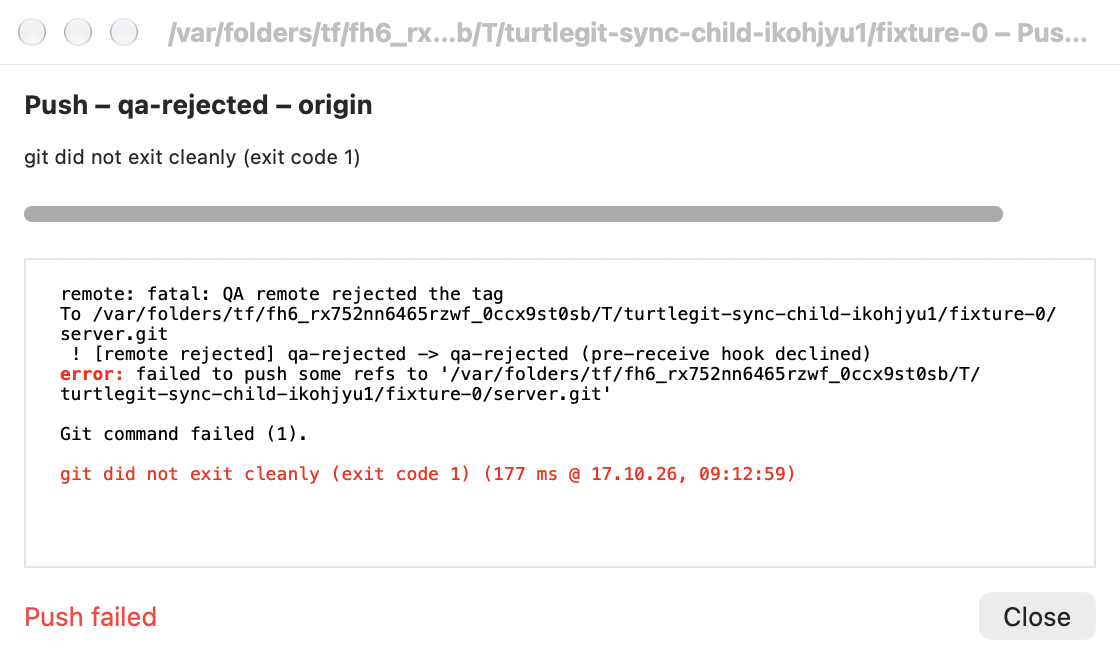
Failed fast-forward recovery and Commit handoff — October 17, 2026
After a failed separate fast-forward, the progress owner now reads the actual unmerged index using a fresh cancellable token. Confirmed conflicts offer the source Resolve action and icon; that action opens the existing whole-project Commit dialog, matching SyncDlg's callback. A failed/cancelled inspection offers no unverified action and appends its own diagnostic while preserving the original Git result, exit-code footer and Git completion timestamp.
Recovery captures an owner/revision receipt. Nested sheets, duplicate/retired clicks and closed/quit-confirming Sync owners cannot launch another Commit. The native handoff closes the acknowledged result, drains its worker, clears its parent sheet and delivers the original result before calling the existing Commit route. This follows the app's other progress post-action handoffs; Windows keeps its progress modal alive while starting a separate TortoiseGitProc process. No staging, resolving or committing happens merely by selecting Resolve.
Cancellation questions capture their current worker token. An answer from the finished Git stage cannot cancel the replacement conflict inspection. A new Abort can cancel that read; forced retirement cancels it, retains lease/Quit accounting and parent continuation until actual drain, and suppresses late actions/footer. The Debug build and expanded native progress/recovery family pass with system and bundled Git. The actual Sync child callback opens a real Commit controller with the conflicted file; index stage entries, HEAD and working bytes are retained. Nested/duplicate/retired receipts, read errors, old/new cancellation questions and forced read drain/Quit fencing pass. Four actual light/dark captures were reviewed. All three owned receivers from the attempts were reaped and independently absent. Core was unchanged and not repeated. Two fixture repairs fixed async sheet overload selection and the injected error's localized message; no app rebuild was needed. See batch evidence. Physical/signed and complete Sync/ProgressDlg acceptance remain open.
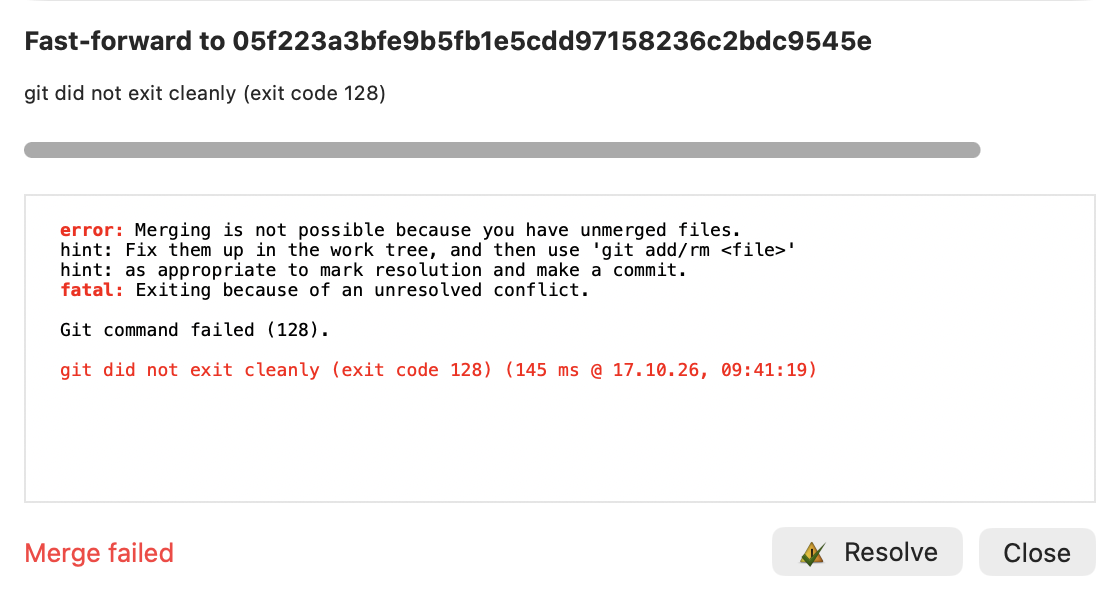
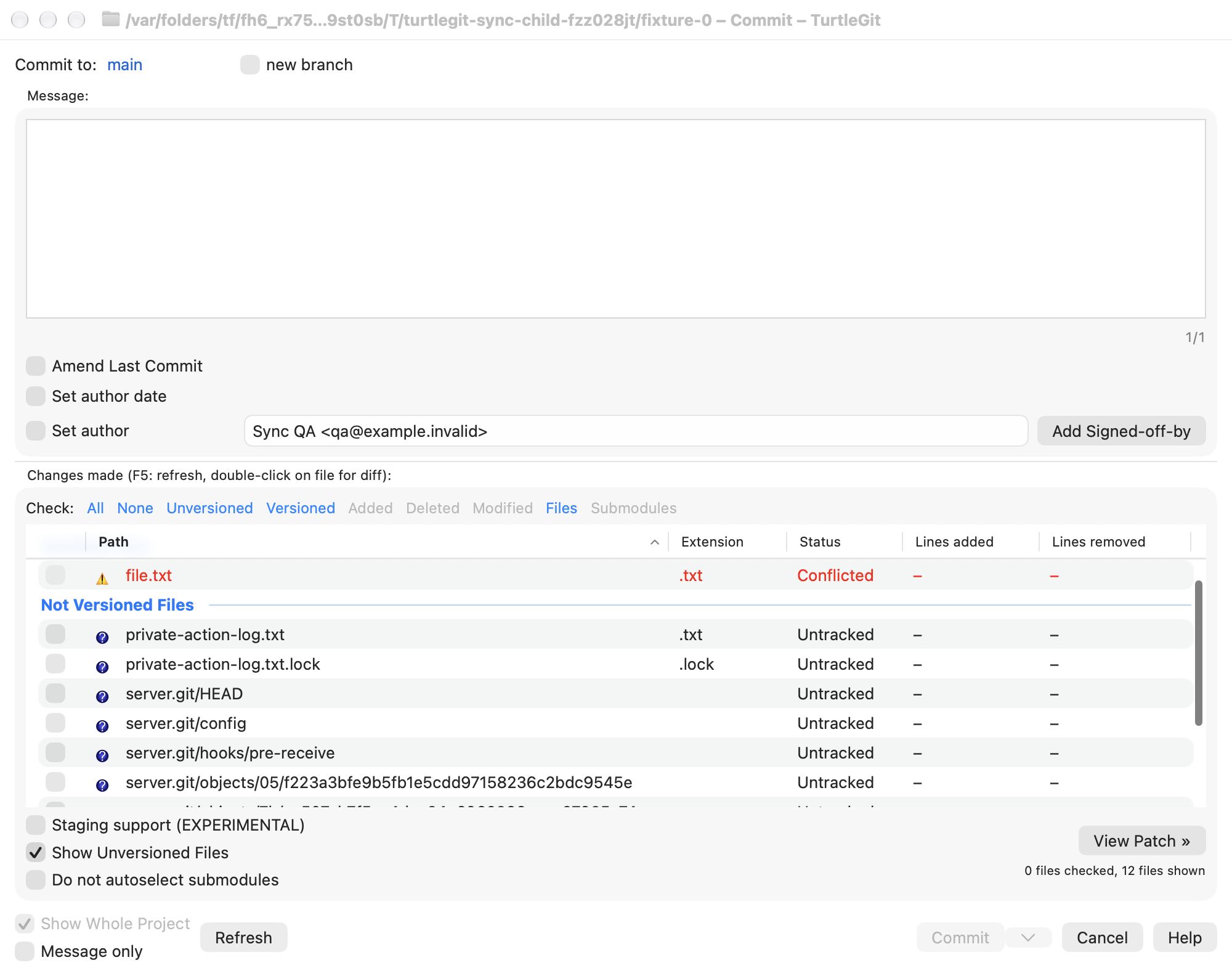
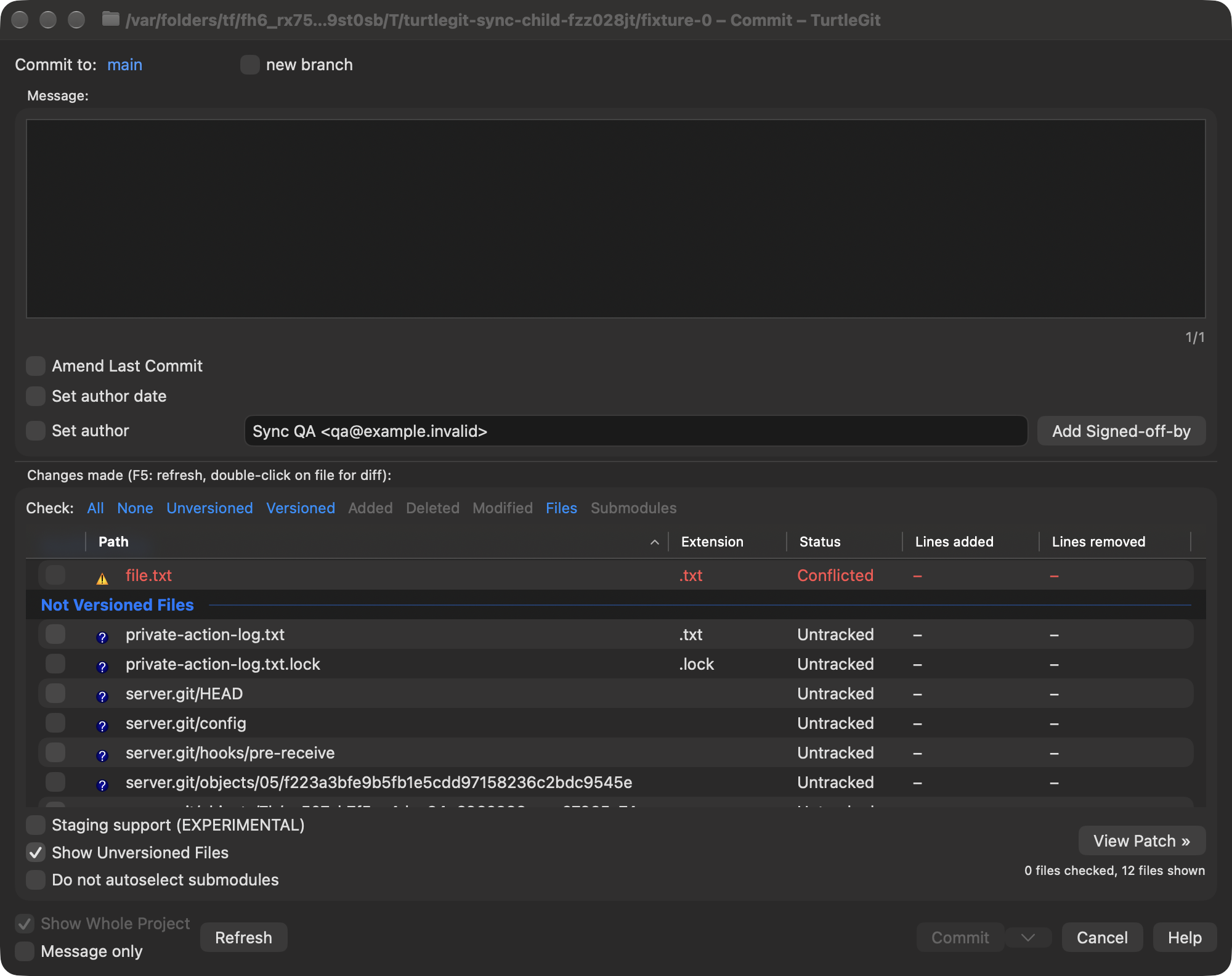
Conflict status table and source action family — October 17, 2026
The conflict tab now uses a native multi-select status table with Path, Extension, Status, Lines added and Lines removed, matching SyncDlg's conflict-list column mask. The shared Working Tree backend supplies actual status/statistics, rebase state, source status colors, file actions and repository access lifetime. The common native interaction adapter supplies list font, original artwork, selection mark, clipboard shortcuts and header customization. Its column profile is isolated under ConflictSyncDlg; default Working Tree columns retain their existing profile.
The source mask exposes Edit conflict for one file, Resolved/Mine/Theirs for a selection, single-file Log, alternative editor, Open, Open With and Finder reveal, and clipboard formats. Rebase labels follow the actual repository state. Double click opens the marked conflict directly through the existing text/image/delete/ submodule editor dispatcher. Quick resolutions use the existing Resolve workflow. Unrelated Add/Delete/Move/Ignore/flags/Blame/Export commands are excluded.
File-menu snapshots retain the shared row/mark/generation checks. Tab, transport, child and Quit state gate dispatch, and actual file actions retain worker/lease ownership. Open With uses an owned application sheet on Sync; forced closure cancels it, retires the backend and rejects late application launches. Explicit F5 refreshes the conflict file list. Successful conflict changes refresh this list through the existing optional RefreshFileListAfterResolvingConflict callback; disabling it retains the displayed rows until explicit refresh.
The Debug build and grouped native conflict-table/Working Tree menu families pass with system and bundled Git. Actual five-column rendering, selection/mask routes, private relative-path Copy, Open/editor injection, isolated column/reset settings, F5, real Mine/Theirs resolution and optional refresh, and owned Open With retirement are covered. All four receivers were reaped and independently absent. Both raw light/dark captures were reviewed: five columns, selected conflict rows and source artwork fit; the private fixture has no configured remote, so transport state is not an acceptance claim. Core was unchanged and not repeated. The first build needed one missing table-row parameter; final review also aligned Status with the shared palette and retained an empty active Conflicts tab. See batch evidence. Wider exact working-path identity, physical menus/keyboard/VoiceOver, every column/header variant and signed/ Finder/AppStore acceptance remain open.
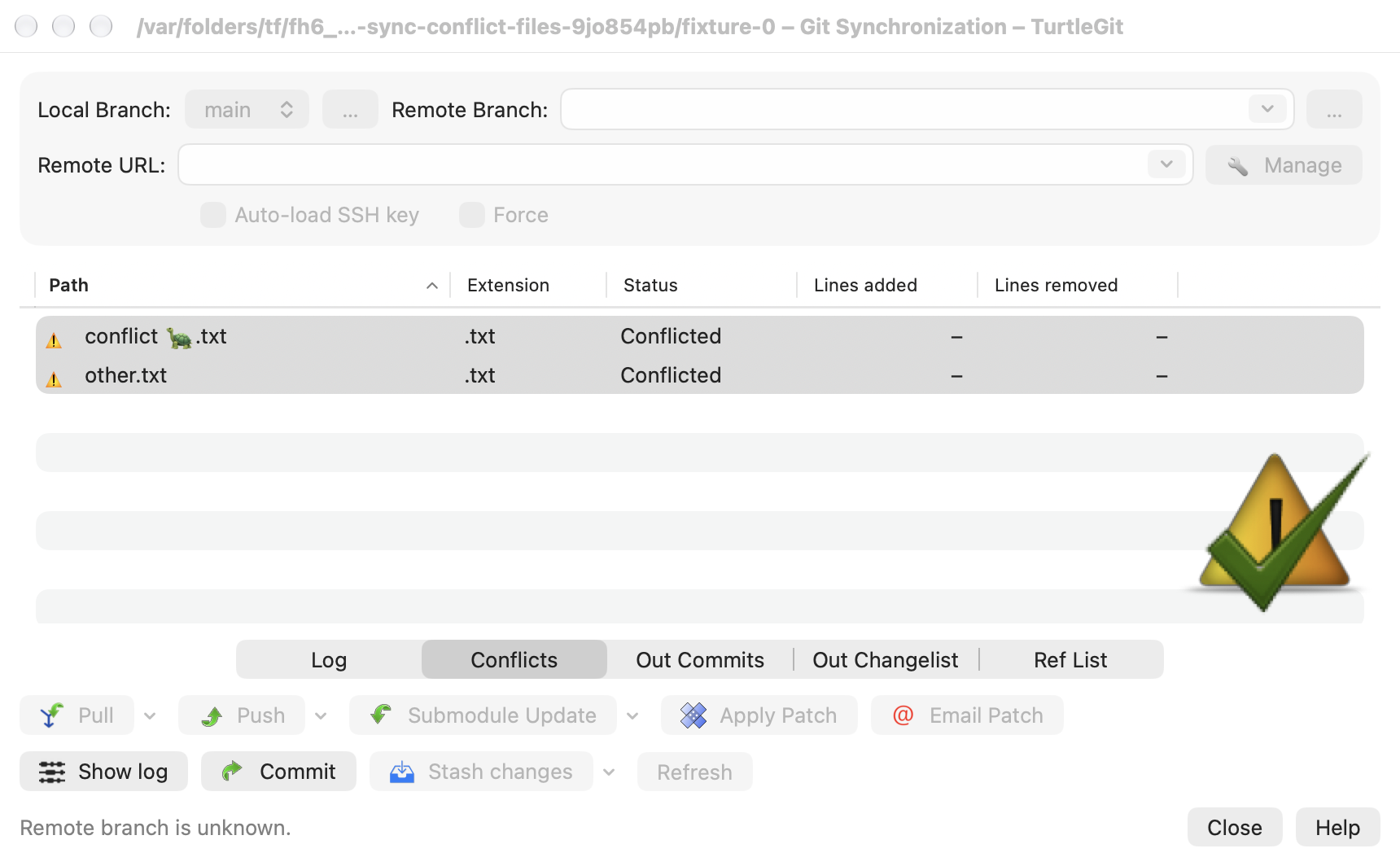
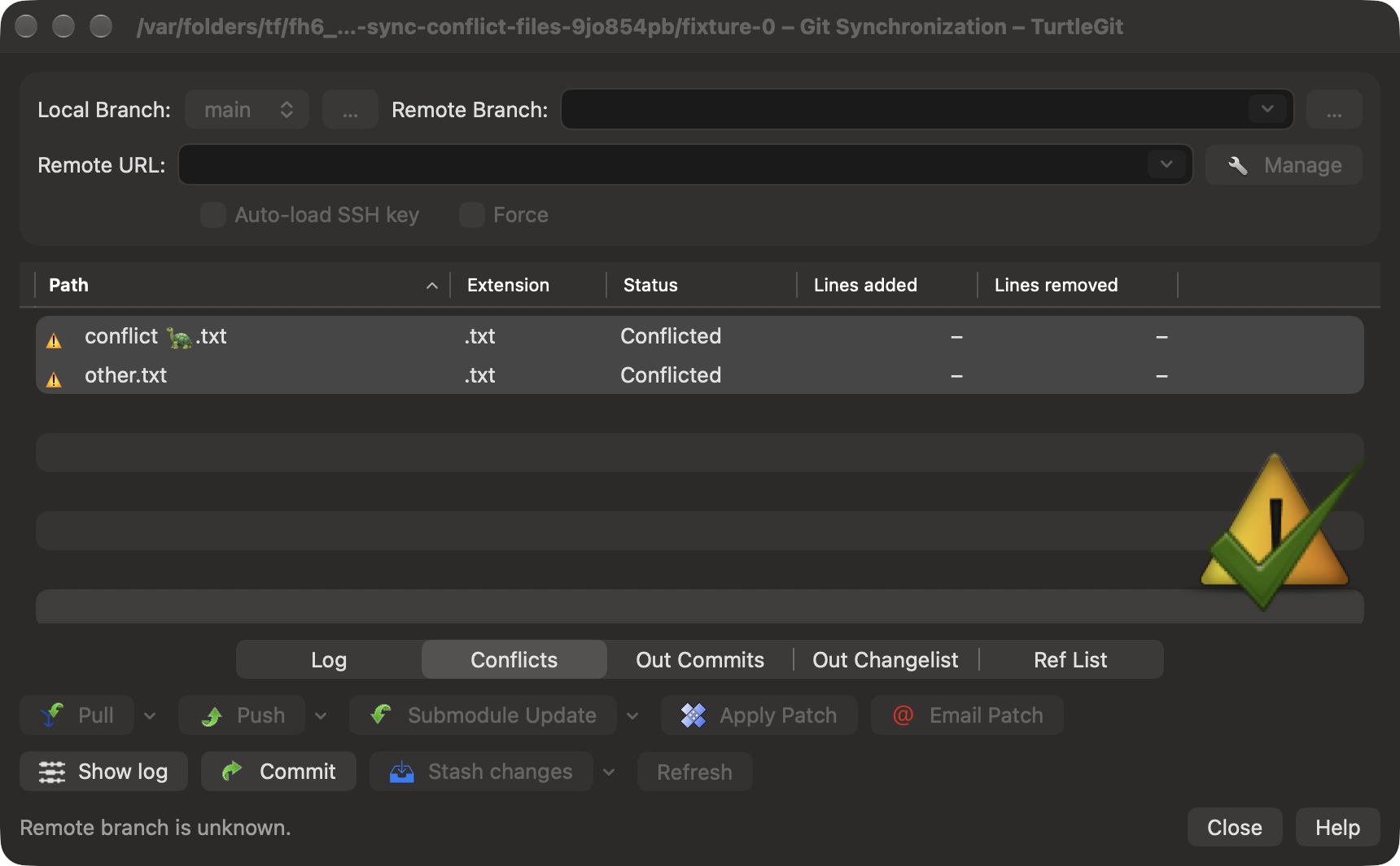
The conflict table now bridges exact Git path bytes through encoded native row IDs and its shared Working Tree selection model, including focus and captured menu marks. Shared native refresh/keyboard replacement uses explicit clear/select transitions. See the working-file selection batch for its regression scope. Wider LFS/Finder identity maps and physical/signed acceptance remain open.
Primary command bands continue the native layout with retained control identity and wrapping at constrained widths. The source command order and existing behavior remain; full dialog acceptance stays open.
Main inline progress — October 19, 2026
Main Sync replaces its input band during inline commands, retains streamed phase/percentage and a timed colored footer, and separates actual Git completion from later metadata and workflow completion. Dock state follows command outcome while independent worker/release counters keep Quit blocked through actual drain. The source does not persist the main Sync transcript through GitProgressList action logging.
See the connected progress family for source distinctions, scoped validation and remaining physical, signed and whole-dialog requirements. This continuation does not certify the whole family or port.
Optional libgit2 transport continuation — October 19, 2026
The connected Clone/Fetch/Sync backend consumes the source global switch and per-command mask, retaining upstream CLI defaults. It connects native progress, actual-connection HTTPS certificate review and combined credentials to a pinned private helper. Accepted certificate exports retain their operation lock through cancellation. The linked batch record states actual validation and the remaining optional-backend, public and signed gaps; older evidence above does not prove this continuation.
Optional remote-reference engine — October 19, 2026
The remote-reference workflow continuation connects source-selected libgit2 reference/tag reads and remote-ref deletions, including the branch picker's source-specific HEAD choice, captured native preferences and post-delete refill. Ordinary Push stays on its CLI source path. Actual grouped evidence and remaining certificate-cache, public/signed/physical and complete source acceptance are recorded with that family.
Native source form control continuation
The connected form family records reference keyboard/focus and bounded captions, Push F5 refresh and Synchronization native split controls, with owned state and remaining acceptance kept explicit.
Embedded Fetch reference notifications — October 23, 2026
The connected transfer-result family carries actual libgit2 Fetch reference notifications through Synchronization and its checkout continuation, selecting the Action/Path Log from the actual execution backend. It retains original endpoint Show Log/Copy behavior, ordered partial results and warnings, independent command completion and owned menu/child retirement. Its dated checkpoint records actual grouped validation and remaining physical/signed/source gates; earlier CLI/transport passes do not independently certify this continuation.
Source Fetch refspec lifecycle — October 23, 2026
Selected libgit2 Fetch now loads the remote, appends Sync's fully qualified selected-branch spec, then fetches through the same loaded configuration. The addition affects subsequent invocations; duplicates and original configured specs retain source ordering. This path does not receive Sync Force, while CLI Fetch retains its existing arguments. Failure or cancellation after an accepted append does not roll it back. This replaces the earlier concrete per-operation configuration gap; it does not certify the whole dialog.
See the source lifecycle contract and limitations and new checkpoint. Anonymous URL plus a nonempty requested spec fails without inventing a named remote. All Remotes retains the documented Mac named-remote iteration adaptation, and the pinned library's swallowed configuration-write return remains an explicit limitation. The dated oracle is retained as the source call-order baseline. Current grouped validation, installed/signed grants, public authentication, physical/VoiceOver and complete source layout remain separate gates.