 TurtleGit for Mac
Import Patch port
The native Apply Patch Serial… command imports mail patches using git am.
Open it from the Repository menu or sidebar, or the TurtleGit Finder menu in a
known working tree. Add patch files, check the ones to import, order them with
Up/Down, review the Patch tab, and choose Apply. This is a partial native port;
the remaining parity work is listed below.
Pinned source: 7338078f8ddd924b8cddee35f512f2286072136d,
src/TortoiseProc/ImportPatchDlg.cpp/.h.
Engine
GitRepository.importMailPatch invokes Git's mail-patch importer with literal
argument arrays and an explicit -- before the file path. The source defaults
are preserved: Three-way, Ignore space change and Keep CR enabled; Sign-off
disabled. Git retains mail author/date/message metadata and creates commits.
An active import prevents starting a second one. Git failures retain recovery
state rather than automatically discarding it.
The worktree-specific Git paths distinguish an am session from either rebase
backend. Abort, Skip and Resolved run the exact source git am recovery commands
only for mail application; they cannot accidentally abort a rebase. Linked
worktrees have independent session state. The API accepts existing readable
local files, supports streamed Git output and cancellation, and rejects invalid
files or pre-cancelled requests before invoking the importer.
Verification
python3 scripts/test-mail-patch.py runs five real-Git cases. The four-engine
record is mail-patch QA. Cases cover Unicode
mail paths with a leading dash, author/date/body/sign-off preservation, real
conflicts followed by Abort/Skip/Resolved, rejection during an actual apply-backend
rebase with exact HEAD/index preservation, linked-worktree isolation, invalid
file/non-file URL and cancellation before mutation.
Native dialog
Checked paths, Add/Remove/Up/Down, the four source option defaults, Patch/Log tabs, and per-row Applying/Success/Failed/Skipped state are implemented. Stable row IDs preserve checks, selection and results while reordering. Options and input rows are fixed for the active batch, with model guards as well as disabled controls. A successful row is not re-imported when continuing after a failure. A skipped row can be checked again to make it eligible for a later attempt.
On a failed import, resolve and stage conflicts before choosing Apply again;
the recovery prompt offers Abort / Skip / Resolved / Cancel. Abort restores
the failed row for retry; Skip/Resolved mark it only when Git finishes that
session. Additional failures retain recovery state. For a pre-existing external
session, recovery does not incorrectly mark the first newly added patch done.
An active rebase is refused. Apply and the completed OK action both check
identity before accepting the dialog, matching OnBnClickedOk calling
CheckUserData before IsFinish. All four effective author/committer name/email
values are required. Environment overrides, role-specific configuration and user
configuration retain their existing precedence; Git validates both resulting
identities. Missing values offer the source Yes / No question. Yes opens the
full native Settings dialog on its Git page for the captured repository and
preferences. Closing Settings with either OK or Cancel causes an authoritative
re-read; it does not certify that identity is now complete. Remaining missing
values repeat the question. No returns to the import without applying another
patch or accepting completed OK. Configuration writes occur through the normal
Git Settings transaction, preserving role-specific
overrides and the user's chosen configuration scope.
The historical identity QA checks cancellation and sequential configuration followed by two real imports retaining the patch author and configured committer. Those injected callbacks predate the full Git Settings ownership described above; they do not validate the new native identity loop. Physical global writes and signed access remain unverified.
Abort while a batch runs stops after the current Git command; it does not kill that command or close the window. Idle Cancel/window-close checks the Git session and offers Abort, Keep session or Cancel. Failed aborts keep the window open. If repository access or the Git session check fails, an explicit Close and keep state choice allows the idle window to close without attempting recovery; Cancel keeps it open. Cancel is the safe default. Quitting is refused during an operation or attached sheet.
Idle application Quit now defers termination and checks each open Import Patch session with the same Abort/Keep session/Cancel choices as window-close. Cancel or a failed abort cancels Quit; Keep retains Git state. An unavailable repository requires the explicit keep-state choice. Import controls and close stay locked while the application completes all quit confirmations, then unlock if Quit is cancelled. The session check does not close the dialog prematurely.
Quit QA checks the actual application delegate with a real conflicted import and captures termination replies rather than terminating the receiver. It verifies Cancel/Keep/Abort, repeated Quit while pending, session preservation/cleanup and control unlocking. Physical sheets and multi-document quit cancellation remain unverified. Patch-file security-scope leases and repository access remain retained by the model.
The command uses the original patch icon in the app and Finder. Finder command
ordering and the pinned folder/patch-file conditions are mapped; selected .patch
and .diff files in a known working tree prefill the dialog. Finder's existing
repository authorization still applies. File selections outside known working
trees and the source's repository chooser remain pending. Geometry uses the
source ImportDlg identity. Patch preview uses the shared unified-diff font, tab size and light/dark line palettes, including added/removed backgrounds and header/hunk colors. Log text uses the shared log font; Git output is
buffered until each command returns, matching this source dialog's workflow.
python3 scripts/test-import-patch.py checks the real native table and preview,
row movement/checks, fixed batch input/options, two real mail commits and sign-off,
retained conflict cursor and all recovery choices, Cancel/Keep/Abort close choices,
and a slow real Git hook proving that batch stop completes the current command.
The native QA record records four Git engines.
Unavailable-session close QA additionally
checks Cancel and explicit close with a temporarily moved Git directory, preserving
the real active import session, HEAD, index and working file.
Finder checks cover menu order, conditions, icons and routing metadata; they do
not prove a deployed Finder extension.
Patch-list commands
For one selected row, View Patch opens the read-only unified diff viewer. Double-click has the same action. The file is read as original bytes, independent of the text preview; Save As preserves those bytes. The existing Unified Diff Viewer setting and Shift inversion choose the configured external viewer or the built-in viewer. External handoff uses an app-owned byte snapshot.
Send Mail… is available for one or more selected rows and passes attachments in patch-list order to macOS email composition. The user composes and sends the message in their mail app. No mail service produces a visible error. File access leases stay retained through the service callback, and viewer handoff/composition block concurrent import, row mutation and window close. Failures re-enable the controls. Context icons follow the application context-menu icon setting.
The source's Review Patch with TortoiseGitMerge command opens a working-tree
review/application workflow, separate from the serial git am import. The single-row Review Patch with TurtleGitMerge command now opens a native
window with a checked file list, original colored patch preview, applicability
results, reverse/strip options and selected complete-file application. Successful
files are marked Applied while remaining files can continue from the original
snapshot. Changed options require Refresh before Apply. Review changes the working
files without staging or creating commits. Parent import/close/quit operations and
child patch operations guard each other. The file access lease stays retained.
Native review QA covers the actual hidden AppKit table and preview, selected application/continuation/reversal, exact HEAD and index preservation, busy close/Quit/options guards and injected context handoff/failure recovery. It does not establish physical menu gestures or visual comparison. Edited result saving is implemented below; hunk-level patch-engine application remains pending.
The Compare tab now shows the focused file before and after the patch, with aligned rows, source Merge colors, line numbers, linked vertical scrolling, difference navigation and native Find. Selecting another file refreshes its comparison; the Original patch tab retains the entire unchanged patch. Content that cannot be decoded as text shows a bounded hexadecimal preview, with exact bytes kept in the comparison snapshot. Absent files and file modes are shown explicitly.
To produce the after image, the Core backend copies only the selected path operation's current inputs into a private temporary repository, applies the original bytes with the same reverse/strip/include and local whitespace policy, then returns exact before/after bytes and removes the temporary directory. Parent symlinks are rejected for original reads and temporary copy/result paths. Forward and opposite-direction Git metadata are paired in opposite record order so renames use the correct preimage. Current files, HEAD and index are untouched. A conflicting focused file reports a preview error; other checked applicable files can still be applied.
Before/after QA records real-Git Core text/binary/rename/mode/add/delete/reverse, unusual-name, symlink, local whitespace policy and stale/unsafe/foreign-review checks. The native receiver checks the hidden before/after text controls, palette, ruler, Find, file selection, linked scrolling and difference navigation. Physical visual/accessibility acceptance remain pending.
The Core review/application backend now keeps original patch bytes, obtains Git's
statistics and summary, and checks applicability without staging or committing.
Application rechecks the same byte snapshot against current files and invokes
whole-patch git apply without index/reject/unsafe-path options. Reversal and
explicit path strip counts are supported. Reviews are bound to their repository.
Git handles text, binary payloads, renames, mode changes, additions and deletions.
The review also exposes Git's ordered NUL-delimited file statistics: raw path
bytes, display path, added/deleted line counts and binary markers. Tabs/newlines
in names are preserved; reverse reviews expose reverse counts. Rename statistics
name the resulting destination; they do not provide the original source path.
Raw non-UTF-8 path bytes remain available separately from the display string.
File-list QA covers actual Git patches with
tabs, newlines, Unicode, leading dashes and binary entries, plus incomplete
metadata rejection.
Working-tree patch QA verifies real files,
unchanged HEAD/index, stale-review rejection and unrelated local changes. This
backend does not establish per-file before/after review, editable merge panes,
hunk/line application or complete TortoiseGitMerge patch-engine parity.
The Core backend can now recheck and apply selected complete files, even if the whole patch cannot apply because an unselected file conflicts. It uses escaped literal path patterns with Git's include filtering, then checks that Git returns exactly the selected paths/record counts. Applying retains those filters and checks current files again. Binary files and renames remain complete operations; the original patch byte snapshot is preserved. All repeated records for a selected path must be selected. Empty/unknown IDs are rejected. Per-file selection requires UTF-8 paths; whole-patch application keeps raw path bytes through Git. Selected-file QA checks literal wildcard/backslash names, an unselected conflict, sequential rename/binary/remaining-file application and reverse rename without changing the index. Native checkboxes use this backend; full conflict/hunk-level patch review remains pending. The source suppresses the generic Apply context command in Import Patch; this native list does too.
The headless receiver checks source selection conditions, exact UTF-16 bytes and read-only export, filename/Shift handoff, attachment order, operation guards and failure recovery through injected callbacks. It does not launch an external app, compose or send mail, or simulate native mouse/menu events. Real context-menu, double-click, external application and mail-service acceptance remain unverified. See patch-list command QA.
Preview text and appearance
The embedded preview now uses the same read-only diff control as View Patch. Shared Unified Diff appearance settings control the font, tabs and line colors. Selection updates keep the original file bytes for export; import still passes the original file path to Git. The display decoder recognizes UTF-8/16/32 BOMs, checks UTF-16/32 byte alignment, and otherwise uses UTF-8 with a Windows-1252 fallback. Other locale-specific legacy encodings remain unsupported.
The source's 250 MiB preview threshold is preserved. A file at or above that size shows an inline notice and remains importable; the notice does not become an exportable patch. Failed reads also show an inline notice. Multiple selection clears the preview, and generation guards prevent old reads replacing the current selection.
Preview QA checks actual hidden AppKit text attributes for default light/dark added-line colors and a custom shared font/color. It also checks BOM display and original-byte export, a sparse 250 MiB fixture and multi-selection clearing. These checks do not establish screenshot or physical accessibility acceptance.
Embedded Find and Escape
The preview's Find context command now opens the native Find bar directly from the text control, including in ordinary dialog windows. With preview focus, Command-F opens Find and Command-G/Shift-Command-G route to next/previous match. Escape dismisses an open Find bar and returns focus to the preview; another Escape requests window close through its delegate, preserving the import's session and operation guards. The standalone diff viewer uses the same Find implementation.
Embedded Find QA invokes native actions in a hidden ordinary window and verifies Find-bar visibility, focus restoration and guarded close dispatch. It avoids shared Find-pasteboard writes and synthetic key events; search matching and physical keyboard acceptance remain unverified.
Edited patched results
Enable Edit patched result in Compare to edit the right pane. The left pane stays immutable. The shared native aligned editor retains source row gaps, Undo/Redo, block context commands with original icons, and encoding/line-ending controls; display gaps never become saved file bytes. Save patched result (or Command-S) applies that focused result. Discard edits returns to the original proposal. File selection, refresh, path options, checks and bulk Apply are guarded until editing finishes, preserving the current draft.
Close and application Quit offer Save / Don’t Save / Cancel for a dirty result, with Cancel the safe keyboard default. A failed save retains the draft and cancels closing/quitting. Don’t Save during Quit does not clear drafts prematurely, so another document can still cancel the overall quit. Closing the parent Import Patch window resolves its dirty review child first. Parent imports are guarded while the child is editing.
The save backend validates the captured input bytes, file modes and permissions, including a rename destination that was absent. It creates private raw-blob Git trees for before/edited-after states, generates a binary-capable patch, checks current files again and applies it without committing. The private index and objects are removed on completion; user index entries are retained unless Auto Add applies. Encoding/BOM, line endings, missing final newline and edited trailing spaces are preserved. Private trees use the repository’s SHA-1/SHA-256 format. External writers are not globally locked.
Following CMainFrame::PatchSave, saving a zero-line result removes the file.
Settings → TurtleGitMerge → General → Add new files to Git after saving a
patched result follows the source Auto Add preference, enabled by default.
Only a newly created destination is added; existing-file edits and rename source
deletions are not automatically staged. A failed Add reports that the result was
saved and does not repeat the file mutation.
Edited patch QA records Core real-Git rename/mode saves, zero-line removal, Auto Add success/failure, stale collision and foreign-review refusal, and SHA-256 UTF-16/BOM/CRLF/whitespace preservation. Native checks use actual aligned text input, Undo/Redo, format-preserving saves, draft locks, captured Quit replies and injected Save/Discard/Cancel choices. Physical sheets/keys/menus, signed sandbox access, comprehensive marked-block and format-menu behavior, rejected-hunk conflict panes, and full source parity remain unverified or pending. Symlink/binary editing remains unavailable; the original selected-file application still handles those complete operations.
Whitespace markers
The shared native diff control draws space dots and tab arrows, matching
CSciEdit::SetUDiffStyle's always-visible whitespace. Marks use the visible
AppKit glyph layout and do not replace text characters. Copy, search, selection
coordinates, accessibility text and original-byte export keep their existing
content. Light mode uses the native secondary label color; dark mode uses the
source 180/180/180 marker color, and increased contrast uses the label color.
The Log tab keeps its separate plain-text control.
Whitespace QA checks actual native glyph geometry, Unicode-adjacent spaces/tabs, offscreen exclusion, private-pasteboard copy and original-byte export. It does not establish rendered visual or physical accessibility acceptance.
Divider layout
A native horizontal NSSplitView separates the patch list/options from the
Patch/Log tabs. The upper pane keeps its height when the window grows, and both
panes have minimum heights so the file controls and preview remain usable.
The divider position is stored in macOS points under the source AMDlgSizer
identity in TurtleGit's dialog-geometry namespace. Reopening restores the height
and clamps it to the available window space. Settings → Saved Data → Dialog sizes
and positions clears it together with window geometry, preserving appearance.
Existing open windows can save new geometry again when moved/resized.
Divider QA checks the actual hidden native split view through its public positioning API, save/reopen restoration, smaller window constraints and Saved Data clearing. It does not simulate mouse dragging or establish physical divider/accessibility acceptance.
Dropped patch files
The patch table accepts native file-URL drops. Files append in provider order,
with directories and duplicate standardized paths skipped, following the source
CPatchListCtrl::OnDropFiles. New entries are checked. The Add panel retains its
separate source behavior and can add repeated paths.
While macOS loads the URL representations, row mutations, imports, further drops, close and application quit are guarded. Failed providers report an error and restore the controls; other valid files in the drop can still be added. File leases use the same sandbox checks as Add. No extension filter is imposed.
Drop QA uses real NSItemProvider file-URL
representations to check ordering, deduplication, directory skipping, failure
recovery and operation guards. Physical Finder-to-table dragging and signed
sandbox access outside the repository remain unverified.
Remaining parity work
Full patch conflict/merge engine, hunk/line application and the full Git configuration settings page remain pending. The source's exact context-menu/keyboard behavior remains pending. Physical keyboard/accessibility, light/dark visual comparison, signed sandbox access for files outside the repository, deployed Finder integration and App Store acceptance are unverified. No screenshot or release-readiness claim covers these hidden native checks.
Prepared result Save As target
The native Save As… context action writes the selected pane's current draft and encoding, then binds that pane to the chosen file and records a clean baseline. Subsequent Save and owned Quit Save write that file. For a rebound prepared result they do not apply the original patch, stage its original path, or mark that proposal Applied. The internal explicit copy-export helper retains its copy semantics for callers that request a copy.
A pending choice blocks editing, Save, refresh, file/options changes, reentry, Close and application Quit. Cancel and write failures retain the draft and show errors. Captured bytes and selected permissions live with the operation; retired owners refuse late destination and empty-file responses. See Save As target behavior.
The older copy-export QA covers that helper's copy semantics, not the newer UI target binding. Physical save panels, overwrite/symlink/permission variants and signed panel grants remain unverified.
Send Mail Apply handoff
Send Mail's Apply Patch command now opens an independent native Apply Patch Serial window containing the highlighted rows in their original order. Matching inherited file grants are retained in the imported items, including output-folder grants outside the repository. Default Add/drop behavior still acquires its own file leases when no inherited grants are supplied. The child retains its normal Apply/recovery/close behavior and survives closing Send Mail. Hidden real-Git handoff checks are recorded in command QA. Signed sandbox acceptance and complete Import/PatchList/application parity remain unfinished.
Forced-close lifetime and successful OK result (October 11, 2026)
The importer now owns a cancellation token across identity queries, serial
imports, recovery and close/quit state reads. Ordinary Abort still finishes the
current command before stopping the batch, as in the source. A forced native
window close invalidates the model and cancels its current Git process; it
suppresses subsequent success/error/close replies and viewer handoffs. Existing
am state is retained rather than automatically aborted. The controller ends
its owned sheet and any pending prompt when closing.
The final OK action records successful acceptance separately from Cancel. This is needed by Sync's modal Apply Patch caller: upstream ImportPatchDlg applies the commits itself and clears m_PathList in OnBnClickedOk. Sync must inspect the result after successful OK rather than applying those files twice. Sync now opens this importer as an owned sheet and consumes successful OK without reapplying files; its focused two-engine native checks pass. Approved Cancel/OK explicitly ends the parent sheet before closing the window. Wider checkpoint verification is tracked in Synchronization parity. Physical prompts, arbitrary mid-write cancellation, complete child mail/editor lifetimes and signed access remain separate acceptance work.
Focused lifecycle groups and the full 24-group native regression passed with system and packaged Git. Both unsigned builds, bundle audits, inventory and site checks passed. The actual driver cleanup passed a forced timeout with TERM refusal. See verification scope and corrected attempts.
The 2026-10-12 single-patch directory-target batch adds
the standalone app/Finder route and ordinary-folder/nested-folder support to
this existing review/editor. It retains separate git am serial import and its
working-repository requirement. Earlier dated constraints remain historical
records; the new audit lists the current implementation and remaining gates.
Review operation ownership continuation — 2026-10-13
Single-patch Review now owns cancellation across metadata, checked-file validation, disposable comparison generation, cached input checks, edited Save and Apply. Busy work exposes Cancel operation; closing a busy window normally waits, while forced closure retires its token and fences late UI publication. Global operation counts keep Quit blocked until real cleanup, including draft prompts and pane export choices whose windows were closed. Late Save/discard or export destination replies cannot publish writes after retirement.
Canceled edited saves retain their draft and permit a checked retry. Apply/read cancellation requires refresh before reusing the plan. Mutations that returned success notify the captured owner even if UI retirement followed; unsuccessful or canceled mutation attempts refresh that owner without claiming success. Cancel is not rollback: changes already written may remain, and an optional Add may be incomplete. The grouped 22-test Core check and six native cases passed across system and bundled Git. The tests held review/selection/comparison/Apply/Save commands, reaped their owned processes, and verified forced closure, draft retry, late prompt/export fencing and global Quit ownership. The final compiler compatibility rewrite passed the four affected partial-file tests and Debug compilation. See dated QA. Physical/signed acceptance and older hosted compiler confirmation remain open.
File patches batch actions — 2026-10-13
Compared TortoiseMerge/FilePatchesDlg.cpp Preview/PatchAll/PatchSelected.
The native file list now retains multiple highlighted rows separately from its
checked-file set. Original-icon Preview, Patch all and Patch selected context
commands accompany full-width Patch selected/Patch all buttons below the file
list, following the source panel placement. The existing whole
checked-selection operation remains available as Apply checked.
Patch all/selected operate in original list order, skip files already patched, report individual errors and continue with later files. Duplicate records for one path are grouped into one complete-file operation. Each file is validated again immediately before applying, using the original captured bytes and target options; HEAD and index are not changed. Successful rows show green Patched; failed rows show red Error with the Git diagnostic. Fixing a failed target allows retry without applying the successful files again. Highlighting does not change checkboxes. Captured menus are fenced by the loaded file-list generation.
Cancellation retains completed results, stops before the next file and requires Refresh to inspect potentially interrupted changes. Closing/retiring the viewer retains its existing owned cancellation, grants and late-result fences. The repository owner still receives settlement after a mutation even if the viewer was closed. Physical menu/layout acceptance, initial failed-hunk/conflict counts, source conflict-editor behavior and signed App Store execution remain open.
Nineteen focused Core tests, four grouped native cases across system and bundled Git, Debug compilation and two documentation tests passed after compilation repairs. The native cases also retain the existing owned cancellation/retirement checks. All owned receivers were reaped. See dated file-patches QA.
Displayed file-panel comparison — 2026-10-13
Compared the pinned TMerge_PatchWindow.png, IDD_FILEPATCHES and its command
strings. The displayed list now uses Path/State with native file-type icons,
basename labels/full-path tooltips, a bold preview row, muted patched rows and
red error rows. Source captions are Preview patched file, Patch all files and
Patch selected files; the panel buttons read Patch selected item/Patch all items.
The list is bounded in width so the comparison gets most of the window.
The earlier checkbox/Changes columns and Apply checked footer were removed from this dialog to follow source selection semantics. The engine's atomic checked selection API remains available internally; ordinary Review users now operate on highlighted rows or all remaining items. Older checkpoint descriptions refer to that preceding UI. Serial git-am import retains its source checked list.
An isolated preview of the real Debug app objects displayed actual per-file results and colored original patch in both appearances. A physical Patch all operation in the preceding layout patched README and the test file, preserved an independently edited source file and reported its error. Final-layout theme controls and context command labels were inspected; final fixture states were prepared through the same real model/Git workflow. The four grouped native cases passed with system/bundled Git. Every preview and receiver was reaped.
The preview must include the merge helper plus its packaged Git/Subversion libraries; a reduced fixture first lacked those and displayed hex fallback. One intermediate native automation connection dropped and that preview exited; its attempted selected-file operation is not counted as successful acceptance. Initial comparison viewport clipping was also observed in an intermediate before/after view. Applied-file preview behavior, viewport initialization, initial failed-hunk counts, full keyboard/VoiceOver and signed execution remain open. The published captures show the Original patch tab and do not certify those pending comparison behaviors.
See display QA.
Preview dispatch and failure states — 2026-10-13
Rechecked FilePatchesDlg.cpp's Preview switch and double-click handler. They
ignore already-patched rows and report rejects for error rows. The native
preview now preserves its shown file when those rows are highlighted: patched
rows do not trigger a read, and failed rows reuse their recorded diagnostic.
Invalid row IDs are refused. Reload also stops substituting another file for
an explicitly focused patched row. Errors are presented inline as a native
adaptation; the source's modal reject presentation remains separate acceptance.
The Compare pane distinguishes a running comparison, an engine failure and a binary/undecodable file. An engine error is shown as its actual diagnostic. Decoded text with no alignment gets a rebuild-preview message, rather than a binary hex label. A save error with a valid alignment retains the text/editor and its existing error display. Processing uses an explicit progress indicator.
The prior displayed check's applied-row-preview concern is resolved for the source no-op/diagnostic dispatch contract. Initial viewport clipping, source failed-hunk/conflict counts, physical modal/keyboard/VoiceOver behavior and signed acceptance remain open. Existing gallery captures record their earlier Original patch tab checkpoint. Focused native evidence follows this change; no full Core suite is required for these native presentation/dispatch changes.
Debug compilation, four unique grouped native cases across system/bundled Git and two documentation tests passed. State assertions require a real comparison editor; those two engine cases were repeated after tightening that fixture. All receivers were reaped. See preview-state QA.
Connected preview placement and viewport batch — October 14, 2026
Commit's View Patch/Partial Staging/Partial Unstaging now share the existing Log screen-aware placement and sticky-edge geometry. A preview opens to an available side or within a visible screen, reuses its frame across mode changes, snaps near a parent edge and follows parent move/resize only while docked. Moving it away leaves it independent. Minimize hides it; activation/restoration raises it without stealing the parent's focus. Ownership, busy/close guards and preference semantics remain in the Commit controller. Native left-side/screen clamping and the eight point gap are platform adaptations to upstream PatchViewDlg's right-edge frame.
Unwrapped patch text now has a measured document extent after layout and viewport resize, preserving horizontal access to long lines. Replacing the patch resets selection and scroll to the start, matching PatchViewDlg::SetText. Appearance updates retain position. Comparison initial selection/first-difference navigation waits until wrapping, text extent and a nonempty viewport are available before it is consumed. The same path handles queued edit caret and combined-pane requests; closed comparison owners retire these geometry callbacks.
The Debug build and six unique grouped native cases passed with system/bundled Git after the recorded closure-capture and fixture repairs. Passing system viewport checks were not repeated. All owned receivers were reaped; no Core suite was run. Light/dark Partial Staging compositor captures were inspected and published in the gallery. See batch evidence. These changes address the preceding placement and initial-viewport gaps, but do not certify all physical side-by-side placement, keyboard, VoiceOver, all monitor/fullscreen layouts, signed grants or complete dialog parity.
Review output ownership — 15 October 2026
Review now treats pane Save As, unified-diff creation and format choices as owned editor operations independently of the shared busy flag. File selection, reverse/strip, refresh, draft Save/discard and replacement remain fenced while a choice is pending. The Review progress row exposes Cancel operation during pane or patch output. Cancel suppresses subsequent destination writes; it does not roll back a write that already completed. Retry creates a new captured request.
Pane output captures its bytes, encoding, filename, folder, chooser and source permissions before presentation. Unified-diff output captures its input document, context and Git executable and forwards the owned cancellation token to the existing generator. Both retain Quit ownership through forced closure until the choice/generator settles; stale replies cannot write or publish errors. Only the request's own save panel is canceled. Native save-panel destination grants and source grants remain alive through the atomic write or generator cleanup.
Format choices share the same reentry/Close/Quit fence and retain permissions until the reply settles. A choice applies only to its original live generation, draft and encoding; retirement suppresses it. Review's recreated editors retain both source-patch and repository access leases.
The older full fixture attempted Change Encoding immediately after insertText, while the authoritative comparison engine was still filtering and correctly refused that command. It now waits for the actual command gate and verifies the chosen encoding before testing export locks. This repairs the setup rather than removing its pending-option or byte-preservation assertions.
This remains copy export. Upstream FileSaveAs target retargeting, complete physical sheet/layout comparison and signed sandbox/App Store acceptance remain open. The existing defaults and normal import/patch behavior remain covered by the full native fixture, with separate ownership cases for held choices, Cancel/retry, active generator cancellation and forced-close late replies.
The prepared native editor now stays mounted while the authoritative engine refines provisional rows; a progress overlay replaces the former view swap. This preserves the actual text view/coordinator, selection and Undo manager across typing and engine completion. The fixture checks editor identity and Undo availability, then restores both the original draft and captured encoding.
Prepared comparison errors now appear inline with a Dismiss action, including copy/patch destination failures while a usable alignment remains. This avoids silently retaining an error on the embedded editor model or replacing the editor with a modal error prompt that would interrupt draft recovery.
Successful Save patched result now retains the same native completed preview,
matching FilePatchesDlg::SetFileStatusAsPatched and CMainFrame::SaveFile rather
than clearing it or jumping to a different file. Core returns the exact saved
content, encoding and deletion state, including successful writes followed by
optional Add failure. The existing editor adopts that clean baseline, clears its
completed-file edit history, and displays saved byte counts/mode. Completed rows
remain protected against another patch/save; the user selects another file to
continue. Full upstream editable history after saving remains unverified.
The subsequent source target batch records source Save As rebinding, later Save/Reload and owner-approved Quit Save checks, with remaining acceptance limits.
Native file-panel interaction — October 16, 2026
The AppKit file-panel batch replaces the SwiftUI table and separates highlighting from explicit preview, matching the source notification handlers. It adds native Return/context-key routing, captured menus and file-list hiding/restoration with scoped Review main-menu commands. Existing per-file application, draft/export and plain-directory/real-index rules are retained. See the linked audit for grouped evidence and remaining full-family acceptance.
The recorded-base recovery continuation adds initial Ready/Conflict/Error classification, versioned-base retry, an embedded native three-pane preview and clean-merge Patch all/selected continuation. Earlier text listing all initial-state and conflict preview behavior as absent is historical; the continuation records the implemented paths and remaining special-file scope.
Binary, symbolic-link and deletion conflicts use explicit patch recovery choices.
Source serial-import form and native list — October 17, 2026
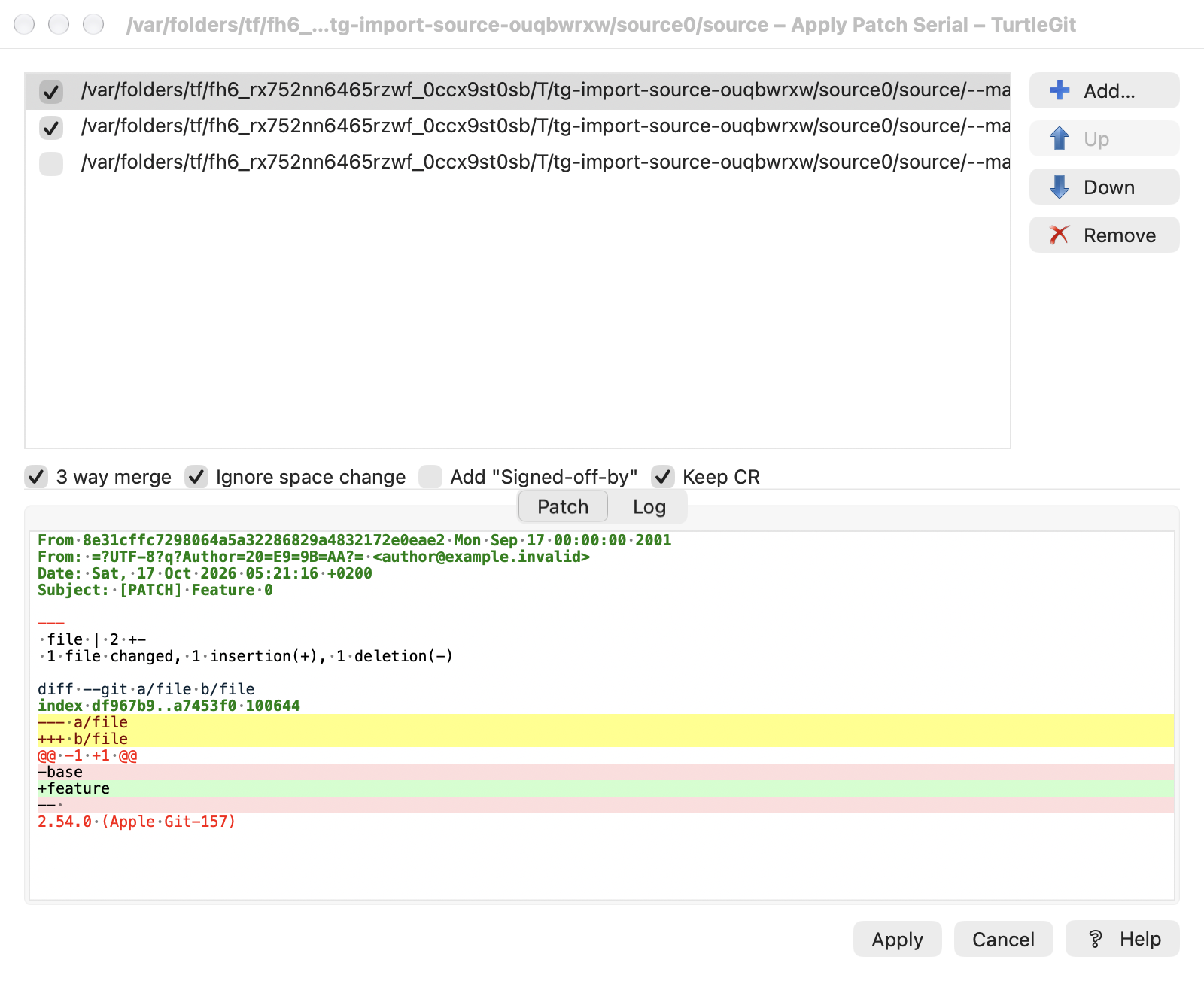
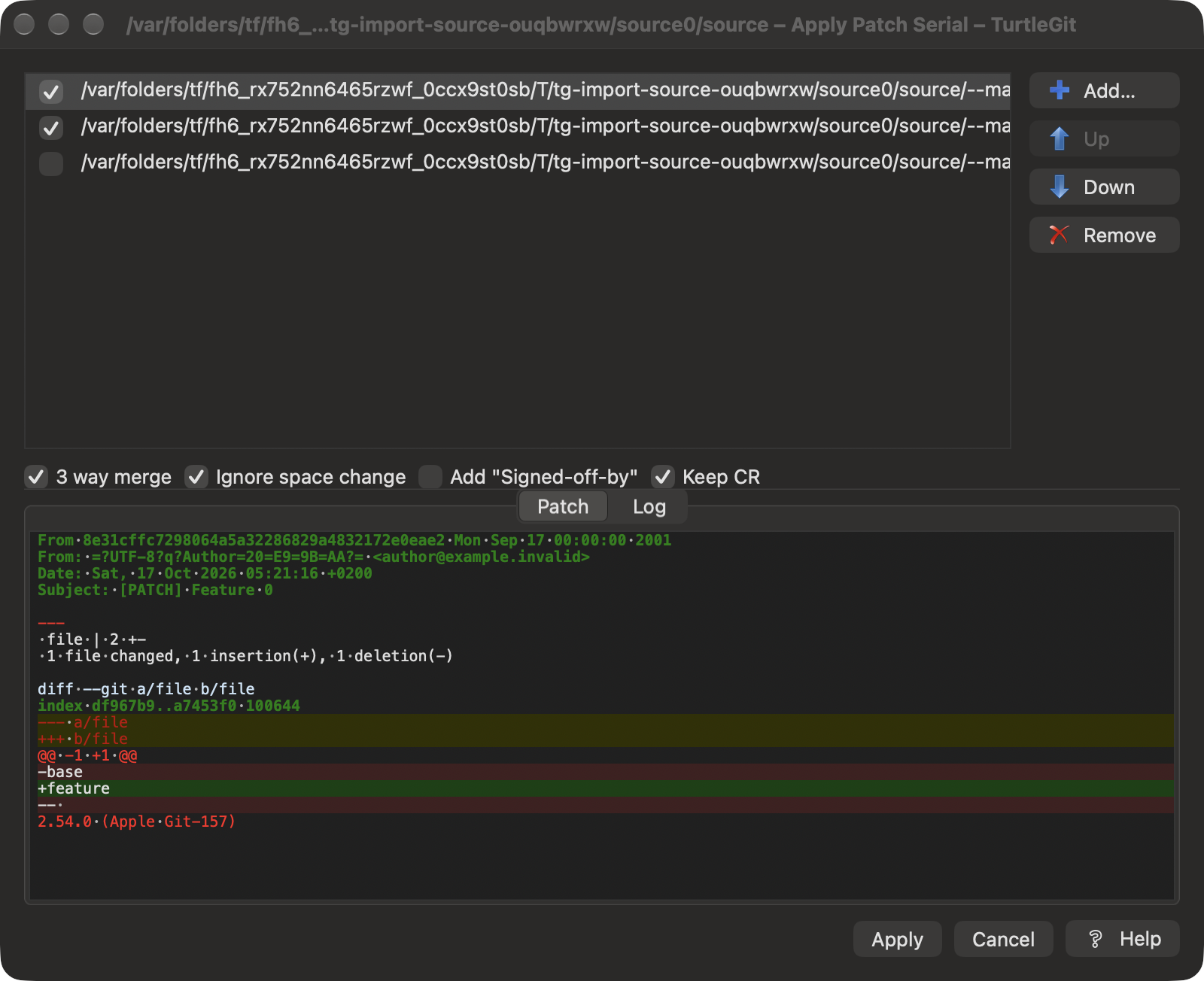
The serial-import window now follows IDD_APPLY_PATCH_LIST: a headerless checked
path list, Add/Up/Down/Remove vertically to its right, four options below, a saved
horizontal divider, Patch/Log tabs and Apply/Cancel/Help. Native multiple selection,
checkboxes and Space checking retain stable row identities. Full paths scroll
horizontally. Applying rows use bold text and scroll into view; successful, failed
and skipped rows use green, red and brown text with an adapted gray background.
This replaces the separate Status column and top toolbar. Native context commands
and double-click View Patch retain original icons and captured row/catalog intent.
Option/list/menu/toolbar callbacks capture their form lifetime. Busy, picker, Quit and catalog changes retire older callbacks. Add owns one file panel and compares its original catalog/options before accepting a reply. Forced closure cancels that panel; replacement/late/duplicate replies cannot add files. Recovery, close and identity questions now use one owned, once-only native alert relay; forced closure settles the pending answer before a retained reply can mutate Git.
Actual imports, close/quit checks, drop providers, preview/viewer reads and mail completion retain an active worker count through their actual completion. Forced window closure cancels Git and suppresses late publication while keeping Quit ownership until work drains. Mail completion is consumed once. Underlying Core mail-import arguments and Git recovery behavior are unchanged in this batch. Physical list/drag/keyboard and sheet behavior, full Windows geometry/colors, large inputs and signed sandbox/Finder/App Store acceptance remain open.
Patch/Log now use native in-pane tabs on macOS 13 and later, so newer macOS versions cannot move them into the title bar. Nested hosts propagate the explicit appearance and enabled state while retaining their own native environment; this keeps labels, checkboxes and patch colors readable in both appearances. Closing also cancels the item providers' Progress objects and refuses further provider loads after retirement; a noncooperative provider still owns Quit until it replies.
Grouped source batch evidence records four final-build case/engine passes, initial compilation/capture/fixture repairs, the strengthened EOF/single-record menu assertions and all twelve receiver PIDs independently absent. The full retained workflow passes with both Git engines.
External mailbox command input — October 18, 2026
Source importpatch now accepts selected non-directory mailbox files regardless
of extension and an independent droptarget repository. The command acquires
input grants before inspecting them and retains grants with native list rows.
Without a destination, authorized first-path discovery or an owned repository
chooser selects the repository. File-only permissions never authorize parent
metadata probing. The original window owns preparation and chooser replies;
Cancel, closure, termination and duplicate/late replies cannot launch a window.
Normal metadata and bare guards remain on repository adoption.
Repeated command entry preserves row identities/checks, order and options and appends only new exact paths; a busy owner refuses changes. Preview and mailbox Git actions remain the existing implementation. Workspace preferences now reach the Import window and its viewer/mail consumers. See command guide and batch evidence for actual Git effects, grants, chooser ownership and remaining signed/physical limits.
Identity, recovery retry and close ownership — October 20, 2026
This batch connects the source identity gate, active-session recovery and owned
window lifetime. ImportPatchDlg.cpp::OnBnClickedOk checks user data even when
all rows are complete. AppUtils.cpp::CheckUserData opens the Git Settings page
and loops over all four effective fields. ImportPatchDlg.cpp::PatchThread
logs failed recovery output and remains inside its active-session loop. The
native implementation follows these relationships rather than treating a closed
Settings dialog or an attempted recovery as success.
Abort, Skip and Resolved retain the captured mail-import session while a recovery choice is outstanding. The Core operation checks that session again before mutation; replacement sessions and rebases cannot inherit an old answer. A failed recovery appends its diagnostic, keeps the failed row/session association and asks again while that same import remains active. Later patches do not run until recovery settles. Only successful session completion updates the associated row to Pending, Skipped or Success. A pre-existing external import never marks an unrelated newly added row done. Cancel stops the continuation and preserves Git's remaining state; it does not imply rollback of an already completed Git command.
Identity reads, Settings, recovery/close questions and worker replies belong to the original import owner. Reentry, changed catalog/options, retirement and cancelled operations cannot consume late approvals. Forced closure settles owned questions, retires Settings and file/viewer children, and cancels outstanding work. The controller's close callback and retained repository/patch grants wait for actual workers and sheet release. Global Quit remains fenced until that work drains, including a producer that does not immediately honor cancellation.
For ordinary idle close, a failed git am --abort retains the native window and
its diagnostic so recovery can be retried. This is a deliberate safety adaptation:
the pinned OnBnClickedCancel displays an abort failure, then falls through to
close. Keep session still explicitly preserves the active import. Unknown session
state requires the separate Close and keep state choice rather than guessing.
This is mail-patch (git am) recovery. Recorded-base merging in Review/apply
single patch remains the separate raw-patch recovery workflow.
It does not run mail-import Abort/Skip/Resolved or create commits implicitly.
The new grouped native runner is scripts/test-import-patch-lifecycle.py, with
system and bundled Git configured in CI. Its intended scope includes actual
Settings repair/re-read, incomplete completed-OK identity, failed recovery retry,
captured-session refusal and forced-close drain. The
batch evidence records actual
execution, failures and repairs; historical passes above do not certify these
changes. The Debug app, twelve distinct focused Core methods with both Git engines
and all six distinct native case/engine combinations passed across the checkpoint
and affected close-path repair. The repair verifies an actual corrupt am session
can be kept through Cancel/retry/accept without changing metadata or Git state.
Only the two lifetime cases were repeated. A stale object
timestamp stopped the native preflight; rebuilding that one derived object
allowed the first actual native run to pass. Physical
keyboard/VoiceOver transitions, full Windows layout/color parity, large mailbox
performance, signed repository/patch-file grants and Finder/App Store acceptance
remain open. No whole-dialog or whole-application completion is claimed.