 TurtleGit for Mac
Log Messages parity
Source keyboard, focus and message actions: command-family review.
Current light/dark main-window review: primary dialog visual review.
Format Patch now opens from the revision context menu with original menupatch artwork and upstream single-revision Since or inclusive multi-revision Range presets. One/two/continuous selection rules and actual generated patch subjects are tested; native menu activation and field layout remain unverified. See FORMAT-PATCH-PARITY.md.
The implementation target is the actual TortoiseGit Log Messages dialog and its selection-dependent context menus. Native macOS controls retain the three-pane arrangement and familiar command order. The initial sidebar log table was removed.
Revision metadata columns
The native revision table now includes the source labels Email, Commit Name,
Commit Email and Commit Date alongside Graph, SHA-1, Message, Author, Date and
Bug-ID. Core history retains %cI independently of %aI; a real repository test
uses different author/committer dates and zones across multiple commits, filtered
older matches and pinned revision scope. SHA-1 cells retain the full hash (the
visible control truncates to column width).
Normal defaults show Graph, Message, Author and Date, plus configured Bug-ID; SHA-1 and the four extra identity columns start hidden, matching the normal Log source definitions. A native header menu offers Reset columns followed by column visibility checkboxes. Bug-ID is available only with the configured issue column. Visibility, widths and order now save in the owning dialog preference store, and columns can be resized and dragged. The October 13 column batch below supersedes the older global AppKit autosave behavior. Reset asks the source Yes/No question in a native sheet; Yes restores default visibility, widths and order. An attached sheet blocks another reset request. Graph resizing now addresses the graph column by identifier rather than whichever column happens to be first after reordering, and keeps wider user-set widths.
ID/rebase replacement modes remain outside the ordinary Log list; the SVN column is implemented in the October 13 batch below. Native header/confirmation gestures, cross-launch width/order persistence and signed sandbox acceptance remain pending. See the metadata-column record.
Date display preferences
Settings → Dialogs now exposes the three upstream options: Short date/time format
in log messages, Relative Times in log, and Use system locale for date/time.
Their saved defaults match SetDialogs.cpp: short format and system locale on,
relative times off. Both Date and Commit Date use these preferences; a preference
change redraws the table without reading Git again. Relative cells provide an
absolute date/time tooltip, following GitLogListBase.cpp.
ISO Git timestamps now convert into the local timezone. Foundation supplies native
macOS short/long date and time layouts; disabling system locale uses
yyyy-MM-dd HH:mm:ss. Relative labels retain LoglistUtils.cpp thresholds and
resource wording, including its signed future counts. The short-format checkbox
is disabled while system locale is off. Settings save immediately through native
preferences rather than a Windows Apply button.
Focused tests cover defaults, persisted choices, timezone/DST conversion, locale layouts and relative boundaries. A headless AppKit receiver checks actual date cells and absolute tooltips; it displays no windows. Displayed settings gestures, live preference refresh acceptance, translated relative labels and signed sandbox acceptance remain pending. The October 16 primary-presentation continuation below adds an owned visible-cell clock refresh while relative dates are enabled. Exact Windows timezone/DST edge equivalence remains pending. See the date preference record.
Actions column
The default-visible native Actions column now uses the seven pinned original
action*.ico assets: five fixed Modified, Added/Copied, Deleted,
Replaced/Renamed and Conflicted slots, plus fetching/error indicators. Icons keep
their source colors and use the original slot order/spacing; tooltips and
accessibility labels identify present statuses. The column participates in header
visibility, width/order settings and Reset columns.
Core action reads use only NUL-delimited name-status data, aggregate changes against every merge parent and handle roots, renames and type changes without reading line statistics. The native table lazily requests visible rows through one owned queue, deduplicates queued/in-flight hashes and caches immutable results. Refresh/invalidation/close cancel that queue and its current Git process group; stale completions cannot update a newer cache or show errors. Failed rows show the source error artwork and refresh retries them. Successful history reloads retain only results belonging to the returned list. Missing visible rows restart after a refresh even if their hashes are unchanged.
Copy-detection/configuration variants, working-copy pseudo rows, incremental/batched reads, displayed scroll/header/light/dark acceptance and signed sandbox behavior remain pending. See the Actions record.
Jump navigation
The top row now has the upstream ten-choice Jump dropdown in source order and
original jumpup.ico / jumpdown.ico buttons: Author Email, Committer Email,
Merge Point, Parent 1, Parent 2, Tag, Tag (FF), Branch, Branch (FF), Selection History.
Email matches are exact; branches include local and remote refs. Up searches
children for the selected first/second parent relationship, while Down searches
that parent's own revision. FF modes inspect real Git ancestry rather than only
loaded rows, so omitted intermediate commits do not break navigation.
The pinned handlers use the first selected row as their comparison origin and start scanning beyond the last selected row; both return without changing selection when the first selected row is the top row. A missing parent in Down also leaves selection unchanged. An exhausted search clears selection and offers “No more revisions found.” with the saved Do not show again checkbox. The native implementation retains those source rules. Git failures surface as errors rather than silently treating a failed ancestry read as a nonmatch.
Selection History retains at most 50 hashes, preserves forward history when the highlighted fork point is reselected, and drops forward entries for a new fork. Its arrows scroll/highlight the target without replacing selection or its details; a target outside the current list produces an informational notice. Native history records selected hashes in visible order; exact Windows event ordering for complex multi-selection remains pending. Reload, selection replacement and close cancel owned ancestry reads and reject stale completions. A normal jump selects and scrolls its match, then uses the existing changed-file reader.
Core tests cover source boundary/multi-selection/parent/reference rules, selection history branching and length, actual FF ancestry across filtered-out intermediates, pre-cancel and owned stalled ancestry cancellation with reaped child and unchanged index. A headless native receiver checks selection, highlight-only history, exhaustion and invalidation. Displayed controls, arrow gestures, scroll/highlight appearance in light/dark, warning suppression/relaunch, keyboard navigation and signed sandbox acceptance remain pending. See the jump record.
Revert merge parents
Single-revision Revert now uses the upstream parent submenu for merges, populated with parent subjects and hashes. The native Yes/No confirmation defaults to No; core applies the selected mainline without committing. Success offers OK/Commit, and Commit routes to the existing repository's Commit workflow. Root/bare/merge/ stash conditions omit the command. Parent metadata shares owned detail cancellation and caches immutable results. See the user guide and Log Revert parity for evidence and remaining multi-commit, conflict, displayed UI and signed checks.
Edit Notes
A single ordinary revision now offers Edit Notes with original edit artwork. The native editor loads the active note, honors project minimum message length, provides OK/Cancel and writes exact Unicode/whitespace/empty content. It refreshes the selected revision's displayed notes after saving. Owned loading cancels on selection/reload/close; saving keeps the editor guarded until completion. Stash and its adjacent index parent are excluded following the source rules. See the user guide and Edit Notes parity for configuration, recovery and outstanding editor/UI/signed acceptance.
Search fields
The search row now has a native Search in menu with independent Subject,
Messages, Paths, Authors, Emails, Revisions, Refname, Tag Info and Notes checkboxes, plus Bug IDs when issue-tracker configuration enables its column. Subject searches only the
summary; Messages searches both summary and body. Authors includes both author and
committer names; Emails includes both identities. Multiple fields match by OR.
Field selection is saved under SelectedLogFilters and reused by subsequent Log
windows. Unset/invalid preferences default to all ten implemented fields; an
explicit empty selection stays empty. Stored unsupported bits are masked out.
All selects the implemented field set; Toggle filters inverts it. Changing fields
or case mode only reloads when search text is entered, preserving a loaded list
and its pagination when no filter is active. Busy windows block these actions.
See the selection record.
Refname searches the full local/remote branch and tag reference names associated
with each commit. Annotated and nested tags resolve to their referenced commit;
annotated-tag searches also accept the upstream peeled ^{} suffix. Lightweight
tags have no peeled search name. This field searches names; Tag Info below
provides annotation-text search. Reference mapping is captured once before filtering
and reused for row decorations. Filtering precedes the result limit, with existing
path and pinned-revision scopes retained. See
the reference search record.
The reference snapshot now uses show-ref --dereference, matching the pinned
CGit::GetMapHashToFriendName CLI route. Git 2.39.5 only peels one level through
for-each-ref's *objectname; using that field lost nested tag decorations and
search results on the hosted runner. The replacement retains the original tag
object for annotation reads and the fully peeled target for commit association.
Log filtering, Revision Graph labels and copied commit details share this read.
Reference keys preserve distinct composed/decomposed names. Existing nested-tag
assertions are retained, with additional checks for Graph classification and
copied outer-tag annotation. See the compatibility record.
Notes searches Git's displayed note text, including configured core.notesRef and notes.displayRef selections. Returned revisions retain those notes and the native message pane appends a Notes section. Message-only Git grep explicitly excludes notes, so selecting Messages does not implicitly search them. Notes are fetched separately from commit records and cached by revision during each history read; embedded NUL data cannot break the commit-record parser. Repositories without notes refs/configuration skip per-commit note reads. Notes now use bounded batched reads; see the October 14 metadata checkpoint below. Full incremental/streaming loading remains unfinished. See the notes record. Tag Info searches annotation text, internal tag names and tagger identity from annotated tag objects associated with the commit. Lightweight tag names and renamed/alias ref names remain in Refname search. Tag objects are pinned in the reference snapshot and cached by object ID; multiple annotated tags on a commit are included, including tags pointing to tags. The target object header and direct commit type header are removed, matching the upstream CLI tag-info reader. Returned rows retain tag information, and the selected message pane appends a Tag Info section. Tagger header dates now use the Log date preferences in search, the message pane and copied details. Stored tag information retains raw timestamps so the message pane can reformat it when preferences change. Only header tagger lines are converted; annotation text, malformed dates and nested tag type headers are preserved. Clipboard reads capture one preference snapshot for all selected revisions. A tag-date search uses the preferences captured by its history read; refresh the search after changing date preferences to refilter existing results. See the tag date record. Displayed layout, links, colors and signed acceptance remain unverified. See the annotated-tag record. Paths searches changed filenames for each candidate commit, including root changes, deletions and both names of detected renames. Merge commits include the union of changes against every parent, rather than only the first parent. Paths are read with NUL-delimited Git name-status output, preserving literal Unicode, newline, tab and wildcard characters. Matching uses the selected case mode and OR combination with other fields before applying the result limit. This is independent of the lower changed-file pane filter and existing history path scope. Unlike upstream's cold simple-list path, which can omit rename old names, native search includes old names consistently before/after loading commit details. Paths now use bounded stdin diff batches, including every parent; see the October 14 checkpoint below. Full streaming history loading remains unfinished. See the Paths record. The menu also offers the upstream Case-sensitive toggle, default off. It applies to every selected field and is saved under FilterCaseSensitively for subsequent Log windows. Plain text uses the upstream term query rules described below; a single positive message term uses the source display matcher in native Log; the match-only Core API retains its Git fixed-string fast path. Empty search shows unfiltered history regardless of field selection; an active positive query with no fields returns no matches; an inverted query can match that empty selected-field text. Search/Return preserves the selected field set. Existing date, path, branch and pinned-end-revision scopes still apply.
Native Log now limits the raw scoped walk, then keeps search-hidden rows for graph/rollup state before display filtering. Its configured count applies to raw records; No limitation removes the count cap. The match-only Core API still provides its prior matching-result limit contract. Both typed history results currently materialize their output; incremental filtering remains unfinished. The source count/date controls are covered by the history-limit checkpoint below. Returned rows retain committer name/email metadata as well as author identity. The native Search in layout and interaction, match highlighting and the complete upstream default field set remain pending. This is partial upstream filter parity; see the verification record. Subject/case follow-up checks are recorded separately.
Plain-text query rules
Ordinary Log search now ports the pinned FilterHelper.cpp substring parser and
matching algorithm: space-separated terms are required, -term excludes,
+term starts an alternative and a leading ! inverts the result. Double quotes
keep a phrase together, doubled quotes retain one quote, and unterminated quoted
text stays a term. Only ASCII spaces separate tokens; tabs/newlines inside a term
remain literal. Terms can match across different selected fields because matching
uses their combined text, preserving the upstream field order. Subject and body
are assembled separately. Case mode applies to the whole query.
The port retains the source's less obvious rules: the ordinary word immediately
after a quoted phrase is parsed with that phrase's prefix, including literal
-/+ characters; an inactive space-only query shows all rows, while a lone !
hides all rows. Inversion also applies to an empty selected-field text. Native
Unicode lowercasing uses Swift rather than the Windows locale implementation;
Windows-locale edge-case equivalence remains unverified. Old/current path names
remain separate searchable lines; upstream cached path|oldPath concatenation
and highlighting remain pending.
The search field now describes term syntax in its tooltip. Single positive message terms use the source matcher in native Log, with the same raw batch as compound/inverted and multi-field queries. The match-only Core API retains the older Git-grep/matching-result limit contract. Increasing a configured count or choosing No limitation can reveal older qualifying commits. Match highlighting, incremental loading and native displayed search acceptance remain unfinished. See the query record.
Regular-expression search
The native Search in menu now includes the source label Use regular expression
before Case-sensitive. It defaults off and persists under UseRegexFilter;
changing it reloads only when search text is entered, and busy windows block the
change. The tooltip switches to regex syntax guidance.
Regex searches use the bundled C++ ECMAScript helper over Windows UTF-16 units,
not Git's basic/POSIX regular-expression dialect. One compiled expression checks
the combined selected-field text for every candidate, with case mode and a
leading ! inversion. Empty text fails an active expression even for .*.
Invalid or empty expressions leave the filter inactive, reproducing upstream
FilterHelper::ValidateRegexp; inversion still applies. Expressions can span
selected fields. Matching precedes the result limit and retains date/path/branch
and pinned-revision scope.
Length-framed records preserve embedded NUL, newlines and surrogate pairs. Regex work uses one batched helper invocation per history read; refresh/close cancel its owned process group and children. A five-second helper deadline uses its own token and does not cancel the owning Log request. Temporary input/output files are cleaned up. The runtime retains its universal macOS 13 slices, inherited sandbox signing route and redistributable source/provenance checks.
Batched filtering currently buffers scoped history and selected-field text; the existing 16 MiB helper input limit can report an error for very large requests. Incremental batches, Windows locale/case-folding edge cases, match highlighting, actual native toggle/persistence gestures and signed sandbox acceptance remain unverified. See the regex record.
Bug IDs column and search
Log now reads one issue-tracker configuration snapshot per native history reload
and passes it into history, so the column gate and extracted row IDs use the same
properties. The Bug IDs column and Search in item appear when bugtraq.url or
bugtraq.logregex is nonempty, matching UpdateProjectProperties. The field bit
participates in saved selection, All and Toggle filters. Returned rows retain their
extracted IDs, and the native table refresh signature includes them so changed
configuration updates displayed values even if commit hashes are unchanged.
IDs come from the existing ProjectProperties port: .tgitconfig/include and
Git scope precedence, one/two ECMAScript extraction expressions or a message
%BUGID% template, duplicate removal, numeric ordering and space-separated
output. Bug IDs queries search those extracted IDs rather than arbitrary message
numbers. They combine with other fields and work with plain terms, regex/case
mode and matching limits. Bare repositories read the committed project config.
The Log-specific extraction helper mode ignores invalid regex syntax, as the
upstream FindBugIDPositions does; existing strict Commit/config validation
behavior is preserved. Missing helpers, timeouts and cancellation still propagate.
Property Git reads and regex extraction receive the owned history token.
Configured regex extraction currently starts one helper per candidate/returned
commit (cached within that history read); batched extraction remains pending.
Windows StrCmpLogicalW locale/punctuation and case-equivalent duplicate behavior
are not fully reproduced by Swift natural sorting. Native displayed column/menu
visibility, preference/config refresh, links/highlighting and signed sandbox
acceptance remain unverified. See the Bug IDs record.
History-load cancellation
Every native Log history read owns an OperationCancellation token. Refresh/search cancels the previous read before creating another; closing or invalidating Log cancels its active read and advances the generation so stale results cannot replace current rows. Log may close during history loading, while mutations, viewer work and attached sheets retain their existing close guards. Mutation work cannot be replaced by a history reload. Cancellation does not show an error for the stopped request.
The core history API now accepts optional cancellation without changing existing callers. It checks before any work (including zero-limit/unborn reads), during ref and commit parsing and between merge parents, and passes the token through every Git command, including notes, tag objects, path diffs and final HEAD/ref metadata. The shared process runner terminates only the owned child process group. A cancelled read never returns its rows. Other Log operations still need their own cancellation coverage; large-output typed-history retention and incremental row publication remain unfinished; raw Git transport is now incremental as recorded in the October 14 checkpoint. See the cancellation record.
Changed-file detail cancellation
Each native changed-file detail selection owns a separate cancellation token. Selecting another revision (including clearing selection), refreshing history or closing/invalidating Log cancels the previous detail read and advances its generation. Stale results cannot replace current files or clear a newer token; cancelled reads do not display an error. Existing first-parent detail semantics are preserved.
The core files(in:cancellation:) API checks before work, between name-status,
numstat and raw Git commands and after parsing, passing the token to each command.
A real repository regression stalls numstat after name-status, cancels its owned
wrapper and child, verifies independent detail reads and exact unchanged index
bytes, and then reads the correct file/statistics again. Native gesture and signed
close/quit acceptance remain unverified. See the detail cancellation record.
Full-detail clipboard cancellation
Full-detail copy now owns its own cancellation token. Another copy (including a simple copy), revision selection, history refresh or window invalidation/close cancels that read. Generation checks prevent stopped work from changing the pasteboard, clearing a newer request's indicator or showing a cancellation error. A cancelled read preserves existing pasteboard contents; a successful read writes all selected revision details together.
commitLogText(revision:includePaths:cancellation:) passes the token through
revision pinning, message/notes/ref/tag reads and changed-file reads for each
merge parent, checking cancellation during tag/path assembly and before return.
A real repository regression stalls the annotated-tag read with paths disabled;
it verifies process/child cleanup, pre-cancel rejection, independent read success,
unchanged index bytes and identical subsequent clipboard text including notes and
tags. Existing changed-file cancellation tests cover the shared path reader.
Native pasteboard and displayed selection/refresh/close gestures remain unverified.
See the clipboard cancellation record.
Specification
Audited baseline: 7338078f8ddd924b8cddee35f512f2286072136d.
src/Resources/TortoiseProcENG.rc,IDD_LOGMESSAGE: filter row, three panes, path filter, project/all-branches toggles and footer controls.src/TortoiseProc/LogDlg.cppandLogDlg.h: selection, changed files and controls.src/TortoiseProc/GitLogListBase.cpp: columns, graph painting and revision menus.src/TortoiseProc/GitLogListAction.cpp: revision operations.- Upstream Log Messages manual.
Implemented and checked
- Separate resizable native window with three resizable panes.
- Compact graph before SHA-1/message/author/date; continuous lanes based on real parent hashes. Circles mark ordinary commits, squares mark merges/branch points. Topological order avoids sorting rows into a misleading graph.
- HEAD in bold; active branch red, other local branches green, remote branches orange and annotated/lightweight tags yellow.
- Full selected commit message, hash, author/email, date and parents.
- Changed paths, extension, action, added/removed counts; binary counts are
–. Root commits and merge first-parent changes are handled explicitly. NUL parsing preserves tabs, newlines and Unicode filenames and both sides of a rename. - Case-insensitive fixed-string commit-message search, optional date range, all branches, path filtering in the changed-file pane and loading 200 more rows.
- Single-revision/base and working-tree unified diff; two-revision unified diff. Double-click a revision opens the comparison. Patch text remains selectable.
- Hash, message and log-details copy actions; changed-path copy and comparisons.
- Branch and lightweight tag creation at a selected hash, detached checkout, soft/mixed/hard reset, revert without committing, and single-parent cherry-pick. Each operation opens a native dialog capturing the exact selected revision. Reset now uses the full revision/type window; see Reset parity for Git effects, native Mixed checks and remaining chooser/progress work.
- Conflict-side Show log can bound history to a verified commit and path; the incoming-side native handoff was checked. All Branches retains that bound.
- Original upstream colored command icons in revision and changed-file menus.
Tests cover graph continuity at merges and branch points, octopus/disconnected histories, real root/merge/rename stats, binary and unusual paths, full commit messages, annotated tags, search and limits. Native preview QA checked selection, merge graph, file stats and double-click diff with disposable sample repositories.
Still partial
| Area | Remaining behavior |
|---|---|
| Columns | Normal Log optional/SVN columns are implemented; ID/rebase replacements belong to the dedicated Rebase list. Broader displayed header/reset and cross-launch acceptance remains open |
| Graph | Compressed Expand/Collapse is implemented for loaded history. Cross-page compression, hidden-ref/merge-parent combinations and physical graph acceptance remain open; see graph guide and Bisect parity |
| References | Branch/ref chooser, remote ref deletion and tracking menus |
| Search/filter | Full history scope controls, search highlighting, displayed jump/selection-history acceptance and keyboard navigation; implemented fields/modes are recorded above |
| Files | Multi-revision union, multi-file diff, file log/blame, restore, save/export revision, open/editor/Finder actions |
| Revision menus | Single/root/merge/multi/working/bare popup variants, captured ref targeting, Find and working clipboard are implemented; all consumer-specific masks, physical tracking and signed acceptance remain open. See popup variants and later source-family sections |
| Mutations | Full branch/tag options, checkout branches, advanced Cherry Pick options and displayed acceptance (audit), multi-commit Revert and other operations, conflict continue/abort |
| Footer | Statistics, walk behavior, View options and upstream settings persistence |
| Comparison | Native side-by-side/three-way editor, merge combined diffs and external tool configuration |
| Accessibility | Full VoiceOver acceptance, keyboard shortcuts and focus parity |
These source mappings remain partial. A populated menu or a working Git command does not establish complete upstream parity.
Icon provenance
Artwork is copied unchanged from the pinned upstream resource directory. The
shared Icons resource folder contains the original license and a source-path and
SHA-256 manifest. We choose its GPL alternative. Both Xcode's shared framework and
Swift Package resources carry the artwork. AppKit reads the multi-resolution ICO
and renders 16-point colored menu icons, without template tinting for colored artwork. The monochrome cherry-pick glyph
uses native template tinting for light/dark contrast. Finder uses
upstream XPStyle status artwork; signed Finder visual QA remains pending.
Finder file/folder requests now scope history to all selected paths. The native Show Whole Project checkbox removes that scope; reopening Show Log from Finder restores the requested selection. Requests for the repository root show its full history. The full upstream folder-history controls and rename-following history remain pending.
Push from a single log revision now opens the separate native Push options window with that exact hash and the original Push icon. The window builds successfully; this specific Log handoff still needs native interaction QA. See PUSH-PARITY.md.
Commit revision chooser
Commit's Pick commit hash/message commands reuse this window as a native sheet.
Selection mode adds Cancel and enables OK only for one revision when loading has
finished, following upstream EnableOKButton. Normal Log's OK still closes the
window. Working-tree pseudo revisions are excluded; the current implementation
has no such row in either mode. Native Commit QA verified single acceptance,
multiple-selection rejection, no-match search rejection and cancellation.
See COMMIT-PARITY.md for insertion and Git-state evidence. This mode does not
establish completeness of the shared Log controls or mutation menus.
Native comparison routing follow-up
Normal repository Log revision menus now open the retained Changed Files window for working-tree, previous-revision and two-revision comparison. A root commit uses the empty tree; a merge uses its first parent. Unified diff remains its separate menu action. One native test verified Log → Changed Files → ordinary two-pane file viewer; HEAD, index and working contents stayed unchanged and the QA process exited. Root/two-revision native variants, file-level comparison routing and history-picker comparison factories remain pending. See comparison parity for inline character/word display and remaining fidelity differences.
Changed-file native comparison routing
Reviewed CGitStatusListCtrl::StartDiff, StartDiffWC and double-click routing
at upstream commit 7338078f8ddd924b8cddee35f512f2286072136d. Log's changed-file
Compare with base and double-click now open retained native two-pane viewers;
Compare with working tree uses the selected historical revision and current
disk contents. The separate unified command uses the original unified-diff icon
and retains its patch sheet. File comparison commands are disabled in history
pickers without a comparison factory. Multi-selection dispatch opens one window
per selected path, with a shared pinned comparison range.
Selected-file snapshots retain rename source paths, added/deleted empty sides and gitlink routing. Unchanged selected files still open a viewer. For working comparisons, actual disk existence determines absence: a file left on disk after an index deletion must display its contents rather than an empty destination. Historical revisions are pinned before tree inspection. Literal path validation and NUL-delimited tree lookup preserve Unicode/newline/pathspec-looking names. Missing paths on both sides produce no file window; directories outside an identified gitlink are rejected.
One real-Git test verifies renamed and unchanged comparisons, duplicate old/new path selection, absent paths, working contents after index deletion, actual file deletion and path escape rejection. It checks exact bytes and unchanged indexes. One native process verified root-commit file double-click: the base was empty, the destination contained exact committed bytes, and editing was disabled. The app was quit immediately afterward; process absence and unchanged fixture HEAD, index and working bytes were verified.
The changed-file list still shows merge changes against the first parent. Upstream per-parent rows and combined historical merge display remain pending; this change does not claim complete merge comparison parity. Native context menu/working/multi-file/submodule acceptance, picker integration, signed scope, file log/blame, export and the other advanced file commands remain incomplete.
Validation: all 259 Swift tests passed. Unsigned Debug and App Store builds, both bundle audits and the static Pages build passed. The App Store audit exercised universal Git 2.55.0 local operations and checked 11 Mach-O files, the Finder extension, licenses and 61 original icons. Signed Finder/sandbox acceptance and App Store approval remain unverified.
File history and historical Save As follow-up
Reviewed upstream file-list Show Log/Show Log of Old Name, FileSaveAs and the
single-file/deleted/directory menu gates at commit
7338078f8ddd924b8cddee35f512f2286072136d. Log's file menu now offers Show log
at the selected revision and, for renamed paths, Show log of old name without
the selected-revision endpoint. Both use retained native path-scoped Log windows
and the original log icon. Pickers without a file-history factory disable these
actions. Native QA verified the selected-file endpoint and loaded history.
Save revision to uses the original Save As icon and a native NSSavePanel with a base-name/short-hash/extension suggestion. The action is hidden for deleted files and gitlinks. Commit-history file rows now include raw-mode metadata, so gitlinks are reliably identified. The core historicalFile method pins the commit and reads exact blob bytes; it rejects missing/escaping paths and gitlinks without checkout or index writes. Export writes the captured Data atomically to the panel-selected destination. Symlink blobs export literal target bytes as a file.
A new real-Git test checks binary bytes, UTF-8 BOM, CRLF/no-final-newline text, symlink targets, current working-file preservation, pinned revision and exact index preservation. The submodule test additionally verifies gitlink file-row metadata and export rejection.
At that audit step, native Save acceptance remained pending: three sequential QA instances opened the panel with the correct suggested revision filename, but Save and New Folder remained disabled. Clearing the read busy state before panel display and explicitly allowing data/other file types did not establish a working save. Each panel was cancelled; no export was created. No root cause is claimed. All three processes were quit and absence verified; fixture HEAD, index and source bytes remained unchanged. Further Save-panel validation investigation is required before claiming this workflow works natively. Old-name/rename, binary, deleted/submodule menu gates and signed sandbox acceptance also remain pending.
The full Swift suite passed all 260 tests before the final native panel-state adjustments; the final Swift application build passed after those adjustments. Full Log/file-list parity remains incomplete, including per-parent merge rows, Blame, revision-file Open/editor actions, multi-file folder export and restoration.
Final unsigned Debug and App Store builds, both bundle audits and the Pages build passed. The App Store audit verified universal Git 2.55.0 local operations, 11 Mach-O files, the Finder extension, licenses and 61 original icons. These checks do not establish native Save success, signed scope or App Store approval.
Save-panel control check and clipboard follow-up
Historical Save presentation now belongs to LogWindowController. The model reads and captures the pinned content/short hash, then the controller presents AppKit UI on the next main-queue turn after context-menu tracking. File types use the suggested extension where known and allow other types. This improves presentation ownership but is not claimed as a fix for disabled Save.
A single subsequent QA process checked both Log historical Save and the previously accepted two-pane viewer Save As. Both showed disabled Save/New Folder controls in the same process. Both were cancelled, and the app was quit with process absence and unchanged fixture HEAD/index/working bytes verified. The disposable bundle has no sandbox entitlements restricting writes; system Open/Save panel-service errors were observed. The broader reproducible failure is not specific to Log's model handler. Its cause remains unproven, and current native Save acceptance remains pending for both workflows. Previous successful viewer-export acceptance remains a historical result, not proof for this run.
The Log file clipboard submenu now offers full paths, relative paths, file/ folder names and all displayed file information, with original copy artwork. It uses visible selected rows in table order; all information reuses the tested ComparisonFileList tab-delimited path/extension/status/line-count payload. Gitlinks have blank extensions through shared mode-aware metadata. Path and line-count text use native primary color when selected, retaining blue when unselected. These clipboard/contrast changes require native acceptance; no additional test process was launched for them.
Validation for this UI follow-up: Swift build and all 12 targeted ComparisonFileList/RevisionComparison tests passed. The prior full 260-test result remains recorded above; the entire suite was not repeated for these UI-only changes. Final unsigned Debug/App Store builds, both bundle audits and the static Pages build passed. The App Store audit verified the universal Git 2.55.0 runtime/local operations, 11 Mach-O files, Finder extension, licenses and 61 original icons. Native clipboard and signed execution remain pending.
Historical Blame handoff
The single non-deleted, non-submodule changed-file menu opens the native Blame window at the selected revision, with original Blame application artwork. Native root and renamed-file history handoffs were checked; full Blame menus, editor layout, encodings and Finder routing remain pending. See Blame parity.
Full revision clipboard details
Log now uses the shared pinned-commit reader for Full log details. It includes revision, author/email/date, full subject/body/trailers, notes, annotated-tag contents and changed paths, including old rename names and every merge parent. Full log details without changed paths retains the metadata, notes and tags while omitting the path section, matching upstream's two full-information choices. Multiple selected revisions are captured in visible table order before reading.
The read runs asynchronously with a progress indicator and the retained repository access lease. Closing or reloading Log, or choosing a newer clipboard command, invalidates the pending copy. No partial multi-revision text is copied on failure. The output uses LF and the Log date preferences for author/tagger dates; tag object/type-commit headers are omitted. Full upstream tag presentation and localized relative labels remain pending, as described in Blame parity. Fast paste before the read finishes can still see the previous clipboard; the progress indicator identifies the pending operation.
Native QA selected two adjacent revisions and verified their order through paste into the Log search field. Full output contained both messages, the note, tag and both path sections. The path-free command retained both messages, the note and tag and omitted both path sections after its read completed. The one QA app was quit immediately afterward; no TurtleGit app process remained, and fixture HEAD, index and working source matched their baseline. Overlapping-request cancellation, window-close cancellation and signed sandbox acceptance remain pending.
Focused GitBlame/TextConflict tests passed. The existing full 270-test result is recorded in Blame parity; the full suite was not repeated for this clipboard option/UI change. An existing compiler warning in conflict-end parsing was removed by dropping redundant nil comparisons after optional bindings; the existing conflict parser tests passed with that cleanup.
Final unsigned Debug/AppStore builds passed without compiler warnings. Both bundle audits passed with the Finder extension, licenses and 62 upstream icons; the AppStore audit verified universal Git 2.55.0, 11 Mach-O files and local operations. The static documentation build passed, and the existing public Pages root returned HTTP 200 with the TurtleGit title. This verifies site availability, not deployment of this commit or signed App Store acceptance.
Historical Save As native acceptance recheck (2026-10-05)
A fresh disposable preview of 6c7be1a opened Log's selected-file Save revision to
panel with Save enabled and the upstream basename/short-hash/extension suggestion.
Go to Folder selected a separate existing output folder, and Save created
source-e9cae95.txt. Its 30 bytes matched the pinned commit blob exactly, including
UTF-8 BOM, CRLF and no final newline. Deliberately different staged and later
working contents remained unchanged, as did HEAD and the complete raw index.
The byte hashes and observed workflow are recorded in
the native QA result.
No application code change was needed to make this run succeed. The earlier disabled-panel observations remain valid historical failures; this acceptance recheck does not establish their root cause or prove they cannot recur. It resolves the current native text-file Save acceptance gap only. Binary, symlink, deleted/ submodule gates, overwrite/cancel, old-name variants, signed sandbox destination scope and a fresh two-pane viewer Save As check remain pending.
The documentation screenshot shortcut did not create an image, so no new screenshot is claimed. Normal Quit attempts through UI automation did not confirm termination; the single identified disposable process was sent SIGTERM after those attempts. Process absence and repository/output byte invariants were then verified. No other processes or system services were targeted.
Historical file Open and editor actions
Pinned GitStatusListCtrl.cpp lines 1884–1889 expose View revision in alternative
editor, Open and Open With for a single non-directory, nondeleted/nonmissing file.
OpenFile (4673–4699) reads historical contents into a temporary file, marks it
read-only, then launches the configured editor, default association or Open With.
Log now exposes these three commands with the original notepad/open icons under
its single-file historical gate. Deleted rows and gitlinks omit them.
The model captures exact bytes at the selected pinned revision with the existing repository security-scope check. Open With presents a native application-bundle chooser; cancellation does not create a preview. The default action uses the macOS file association, and alternative editing uses the same saved TextEdit/custom-app preferences as Commit. Explicit chosen apps retain their selected resource scope until the workspace callback completes.
HistoricalFilePreview creates a unique private directory (0700) and read-only
regular copy (0444), preserving the filename extension and including the short
revision hash. Historical symlink blobs remain literal target text; targets are
never followed. Working-tree, empty-tree, unpinned, non-blob and malformed preview
inputs are rejected. Copies stay alive for the application session, including
after Log closes. Failed launches discard their copies, and normal application
termination discards all retained previews. External edits cannot change the
repository through these copies.
Two new regressions check exact text/binary/symlink contents, literal Unicode and newline filenames, distinct private copies, read-only modes, disposal, invalid inputs and raw index/HEAD/working preservation. The comparison suites passed 20 tests; alternative-editor preferences passed two more. Debug and unsigned App Store builds and both bundle/runtime audits pass. The expanded SwiftUI menu is factored into a separate view-builder expression to avoid the Xcode type-checking limit.
Native QA verified all three commands in the first historical-file context menu
and invoked the alternative-editor action. A temporary source-e9cae95.txt copy
was created for the selected revision and retained during the session. TextEdit
presented an Open chooser, so an actual historical document in the editor was
not verified. UI automation then returned a ScreenCaptureKit invalid-parameter
error; that observation is not evidence of a TurtleGit launch failure or success.
The same QA process subsequently quit normally, the preview directory disappeared,
and exact HEAD, raw index and original working bytes remained unchanged. No
TurtleGit test processes remained. No new screenshot is claimed for this run.
Native default-association document acceptance, Open With selection/cancel, custom-editor errors, binary/symlink/rename and deleted/gitlink menu variants, read-only document behavior, repeated-session cleanup and signed sandbox handoff remain pending. This is a partial port of historical opening, not full native editor or file-context-menu parity.
Historical multi-file folder Export (2026-10-05)
Upstream GitStatusListCtrl.cpp::FilesExport (4504–4544) was compared directly.
Log now includes Export with the original colored icon for eligible selections.
A native directory chooser captures the selected revision and files before the
operation. Exports preserve repository-relative directories and visible list
order, replace existing destination copies, skip deleted files and gitlinks,
and read exact blobs from a pinned commit. Historical symlink blobs become
regular files containing the target text. Each failed file offers a native
Ignore/Abort sheet; Ignore continues and Abort stops subsequent files while
retaining successful copies. Cancelling the directory chooser starts no export.
Core preflight rejects Git metadata, escaping destination parents and selected working-source aliases before writing. Per-file checks repeat parent/source validation, use a sibling temporary file and atomically replace the destination. A chosen folder's security scope stays active throughout the operation, and the App Store route requires the repository grant too. These unsigned checks do not prove signed sandbox acceptance.
Six export regressions pass, including two new historical tests covering a moving HEAD, literal Unicode/newline paths, binary blobs, broken symlink target text, nested hierarchy, overwrite, deleted/gitlink skipping, continuation after a missing blob, destination-parent aliases and raw index/HEAD/working preservation. Debug and unsigned App Store builds and both bundle audits pass (64 icons, 11 universal Git Mach-O files).
Native QA displayed Export for three selected files. Menu accessibility IDs became invalid between tool calls and the menu did not remain visible for a successful invocation. The chooser and Ignore/Abort end-to-end acceptance are therefore pending; no exported native output or new screenshot is claimed. The incidental read-only comparison was closed, the one QA app quit normally, and exact fixture HEAD/index/working bytes were unchanged with no QA process remaining. Native overwrite/cancel/error continuation, signed sandbox grants, and exact upstream marked-row menu eligibility/order remain pending. Full Log and file-context parity remains incomplete.
Native Export acceptance follow-up at 35d4672
A new single-instance QA session successfully invoked Export, chose a separate
folder, and wrote all three selected files. Filesystem verification matched the
selected commit's 30-byte UTF-8 BOM/CRLF/no-final-newline text, four-byte binary
blob under nested/, and 14-byte broken symlink target as a regular file. The
staged and working versions of the text file differed from the selected blob;
neither was changed. Exact HEAD, raw index and working bytes were preserved.
With the first destination (link) deliberately occupied by a directory, the
native warning showed the file, full revision, destination and Is a directory
error. Ignore retained that directory and exported both later files exactly.
Abort retained the directory and wrote neither later file. No sibling temporary
files remained. A subsequent chooser Cancel returned to Log without starting an
export. The app quit normally and process absence was checked before any further
UI observation. No code change was needed for these acceptance checks; the prior
menu automation failure did not reproduce after explicitly raising Log.
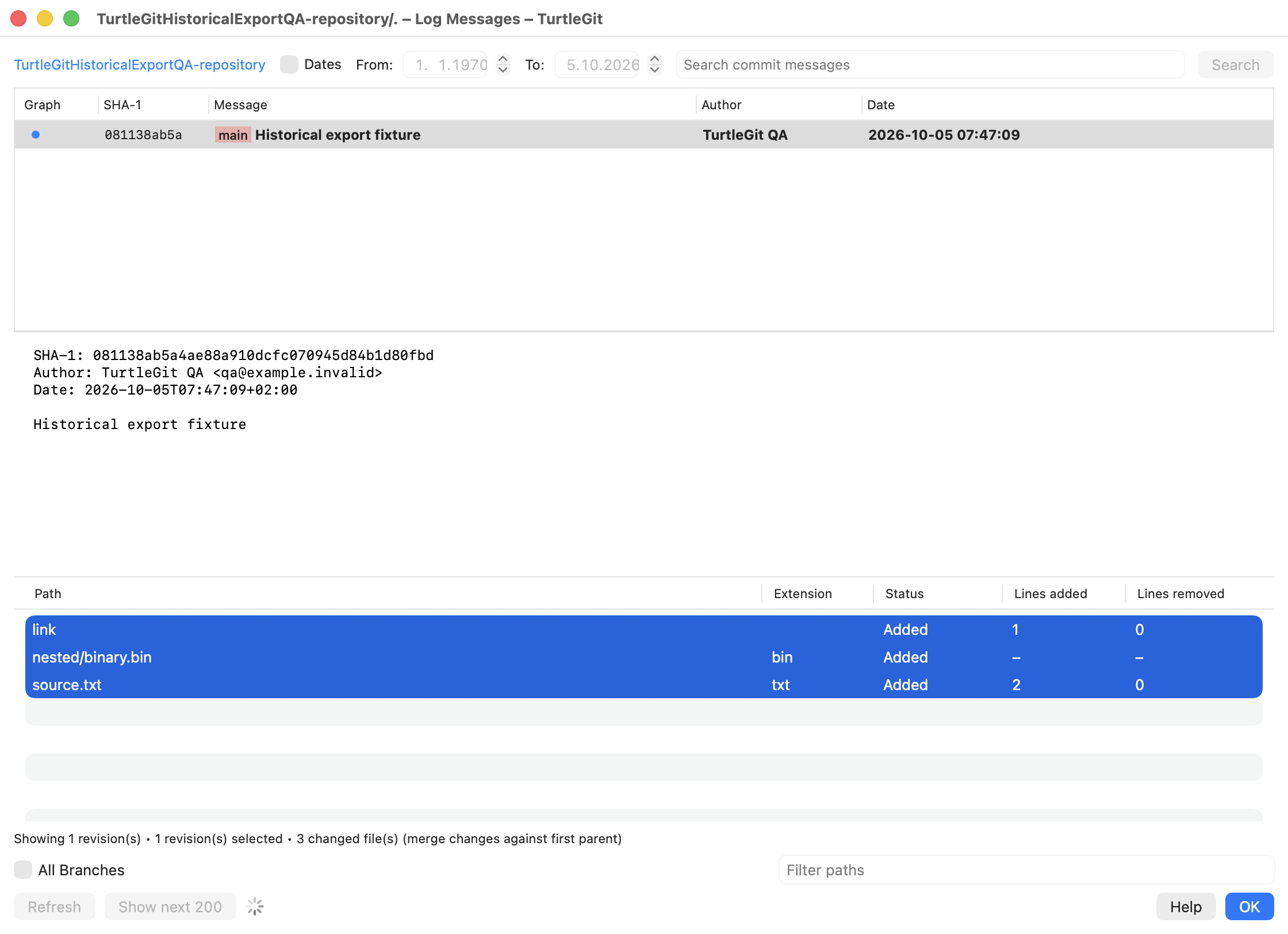
Recorded hashes and native coverage are included with an actual Log capture. The screenshot captures the underlying Log selection during export; it does not capture the separate AppKit warning sheet. Native overwrite, deleted/gitlink marked-row menu gates and ordering, dark-mode warning appearance and signed sandbox access remain pending. Full Log parity remains incomplete.
CI compiler follow-up
GitHub's Swift 6.1.2/Xcode 16.4 rejected the Export Task at 35d4672
with a type-checking timeout, before integration tests could run. Local builds
had passed. The task now calls a separate async function with explicit result
and message types; the failure message is assembled from a typed string array.
This retains the verified export behavior while reducing inference complexity.
The correction must pass a fresh GitHub run before CI compatibility is claimed.
Compare two historical files (2026-10-05)
Upstream GitStatusListCtrl.cpp menu eligibility (1796–1811) and command
implementation (2260–2285) were compared directly. Log now offers Compare two
files for exactly two visible selected non-gitlink files. It preserves displayed
row order, compares distinct paths in the selected revision, and independently
uses that revision's first parent for each deleted side. Both revisions are
resolved to commit hashes before a snapshot reaches the existing read-only
comparison viewer. Identical paths, wrong selection counts, missing blobs and
non-file/gitlink content are rejected. RepositoryModel applies the existing
App Store repository-grant check before reading historical contents.
A real Git regression verifies a deleted left side, reversed order/deleted right
side, literal Unicode/newline/leading-magic filenames, symlink target blobs,
exact raw index preservation and unchanged pinned bytes after HEAD advances.
All seven FileComparison tests pass. Native QA selected a deleted/modified pair
but context-menu automation returned noWindowsAvailable and invalidated-row
errors before invocation. The process was still alive and its Log contents were
observable; those errors do not establish a TurtleGit failure. Native menu/viewer
acceptance is pending, with no new screenshot claimed. The one QA app quit
normally; exact HEAD, raw index, later working bytes and the deleted path's
absence were preserved, and no QA process remained.
The file menu is now ordered Show log/old-name/Blame, Export, Save revision, alternative editor, Open and Open With for the implemented commands, matching the relative upstream order. A separate view-builder reduces Swift inference complexity after the earlier Swift 6.1 Export timeout. Exact marked-row gates, missing restore/prepare-diff/explore commands, alternative diff tools and signed sandbox validation still prevent full file-menu parity. Native binary/symlink, root/both-deleted/merge pair variants and reversed order remain pending.
The previous compiler correction at 6b3d697 passed the full GitHub macOS workflow, including integration tests, Debug/Finder build, universal Git runtime and unsigned App Store build/audit. This does not prove the new pair change or signed distribution readiness.
Unified diff for a file selection (2026-10-05)
Upstream IDGITLC_GNUDIFF1 (2290–2365) iterates selected rows and appends each
file's patch to one read-only viewer. The Log file menu now accepts multiple
selected files for Show changes as unified diff. It captures visible list order,
reads only those paths against the selected commit's first parent (or root), and
concatenates their patches. Rename entries include old and new literal paths so
Git emits the rename rather than just the destination addition. Duplicate paths
are ignored; empty selections are rejected. The operation is busy-guarded and
checks the App Store repository grant before reading. Unified patch text remains
in the existing separate read-only sheet.
A new real Git regression verifies root additions, multi-file ordering, rename-from/to metadata, leading pathspec-magic/Unicode/newline names, exclusion of an unselected change and later staged/working contents, duplicate filtering, and exact raw index/HEAD/working preservation. The five CommitHistory tests pass. The original assertion expected the old Unicode path unquoted in the patch; it was corrected to account for Git's quoted patch headers without changing the fixture's names or content coverage. Debug builds pass. Native multi-file patch sheet acceptance, configured filters/tools, per-parent merge rows and error-partial output still require verification.
The separate historical pair native retry again selected both rows but returned
an automation noWindowsAvailable error when opening the context menu. Its one
QA app quit normally; exact repository state and process absence were checked.
No native pair handoff or new screenshot is claimed. This does not block the
remaining source port, and full Log parity remains incomplete.
Reveal in Finder (2026-10-05)
Upstream GitStatusListCtrl.cpp Explore eligibility (1898–1899), dispatch
(2151–2153), and CommonAppUtils.cpp::ExploreTo (467–489) were audited. Log now
includes Reveal in Finder after Open With, with the original Explorer icon.
A single non-deleted historical row and a working-tree repository are required;
gitlink directories remain eligible. The command selects the current disk item.
If it no longer exists, it opens the nearest existing parent directory inside
the repository. It does not check out the historical blob. The App Store route
checks the retained repository grant before resolving the path.
The core resolver handles literal paths and broken symlink items, rejects bare repositories, Git metadata and escaping parent aliases, and performs no Git or filesystem mutation. Six WorkingFileRestore tests pass, including two new reveal regressions for normal/broken-link selection, missing nested/root fallback, unsafe paths and exact raw index/HEAD preservation. Debug and unsigned App Store builds and both icon/runtime audits pass (64 icons, 11 universal Mach-O files).
Native QA invoked Reveal on a modified file in Log. Finder selected right.txt
and displayed its later working contents, which differ from both selected and
staged bytes. The first menu showed Show log/Blame, Export, Save, editor, Open,
Open With and Reveal in that relative order. Selecting the older root commit's
left.txt, absent from the current disk, opened the current repository folder
without restoring the file. A transient activation interruption was refreshed
and the missing-file handoff retried before acceptance was recorded. Only the
QA repository Finder window was closed; TurtleGit quit normally. Exact HEAD,
raw index, working bytes and deleted-file absence were preserved, with no QA
process remaining. Native evidence records this
coverage. No new screenshot is claimed.
Native nested missing-parent, symlink, gitlink/bare/deleted menu variants and signed sandbox handoff remain pending. Full Log menus, marked-row semantics and historical comparison acceptance are still incomplete.
Mark for comparison (2026-10-05)
Audited upstream GitStatusListCtrl.cpp menu construction (1894–1913),
PREPAREDIFF dispatch (2155–2166), and external DiffLater import (3170–3179),
against pinned upstream 7338078f8ddd924b8cddee35f512f2286072136d.
Log now offers Mark for comparison and a dynamic Compare with action for one
non-deleted historical regular file. Both use original comparison artwork.
The mark belongs to that Log dialog, survives revision changes and comparison,
and disappears when the dialog closes. Same-path labels show the saved full
revision; different-path labels show the saved path and eight-character hash.
Both endpoints are resolved to commits before content is read. The App Store
route checks the retained repository grant.
Eight FileComparison tests pass, including a new real-Git regression for same/different literal paths, binary contents, Unicode/newlines, invalid paths, pinning across a later commit, and exact index/working/HEAD preservation. Debug and unsigned App Store builds and resource/runtime audits pass (64 icons, 11 universal Mach-O files). The preceding base commit's GitHub macOS and Pages runs also passed; this change's CI must be checked separately after push.
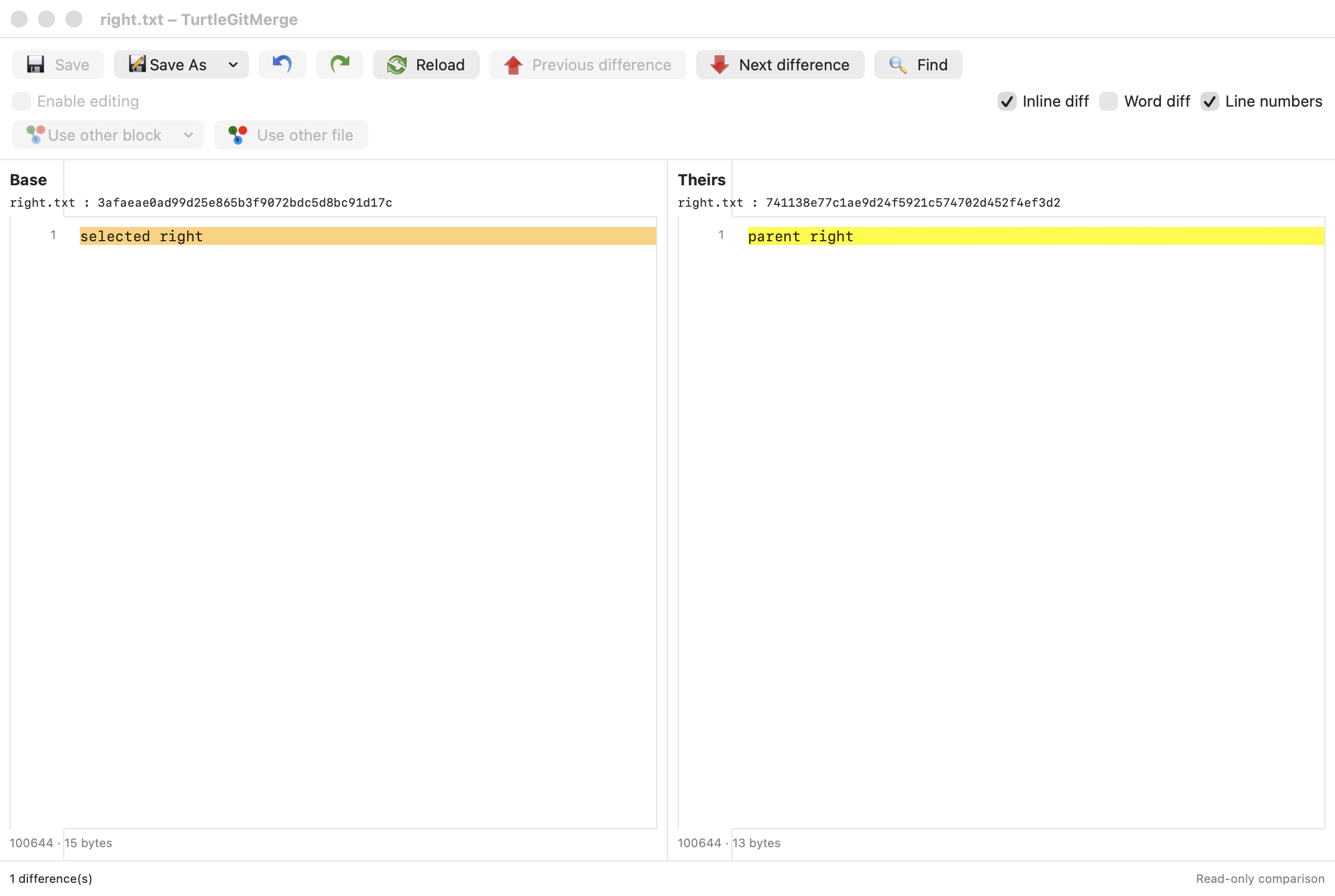
Native QA marked right.txt in the latest commit, changed to the older revision,
and invoked Compare with using the full-hash label. The viewer showed the marked
15-byte selected right and older 13-byte parent right, with editing and Save
disabled. The mark remained available for the older revision's left.txt; its
menu label was Compare with right.txt:3afaeae, and the viewer compared the same
marked content with 12-byte parent left. HEAD, raw index and working bytes
remained exact; the deleted disk file was not restored. The one QA app quit
normally, with no remaining QA process.
Recorded acceptance evidence and the
actual native screenshot document the
checks. The screenshot shows the same-path viewer with an inactive title bar;
it does not capture the context menu.
External working-file DiffLater import, gitlink comparison, alternative diff tools/Shift behavior, long-path compaction, additional native file types and signed sandbox acceptance remain pending. This section does not establish full Log parity.
A follow-up source audit of Git.cpp::GetShortHASHLength (3011–3014) found a
fixed return value of eight, not a configurable hash length. Different-path
comparison labels now use eight characters, matching this pinned upstream.
The native record above intentionally retains the seven-character label seen
before this correction; it proves the viewer route, not the corrected label.
Long-path compaction remains pending. Explorer's ContextMenu.cpp DiffLater
handler (1350–1371) stores an absolute working-file path, consumes it after
comparison, and supports Control to clear and Shift for an alternative tool;
that shared Finder/app route still needs porting.
The external mark's private bookmark store and metadata-only Finder snapshot now have persistence, renewal and conditional-consumption regressions. The Finder/app working-file routes and Log external-mark comparison now open the native viewer. See comparison mark parity for the complete source audit and required integration. This storage foundation does not change the verified historical Log comparison route.
Log external working-file mark import, mixed historical comparison, shared-token consumption and dialog-local reuse are now implemented and natively verified for a regular file outside the repository. Only that working pane becomes editable. The selected historical revision remains pinned. See comparison mark parity for tests, the native screenshot and remaining signed/tool/path variants. This does not establish full Log parity.
Native mixed-comparison Save now has exact UTF-16/BOM/CRLF and 0755 acceptance, including external-change refusal and Reload Cancel/discard behavior. A native prompt bug was fixed so Reload/Close/Quit name the actual edited file, and all three corrected labels were checked. See comparison mark parity for the QA record and remaining active-pane/signed sandbox limitations.
Log revision and selected-file unified-diff actions now use the shared external viewer preference and Shift inversion. Exact non-UTF-8 patch bytes are preserved through the external preview, with a real Git apply-check regression. The built-in sheet remains available through the same choice. Native launches and Shift interaction remain unverified; merge-parent/combined variants and full Log parity are still pending. See unified diff viewer parity.
Native revision menus now include Merge and Rebase onto selection, with original icons, reference/hash presets and fresh repository-state guards. Merge/Rebase handoffs records origin recovery and limits.
Single-revision Log Export now has the original icon and a native archive dialog with HEAD/Branch/Tag/Commit, Whole Project and overwrite confirmation. Revision Export records the implementation and remaining displayed, signed sandbox and entry-point checks.
Compare parent with working tree
The historical file menu now offers Compare parent with working tree, using the original comparison icon and a parent subject/hash label. Parent subjects are loaded for ordinary commits as well as merges. The command uses the first parent for ordinary rows and each selected occurrence’s own parent for merge groups; it reuses the root revision-file comparison viewer, including rename mapping and missing sides. Root commits and the synthetic working-tree row have no command. Busy, bare, invalidated, multi-revision and empty file selections refuse the handoff.
This follows GitStatusListCtrl.cpp's GetParentCommitInfo and StartDiffWC(parent), with per-parent groups now loaded into the native file list. Shift selection of an external two-pane diff tool is also pending. The native receiver checks model dispatch and actual comparison bytes with an injected root viewer callback; displayed menu/window and signed sandbox acceptance are separate.
Per-parent file data
GitRevLoglist.cpp reads each actual parent in commit order and retains separate
file occurrences. The Core logFileGroups reader now follows that contract:
actual metadata from the pinned commit, one group per parent (including empty
groups), and one empty-tree group for a root commit. Each group retains its
parent hash and a scoped Log entry for the existing patch readers. Paths,
renames, statistics and submodule modes remain separate across parents.
Native Log now loads all merge parent groups and displays Diff with parent headers in the same file table. Empty groups remain visible unless a path filter excludes them. Headers are removed from selectable file IDs; duplicate paths have separate occurrence IDs that never replace their actual filesystem path. Comparison and parent-to-working requests batch by parent, so a busy root model cannot discard a later group. Selected unified diff retains one patch for each parent occurrence, while deduplicating repeated selections of that occurrence. Deleted-file pairs resolve each side’s own parent. File log/open/export/clipboard continue to use actual paths and the selected commit, not the occurrence ID.
Headers currently occupy the Path column as native table rows; full-width group styling, collapse controls and displayed light/dark/keyboard/VoiceOver acceptance remain pending. The pinned reader emits per-parent rows; MERGE_MASK has handlers and a reserved group header but no row producer in the current source. A combined-merge viewer requires further source/runtime evidence. External two-pane tool selection remains separate parity work. Root viewer batch wiring is compiled and inspected; the native fixture injects its callback and reads actual Core comparisons. Successful displayed viewer dispatch and signed sandbox access remain unverified.
Working-file Add and Commit
The working-tree file menu now offers Add for selections containing an unversioned file, plus Commit for the selected paths, using the original icons. Both read fresh working status and retain selection/invalidation guards before handing off. Add reuses the native Add progress route; Commit reuses the existing scoped Commit dialog and now refreshes repository Logs on completion. These commands pass paths, not the whole repository. Displayed Shift Add mode menus, the remaining file commands and displayed menu/dialog acceptance are still pending.
Working-file Revert and index flags
Log now offers scoped Revert through the existing Revert chooser/progress route. Mixed selections pass only versioned files. The working-tree row also reads index flag metadata without refreshing/writing the index. Locally ignored rows remain visible, including typed gitlinks, so users can clear assume-unchanged and skip-worktree flags. Status shows the current flag and Commit is disabled for the marked locally ignored file. Flag menus use the existing marked-row policy and confirmation; the Core engine revalidates current flags under its private index lock. Confirmation cancellation, changed revision selection and invalidation prevent dispatch. Successful or partially successful changes request Log refresh.
The hidden native check executes real assume/skip/clear and Revert progress in a disposable repository, checks restored bytes and unrelated file/HEAD preservation, and removes owned Trash results. Confirmations and root callbacks are injected. Revert currently opens the existing chooser instead of upstream’s direct status-list confirmation/progress sequence. Displayed dialogs, partial flag failures through this new route, locally ignored Revert semantics and signed sandbox access need further acceptance work.
Historical file Revert
Historical file menus now offer Revert to this revision and Revert to parent revision with the original Revert icon. Parent groups retain their actual parent hash, including parent 2 and duplicate-path occurrences. Like upstream's GitStatusListCtrl.cpp RevertSelectedItemToVersion, restoration uses the old path for renames, checks out into both index and worktree without moving HEAD, and parent-added paths use rm --cached --ignore-unmatch while retaining working data. Existing regular files and symlinks go to Trash by default; gitlink directories are not recycled. Per-file failures offer Ignore/Abort and completion reports counts by revision. Changes refresh repository Logs.
Targets are pinned and checked against actual commit/parent files, with literal pathspecs and confined destination paths. A missing historical old-name target is rejected before recycling local data. This deliberately avoids upstream's possible checkout failure after recycling a rename's old path. Checkout failures after a successful recycle retain the resulting Trash URL. The supported older Git versions receive the validated hexadecimal hash directly, without checkout's newer --end-of-options option.
Core fixtures cover raw bytes, literal unusual paths, parent-added preservation, current/parent restore, renames, invalid selections, unchanged HEAD and unrelated staged content. Hidden native fixtures execute current and parent-2 restoration, duplicate-parent occurrences, summaries and stale/bare/invalidation guards with injected dialog callbacks. Displayed menus/dialogs, the Ignore/Abort failure interaction and signed sandbox acceptance remain unverified. Full port parity is still incomplete.
File Ignore menu
Log now offers Add to ignore list when the marked file is unversioned or deleted, including historical deletions. Name, extension and single-file containing-folder choices reuse the native Ignore dialog. Mixed extensions use separate name/mask commands as in GitStatusListCtrl.cpp; matching extensions retain the submenu. Original Ignore icons remain attached. Selections are read in visible list order; actual historical parent groups or fresh working status are checked before the handoff. Busy/bare, changed selection, invalidation and externally staged cached unversioned rows prevent dispatch. Ignore writes rules without removing tracked files or their working contents. Rule changes now refresh all repository Logs.
Hidden native fixtures verify path/mask/folder routing and historical deleted paths, then execute the native Ignore model to write a literal unusual filename rule and refresh unversioned visibility. Dialog and root/completion callbacks are injected. Menu layout and displayed Ignore interaction, signed sandbox access, working-file Delete and other outstanding file commands still need acceptance. SwiftUI file selection now retains the last singly added selection as its mark. Ambiguous range selection retains the existing mark or falls back to the first selected visible row; physical mouse/keyboard acceptance remains pending.
Working-file Delete
The working-tree file menu now offers Delete for an unversioned, ignored-copy or missing marked file, using the original Delete icon. The table's native Delete command uses the narrower unversioned/ignored-copy keyboard policy. Shift requests permanent deletion; otherwise selected existing files go to Trash. A native Yes/No confirmation precedes mutation. Like upstream DeleteSelectedFiles, the operation processes all selected paths and removes their exact index entries, including tracked paths in a mixed selection, without moving HEAD.
The existing Core delete engine locks the index and revalidates selected status; it never falls back from failed Trash to permanent removal. Log retains resulting Trash URLs, refreshes repository Logs on success/partial file mutation, and refuses changed revision/file selection or invalidation while confirmation is held. Native fixtures inject confirmations and completion callbacks while executing real Trash, permanent deletion and index changes in disposable repositories. Displayed menus, keyboard events, confirmation interaction, partial errors through this new route, selection-mark fidelity and signed sandbox acceptance remain pending. Historical file rows do not offer Delete.
The file-selection binding now remembers the last singly added row, clears the mark when its selection disappears or the revision changes, and excludes group headers. Delete, Ignore, working index flags/Commit eligibility and historical Revert/parent menu titles share that mark. File execution order remains visible list order. Hidden fixtures use the real binding to select a tracked row then add an unversioned row, and parent 1 then parent 2 duplicate-path occurrences. Ambiguous multi-row additions retain an existing selected mark or use a first-row fallback. Right-clicking an already selected row, range endpoints, keyboard anchors and displayed selection behavior still require runtime acceptance.
Show submodule log
Gitlink rows now offer Show submodule log with the original Log icon, separately from Show log in the parent repository. The child repository is validated through the existing submodule-comparison reader. Historical nondeleted rows default to the exact recorded gitlink hash, matching LogSubmoduleShowRevision (default true). Disabling that preference, selecting a working-tree row, or selecting a deleted historical gitlink opens general child history. Deleted rows resolve the actual parent group's gitlink; merge file occurrence metadata is retained.
The route checks fresh working status or actual historical group membership, repository access and child checkout identity before handing off. An uninitialized checkout or unavailable pinned child revision reports an error without fetching or initialization. Busy/bare, multiple-file, changed revision/file selection and invalidation guards prevent stale dispatch. Root wiring opens child Log with no parent path filter, retaining the parent's access lease and selected Git runtime.
Hidden native fixtures exercise literal gitlink paths, parent versus child Log, recorded hash and actual child history range, preference-disabled/working/deleted history, unavailable revisions, missing initialization and exact index preservation. Root callbacks are injected. Displayed menus/child windows, event input and signed sandbox acceptance remain pending.
Working-file Shift Add modes
With Shift held, an eligible marked unversioned file now offers Add as Executable (+x) and Add as Symlink with the original Add icons. All selected paths are passed to direct Add progress, as in GitStatusListCtrl.cpp; ordinary Log Add now also uses that direct route, including selected folders. The Explorer/main Add chooser route is retained separately. The progress model carries the initial mode through the reviewed-path validation into the existing private-index Add engine. Executable and symlink modes update Git index entries to 100755 and 120000 without chmod or creating a disk link. Selected directories keep their child modes unchanged.
Marked-row eligibility, fresh unversioned status, real file type for Shift modes, access and stale revision/file-selection guards precede handoff. Progress completion refreshes repository Logs. Alternate mode post-actions are shown only after normal Add; Commit remains available after a successful variant Add. Native fixtures run real mixed file-mode Add progress, raw blob checks, unchanged regular working-file permissions/types, directory/gitlink Add, held-index/pre-cancel refusal and unrelated staged/HEAD preservation. Root callbacks are injected. Displayed Shift events, progress post-action menus and signed sandbox acceptance remain pending.
File clipboard headings and displayed values
A follow-up audit of the pinned GitStatusListCtrl.cpp menu, GetCellText and
CopySelectedEntriesToClipboard corrected Log's file clipboard formatting.
The upstream COPYEXT command means Copy all information to clipboard;
it is not a separate extension-only command. The four existing named commands
remain, with the original Copy artwork.
Full paths, relative paths and file/folder names now end each selected row with LF, including the last row. All information adds the Path, Extension, Status, Lines added and Lines removed headings followed by tab-separated cells. Log uses a shared status-list formatter while retaining each merge-parent occurrence and its own statistics. Working-tree copies use the displayed Assume unchanged or Skip-worktree status instead of a generic Modified label. Group headers and filtered-out files are excluded; busy and invalidated models preserve the previous clipboard.
The native Path cells now show the default source (from old path) rename/copy
suffix, and Extension includes the leading dot, including dotfiles. Typed gitlinks
have no extension. These are display labels; Git commands and the three path/name
copy commands retain actual paths. The formatter preserves Unicode and embedded
newlines/tabs rather than quoting or deduplicating paths.
The five focused Core tests cover both existing status-list consumers and the new occurrence-aware format, different statistics for duplicate paths, displayed flag overrides, rename/copy labels, reordered/empty column inputs, literal names and gitlinks. Native receiver checks use actual historical rename/merge rows and working index flags with a private pasteboard; resulting records are in the file clipboard QA record. The Core tests do not establish displayed interaction acceptance.
Log's current-column context command, native column visibility/order persistence, AbbreviateRenamings setting consumer, composed light/dark appearance, physical menu/keyboard gestures and signed sandbox acceptance remain pending. The default five-column clipboard change does not establish complete menu or Log parity.
Walk Behavior
The native Log now exposes the six pinned Walk Behavior menu choices, in source order: First Parent, No merges, Follow renames, Full history, then Compressed Graph and Show labeled commits only. Each choice has a checked state; the button shows when any choice is active. The two graph modes replace one another and turn off when selected again. Busy and invalidated models refuse changes.
The first four options use Git's --first-parent, --no-merges, --follow and
--full-history. Follow renames requires a single file scope, turns off All
Branches, restores the original file scope instead of Whole Project, and disables
both controls while active. Changing scopes clears Follow. Eligibility checks
working directories and committed tree modes, including bare repositories where
Git's own administration directories must not be mistaken for committed folders.
Typed gitlinks are also excluded even without a checkout. Literal Unicode,
newline and wildcard-like filenames retain their meaning.
Compressed Graph keeps HEAD and supported reference labels, merge commits and
fork points. Labeled-only keeps HEAD/reference rows. The synthetic working-tree
row remains visible. Graph copies bridge hidden loaded linear ancestors;
actions, parent comparisons and file groups continue to use actual commit parent
hashes. Merge/fork node shapes retain actual topology even when graph edges
collapse. Ordinary walks now use the same --parents flag as upstream
GetLogCmd. Git's rewritten links are stored separately as graph parents; actual
parents are recovered in bounded batches from pinned commit hashes. This connects
path-filtered rows across omitted intermediate commits while file groups, path
search and parent actions still use the real commit topology. Full history keeps
raw parents, matching upstream's mutually exclusive flag choice. The native Log
applies display projection separately.
Four Core tests exercise real merge and rename histories, combined First Parent and No merges, a merge that hides mainline path changes unless Full history is used, scope restrictions, a bare administration-directory name collision, readonly repository preservation and graph projection invariants. The existing 34 Commit History tests also pass. The native receiver exercises all six model handlers, working-row/graph alignment, literal rename following, mutually exclusive modes, All Branches/Whole Project transitions, scope reset and busy/closed guards, with an actual hidden hosted Log view. See the walk QA record.
Compressed search now retains raw rows and forced state propagation; see the search-hidden walk section below. Follow renames hides the native graph, as upstream does. The synthetic working row above a hidden HEAD and displayed light/dark/keyboard/VoiceOver acceptance and signed sandbox behavior remain pending. Compression currently applies to the loaded revision batch, so Show next 200 can reveal more retained nodes. This is progress toward the complete upstream walk/graph behavior, not full Log acceptance.
The graph-parent regression additionally verifies a real omitted path ancestor,
connected normal/labeled graph rows, actual file lists and parent-revert targets,
Full history raw-parent behavior and exact repository preservation. The native
receiver checks the same path graph through LogWindowModel. See
the graph-parent QA record.
View → Labels
The four upstream label switches now appear under View → Labels in source order: Tags, Local branches, Remote branches and Other refs. All start enabled, with settings saved separately for each repository. Normal history redraws its label cells without reloading or changing selection. Compressed/labeled-only history refreshes the projection when a switch changes. Busy and invalidated models refuse changes.
The visibility mask follows LOGLIST_SHOW* and ShouldShowRefsFilter: hidden tag,
local and remote labels stop retaining their commits in graph modes. HEAD remains
visible even with its local branch label hidden. Stash and Bisect labels keep their
independent always-enabled flags. Other refs (including Notes) can be hidden from
painted labels, but do not retain commits in labeled-only history even when shown.
Full reference metadata stays attached to entries for revision actions and search.
The Core regression covers all six mask categories, retained HEAD, unknown/Notes refs, graph bridging and unchanged parent/reference metadata. A native receiver uses actual annotated tags, local and remote branch refs and another ref on separate commits. It inspects the attributed label cell before/after hiding, checks normal-row/selection preservation, reopening preferences and repository isolation, actual labeled/compressed rows and edges, closed/busy refusal and exact HEAD/index/working-file preservation. Its preference domain is private and removed. See the label QA record.
The View menu's Gravatar command now has a partial native implementation; see the Gravatar section below. Footer ordering now places All Branches before Walk Behavior and View; exact displayed spacing, physical menu interaction, color/layout and accessibility acceptance remain pending.
View → unrelated changed paths
View now has Hide Unrelated Changed Paths and Gray Unrelated Changed Paths before Show Unversioned Files and Labels, matching upstream order. Gray starts enabled for each new Log; these two modes are mutually exclusive and selecting the active mode returns to showing all paths. Mode changes act on loaded file details without reloading history. Hiding a selected file prunes its selection and selection mark; existing commands refuse hidden rows. Whole Project bypasses the scope styling.
Literal prefix matching follows FillLogMessageCtrl, including old paths for
renames/copies and directory/submodule boundaries. Multiple native scopes form a
union. Directory types come from working filesystem attributes or pinned Git tree
modes; bare Git administration directories are not used as working directories.
Git path UTF-8 bytes are compared without case folding or Unicode normalization.
The complete changed-file list is retained. In particular, working-tree details
no longer discard unrelated tracked paths before Gray/Hide can act. Unversioned
paths are inserted independently of the unrelated-path mode, as upstream does.
All five file columns now use the pinned CColors roles and saved preferences: Modified (including type changes), Added (including scored copies), Deleted (including missing), Renamed (including rename scores) and Conflict. Renamed is source blue rather than the former generic brown. Gray overrides action color for unrelated paths, and selected text uses native primary color. Native dynamic colors follow the source HSL dark conversion; the Log view subscribes to Apply notifications. The Log color QA checks exact defaults and saved custom Modified/Renamed values in the real historical path fixture on Apple and bundled Git, retaining working-tree/filter guards. Physical rendered repaint, theme/selection contrast, graph/label colors and remaining color settings still need verification.
Core checks exercise literal special/Unicode/newline prefixes, Unicode byte inequality, directory-prefix collisions, gitlinks, rename/copy origins, toggle states and directory typing in a real bare repository. The native receiver checks a real rename out of a scoped folder, historical and working tracked paths, mode/selection/clipboard guards, color choices, Whole Project bypass, unversioned controls, hidden hosted menu construction and repository bytes. See the path View QA record. Physical menu and color appearance acceptance, richer path-filter expressions and multi-revision file aggregation remain pending.
Show Unversioned Files now defaults to enabled in both Commit and Log, matching
upstream AddBeforeCommit. Both dialogs read and save the same application-wide
preference, so reopening either dialog uses the last choice made in the other.
Existing open dialogs retain their own current switch state. Log updates loaded
working rows without a history reload; Commit filters its loaded status list.
Busy/closing guards refuse preference changes. The native receiver uses a private
preference domain and real tracked/untracked files to check default visibility,
hide/show, reopen in both directions and exact repository preservation. See
the shared unversioned QA record.
View Patch
View → View Patch now opens a separate native read-only patch viewer that follows
the Log selection. The existing unified viewer supplies syntax coloring, search,
Save As and printing, with staging/applying disabled. The child belongs to the Log
and closes with it. The repository-local tgit.logshowpatch setting stores the
choice and reopens the panel for a new Log. Closing the patch window also disables
the setting, including while the parent Log is busy.
FillPatchView semantics are separate from the manual unified-diff command: one
revision with no selected file rows shows first-parent changes with statistics;
selected versioned files concatenate individual patches in list order using each
row's merge-parent index and both rename paths. Unversioned rows produce no patch.
Multiple/no revisions clear the view. Root commits and unborn working trees give
an empty preview, matching the upstream comparison behavior. Working previews pin
fresh HEAD and preserve the index. External diff/text conversion tools are disabled.
Selection and file/filter changes cancel prior work and coalesce through a 100 ms delay. Reload and close cancel owned reads; generation and selection checks keep late completions from updating the viewer. Busy/error indicators appear in the Log. The native receiver holds real model reads across selection changes and close to verify stale output is discarded, and creates/owns an actual hidden read-only patch child to check data, disabled applying, reopening and close behavior.
Core checks cover whole statistics, literal selected-file bytes, working changes, unversioned omission, roots, cancellation and exact HEAD/index preservation. See the patch preview QA record. A further real merge fixture verifies selected rows from both actual parents, visible-order concatenation, both rename paths (including literal pathspec syntax and newline), raw invalid-UTF-8 patch bytes, binary-file markers and configured zero context. It deliberately clears the caller’s cached parent list and checks that previews still resolve actual parents. Whole preview bytes match first-parent diff-tree output; HEAD, index, config, notes ref and working bytes remain unchanged. See the merge and byte QA record. These are Core reader checks, not viewer Save As acceptance. Actual signed-commit metadata, binary/invalid-UTF-8 viewer exports, displayed alignment and moving/resizing, keyboard/physical menu/light-dark/VoiceOver and signed sandbox acceptance remain pending. Full Log acceptance remains incomplete.
View Patch visibility now changes immediately even if remembering the repository setting fails, matching upstream's independent create/destroy behavior. Failed persistence is shown separately from a patch-read error; it does not set Log busy, close a usable viewer or prevent hiding it. Preference writes are ordered so rapid show/hide/show sequences finish with the last requested setting. A real config-lock receiver case checks usable open/close, exact config and owned-lock preservation, recovery after removing the lock and ordered rapid toggles. See the preference failure QA record.
The native patch viewer now aligns to the Log frame height when opened. It uses
available screen space on the right, then the left, and otherwise clamps the
initial frame to a visible screen. Negative monitor coordinates are supported.
As in PatchViewDlg, a docked viewer follows parent movement and aligned vertical
edges follow resizing. A dragged-away viewer stays at its independent position;
within five points of either docking edge it snaps back. The native gap is eight
points. Log retains ownership without a Cocoa child-window relationship that
would force detached windows to move. Showing/restoring the parent raises the
preview without activating it; parent minimization hides it, and closing Log
still closes its owned preview.
The native receiver exercises deterministic initial-placement/bounds cases and actual hidden NSWindow move/resize and snap/detach notifications. See the placement QA record. Displayed screen transitions, minimization/restoration, Spaces/fullscreen, manual drag/resize and VoiceOver acceptance remain pending; geometry checks do not prove visual parity.
The first actual-frame check found SwiftUI changing the patch window's minimum height to its content fitting size. Patch hosting now disables automatic sizing limits and keeps the explicit resizable window minimum, so the patch text scrolls rather than forcing a taller window. This uses the macOS 13+ NSHostingController sizingOptions API. The original failed frame check and diagnostic frames are retained in QA logs.
Gravatar
View → Gravatar reserves a native author-picture area on the right of the message
pane. Only a single ordinary commit supplies its author email; empty, working-tree
and multiple selection clear the picture. The visibility choice saves separately
for each repository. An unset choice inherits Settings → Dialogs → Enable Gravatar,
which starts off. Existing saved choices keep precedence over that global default.
The URL field uses the source default https://gravatar.com/avatar/%HASH%?d=identicon;
all %HASH% occurrences are replaced. Email whitespace is trimmed, text lowercased
and UTF-8 bytes hashed with SHA-256 by default. The source MD5 compatibility option
is also available. URLs must have an HTTP(S) scheme and a host; macOS transport
security still applies to custom endpoints.
CryptoKit replaces WinCrypt, URLSession replaces WinINet and SwiftUI/AppKit replaces the picture box. Each selection owns a delayed 500 ms request; another selection, disabling the feature or closing the Log cancels it and rejects stale completions. As upstream does, a previous picture remains until a new request succeeds or fails, while an empty selection clears immediately. Failed/non-200/empty/invalid image responses clear the picture without interrupting Git work. Decoded downloads are limited to 8 MiB. Successful images cache for seven days in an app temporary subdirectory. Native cache keys include the full request URL so switching custom providers or hash modes cannot reuse the previous provider's image. Cache-write failure keeps a usable downloaded picture. These are explicit macOS adaptations.
A headless receiver uses a mock URLProtocol transport, including delayed completion, to check SHA-256/MD5 vectors, repeated placeholders, normalized and empty addresses, URL scheme refusal, default-off/no-request behavior, actual image decoding, cache hit/expiry, HTTP failure, multiple-selection clearing, cancellation/stale completion, repository/global preference precedence and hidden native Log layout. Its Git fixtures preserve exact tracked/index/config/HEAD bytes. No repository email hash is sent externally by these tests. See Gravatar QA.
Displayed image scaling/placement, physical View/Settings interaction, custom URL history, full source temporary-file cleanup controls, real provider/redirect/TLS behavior and signed sandbox/network acceptance remain pending. No screenshot or App Store acceptance is claimed; the complete Log and application ports remain incomplete.
Compressed graph Expand/Collapse
A single ordinary revision in Compressed Graph now offers Expand or Collapse
before Copy to clipboard. Active text searches suppress the command, following
IsFilterActive; empty/inversion-only and invalid ECMAScript expressions remain
inactive. The existing C++ matcher determines regular-expression activity rather
than substituting Foundation's different regular-expression syntax. Date/path
walk bounds still restrict the loaded history. Busy, multiple/working selection,
normal/labeled graph mode and closed Log models refuse rollup changes.
Expanded state propagates down a linear segment until a label, merge or fork. Those boundary nodes retain their own state. Expanding a merge reveals each linear parent arm; a fork stops inherited expansion. Per-hash overrides follow the source toggle rule: reversing a forced state removes that override, while an explicit choice matching its current default can be retained for later topology changes. Choices last for the Log session. Refresh applies a snapshot of the map, so a superseded read cannot overwrite the current projection.
Graph copies bridge omitted ancestors, while action/detail entries retain their
real parent hashes. Collapsed nodes draw a hollow circle or junction square;
node-connected edges stop at its border. Expanded nodes retain the filled shape.
This is a native adaptation of paintGraphLane, not a claim of exact GDI rendering.
The menu command has no invented replacement artwork: the pinned command supplies
no dedicated icon. Graph accessibility state and exact geometry still need review.
Core fixtures cover label/merge/fork boundaries, merge-arm expansion, forced mid-segment collapse, reverting overrides, actual parent preservation and ignored overrides in normal mode. Search tests use the pinned C++ helper for empty, inverted, valid and invalid patterns. Native receiver verification and remaining acceptance are recorded in rollup QA.
Projection still operates on the loaded revision batch. Cross-page rollup behavior, compressed/search combinations, malformed/out-of-order topology, physical menu and light/dark graph appearance, keyboard/VoiceOver and signed sandbox acceptance remain pending. The full Log and application ports remain incomplete.
Revision double-click preference
Settings → Dialogs now includes the source checkbox Can double-click in log list
to compare with previous revision (DiffByDoubleClickInLog), off by default.
The revision table's native double-action selector reads it for each activation,
so changing the setting affects already open Logs. The earlier unconditional
unified-diff double-click action is replaced by the source parent-comparison
handoff. Explicit context-menu unified diff remains available independently.
The first selected row in visible order supplies the comparison origin, including
multiple selection, as DiffSelectedRevWithPrevious does. A commit compares with
its first actual parent, including when compressed graph rows hide that parent;
a working-tree row uses its captured HEAD. Roots and unborn working trees offer
No previous version. rather than inventing an empty-tree comparison. A native
informational sheet is used when the Log owns a window; headless/no-sheet cases
use the existing navigation notice. Busy/closed and an occupied unified viewer
refuse the handoff. Native settings save immediately through UserDefaults rather
than the Windows Apply button.
Programmatic double-action routing and actual revision pairs, defaults/live changes, merge/root/working/multiple selection, guards and repository preservation are recorded in double-click QA. Physical pointer timing, clicked/selected ordering under modifier gestures, Shift alternate tool selection, follow-rename/path-specific comparison factories and displayed settings/sheet/keyboard/VoiceOver/signed acceptance remain pending. This is partial Log parity; the full application port remains incomplete.
First-lane branch revision counter
The native single-selection message header now appends Branch RevNo: <count>
when Display branch revision number (ShowBranchRevisionNumber, default false)
was enabled when opening Log and the selected node is in native graph lane zero.
The count is Git's first-parent walk, not the total reachable commit count and not
a unique revision identifier. Selection clearing, multiple selection, working-tree
rows and side-lane nodes omit it. Generation checks discard stale detail reads.
This adapts LogDlg.cpp's active-first-lane gate. Native graph layout is not yet proven identical for all filtered, compressed and all-ref histories; the feature uses the native first lane rather than claiming complete Lanes equivalence. Counter QA records four-Git real merge history, displayed-message model and rapid-selection checks. Hidden settings layout does not establish physical toggle, themes, accessibility or signed runtime. See Push parity for the matching post-transport counter.
Configured log message font
Settings → Dialogs → Font for log messages now applies to the message details
pane, matching LogDlg.cpp::SetupLogMessageViewControl. This call targets
IDC_MSGVIEW; the revision table has the separate opt-in described below.
The changed-file list keeps its existing native font. The setting shares LogFontName/LogFontSize with Commit, Merge
and Rebase. Menlo replaces Consolas on macOS, with the source default of 9 points.
Changing preferences updates an open pane and retains its selected text.
The read-only native OutputView opts into this setting explicitly. Other output
views keep their existing 12-point system monospaced font. See
Log/Rebase font QA for actual hidden native
pane checks. Physical font-control interactions, light/dark composed appearance,
rich-message links/styling and the complete Log dialog remain partially verified.
Optional font for the revision list
Advanced → LogFontForLogCtrl now enables the shared log font for the native
revision table, matching GitLogListBase.cpp::InsertGitColumn. It defaults to
false. With it enabled, text columns and reference-label text use the selected
font, HEAD keeps a bold face when available, and row height follows native font
metrics with a 24-point minimum so text is not clipped. Font preference changes
reload the cells without changing the displayed revision set. Disabling the
option restores the existing table typography and 24-point rows.
After building Debug, python3 scripts/test-log-table-font.py checks an actual
hidden table using two real Git commits. It verifies default-off behavior, enable,
live size change, disable, HEAD bold, message attributes and font-aware row height.
Column autosave is disabled only in the isolated fixture. See
revision-table font QA. Physical Advanced
editing, selection/scroll/column-layout preservation, visible graph composition,
light/dark appearance and all shared GitLogListBase consumers remain unverified.
Reference and graph color follow-up
The Log now uses saved pinned CColors reference roles with opaque backgrounds and source weighted contrast text, plus eight BranchLine colors and saved line width/node size. Native Settings adds a Log tab with reference/graph wells and source geometry ranges/defaults. The existing native revision table subscribes to Apply and accessibility display option changes and reloads its cells, with private defaults shared by labels and graph cells. See appearance details and palette QA. The source lane state machine, lane-index/active-merge colors and native gradient/shape painting are now adapted as described below. Complete filtered topology and label borders/tracking shapes/symbolization still need source parity; physical contrast and signed acceptance remain pending. Named accessibility appearances alone do not enable system Increase Contrast on this host; native providers use the actual flag.
Lane state and native graph painting
Normal graph rows now carry the pinned Lanes states rather than drawing the previous compacted parent curves. Native Log/Blame painting uses empty-slot reuse, joins, tails, crosses, merge/initial nodes, source lane-index colors, active merge gradients and source line/node dimensions. Rolled nodes have source one-point outlines and leave gaps in crossing lines. Synthetic working-tree rows have no painted graph, matching the source empty-hash gate.
The independent lane oracle verifies exact state snapshots and active columns, including first-parent merges, boundaries, octopus/disconnected/criss-cross histories and deterministic random DAGs. Graph projection keeps actual commit parents separate from display parents. Existing abstract edges remain a compatibility connectivity representation; they are no longer used for native painting. Shared GraphCell reacts to Apply and accessibility display revisions for Log and Blame.
Compressed/labeled visibility now preserves full-walk lane snapshots, including hidden records, and its forced-rollup logic is compared with the pinned source filter block. Native text search now carries match flags over the raw walk. Path-simplified Git metadata remains a separate parity task. Boundary metadata loading now follows the source advanced setting and minus mark; see the boundary history section below. Source drawing coordinates/gradients are adapted to Core Graphics; physical raster, selected-row contrast, Retina, scroll/clipping and signed acceptance still need review. No new screenshot is supplied here.
Hidden-row walk and full-view rollup
Upstream LogDataVector::append advances lane state even when a record is
hidden. Projection now snapshots the full input walk before selecting visible
rows; hidden merges/forks therefore retain their lane assignment at the next
shown row. Actual commit parents and the compatibility display-parent edges
remain separate from the painted lane states.
Collapse/Expand is available in both complete and compressed views, with the existing single-selection/busy/closed/active-search guards. Complete view honors forced collapse until a label/merge/fork boundary, which stays expanded by default there; compressed boundaries stay collapsed by default. Labeled-only view ignores forced overrides. Label changes trigger a reload when any forced states exist, even in complete view. Source checks and hidden native menu/Git acceptance are recorded in projection QA. Physical graph/scroll/selection contrast and complete search/path walker metadata equivalence remain unverified.
Boundary history endpoints
The existing Advanced setting LogIncludeBoundaryCommits now takes effect when
opening a Log, matching the upstream constructor's default false and saved
registry value. The native Log captures its UserDefaults value at construction.
Enabling it adds both --left-right and --boundary, as CGit::GetLogCmd does
for LOG_INFO_BOUNDARY. Git's %m field travels separately from the full commit
hash; only its minus mark sets LogEntry.isBoundary, matching
GitRevLoglist::IsBoundary. Left/right marks are ordinary commits.
Both direct layout and compressed/labeled projection pass that boundary flag to the source lane state machine. The excluded endpoint keeps its actual parents, full message and file-detail eligibility; a boundary symbol does not replace commit identity or action parents. Disabled and ordinary complete walks retain their previous scope. The Advanced choice is read when opening a new Log, rather than adding a different checkbox to the source Walk Behavior menu.
Real difference and symmetric-difference fixtures check excluded endpoints, full-history and ordinary parent metadata, real file details and unchanged HEAD/index/config/working files. The compiled pinned C++ projection oracle now includes boundary rows alongside normal, compressed, labeled, forced-rollup, reference-mask and first-parent combinations. Native model checks use private preferences on both Git engines. See boundary QA. Physical boundary raster/Retina/selection, search/path combinations and signed sandbox acceptance remain pending; this does not establish full Log parity.
Working-tree row preference and file-list font
LogDlg's source LogIncludeWorkingTreeChanges is default true and combines with a non-bare checkout and the caller's ShowWorkingTreeChanges flag. Native Log now captures that saved preference when constructed, uses it to initialize the working-tree choice, and keeps it as a read gate. A disabled Advanced preference cannot be bypassed by setting the native runtime checkbox. Normal Logs can still hide the row; revision pickers and bare Logs never add it. This corrects a stored setting that previously had no effect.
The changed-file Table now uses LogFontForFileListCtrl (default false), with the same configured log font used by source GitStatusListCtrl::Init and FileDiffDlg::OnInitDialog. It is independent of LogFontForLogCtrl, which still controls the revision table. The shared status/file table modifier covers the other status dialogs, including both Commit staging lists; native Add also updates text/row frames. Autosizing uses the selected file font rather than always measuring the system font. Changing fonts does not change the file data, checked paths or selection.
The native list preference QA covers real history and dirty/untracked files with private defaults, Log/Commit row heights, native Add text fonts/frames and checkbox/highlight preservation, font-aware Commit column sizing, and enabled/disabled/picker/bare working-row gates on both Git engines. Other consumers are wired through the shared modifier and checked by compilation/source review. Physical raster, all-dialog interaction, header font equivalence, extreme font sizes and signed sandbox remain unverified.
Search-hidden raw walk and Follow graph visibility
The source worker computes compressed/forced visibility first, applies its text filter next, then calls LogDataVector::append even for hidden records. Native Log now requests retained raw rows, applies its raw batch limit in Git, and carries matchesHistoryFilter separately from commit identity and parents. It uses the same display matcher for literal, compound and regex search rather than removing literal matches through Git grep before graph construction. CommitGraph updates rollup/children/lanes across all raw records, then combines source visibility with the match flag. The source synthetic working row stays outside the text filter, as it is added before the worker's commit loop.
Search-hidden HEAD can therefore still expand ordinary ancestors; a hidden collapsed label still suppresses its segment. A displayed match keeps the raw walk's active lane instead of becoming a new branch solely because earlier rows were filtered. Invalid regex activity and original action/detail parents remain unchanged. The public match-only Core history API keeps its prior behavior; retainFilteredRows is the native Log's explicit raw-walk contract.
RevisionTable also reloads graph cells when snapshots change while displayed hashes remain identical. Follow renames hides the graph column as the source end-of-loading ShowGraphColumn call does; disabling Follow restores the saved column visibility. The graph header choice is disabled while Follow forces it hidden, and column reset respects that state.
The compiled pinned C++ visibility/rollup/filter-order/lane oracle adds all, alternating and no-match masks to boundary/first-parent/reference/forced cases. Real Core and native Git fixtures check raw count limits, literal/compound/regex/ invalid modes, forced inheritance, boundary/action/file preservation, existing menu guards, same-identity graph refresh and Follow hide/restore. See search-walk QA.
The initial raw 200/Show next 200 scope recorded at this checkpoint is superseded by the count/date/no-limit scope below. Streaming, match highlighting, physical Windows/macOS raster/Retina/scroll/keyboard, all search/path combinations and signed sandbox acceptance remain pending. This does not establish full Log or application parity.
Default history limits and From/To controls
The native Log replaces its fixed 200-record batch and Show next 200 button with the pinned source's No limitation default. Dialog settings offer the six source choices, in order: No limitation, Last selected date, Last N commit(s), Last N year(s), Last N month(s), and Last N week(s). The numeric field is blank and disabled for the first two. Apply saves the selected scale and only a positive parsed number; invalid, zero and negative input retain the saved number. Cancel restores the saved values. These controls use a draft, rather than writing each keystroke to preferences. The surrounding Settings property-sheet lifecycle is still a macOS adaptation and does not establish full source Settings parity.
Log's From menu offers No limitation, the saved numeric scale when applicable, and Configure default. Configure default opens the same scope controls in a macOS sheet. The live window retains its captured number, as the source menu does. Choosing No limitation removes the repository's saved From date and ignores its lower bound, while retaining an explicit To bound. From changes select the date scale, clamp to To and use local midnight. To changes clamp to From and include the day's final second. From is saved per repository only when Last selected date is the configured default. Explicit revision callers ignore the initial date/relative default but preserve a saved commit-count limit.
Relative years, months and weeks use the source's fixed 365-, 30- and 7-day intervals, anchored at local midnight, including the source DWORD cast before signed subtraction. They are not calendar-month/year subtraction. The initial displayed From/To dates come from the raw loaded committer dates, except for explicit bounds, matching the source loading handler. Count limits apply to the raw walk before visibility/search filtering; other scopes remove the count cap.
The Core checks cover saved defaults, repository-specific dates, count/date Git reads, fixed intervals and a Berlin daylight-saving day. A compiled oracle checks 2,160 scope cases against the pinned GetLogCmd filter body, with injected local-midnight epochs. The native receiver checks an uncapped 205-commit Log, range/count/date interactions and actual Settings controls with both Git engines. See history limit QA for evidence and final build scope. Streaming and large-history performance, full Settings property-sheet integration, non-ASCII Windows numeric parsing, non-Gregorian user calendars, physical date/menu/sheet keyboard/VoiceOver/Retina behavior and signed sandbox acceptance remain pending.
Full commit message on each Log line
The preference FullCommitMessageOnLogLine is now consumed by native Log, Blame history and Rebase's commit list, matching their shared upstream GitLogListBase constructor. It defaults to false and is captured when each model is constructed. Existing windows retain their choice; reopen the window after changing the preference. This key is not one of the source's 52 registered Advanced Settings entries, so that catalogue is unchanged. The source SetDialogs page exposes it as Display subject and body of commit messages; native Settings → Dialogs now exposes the same checkbox. Earlier runtime-only notes missed this ordinary Dialogs setting.
The display renderer uses GitRev/gitdll's raw first-LF subject/body split. Short mode displays that first line. Full mode appends one space and the remaining body when present, then replaces every CR and LF with one space. Blank lines, CRLF's two characters, tabs and other whitespace are retained rather than trimmed or collapsed. This also avoids repeating a continued heading: Git's %s summary folds the first paragraph, whereas the source subject is the raw first line. Synthetic working-tree rows keep their existing descriptive title.
Reference labels retain their styling, and the message remains a single truncated line. Full raw message, subject metadata, clipboard commands, commit actions, selection and details are unchanged by this display preference. Subject and Messages searches now use the same raw first-LF split independently of the display preference. Git summary metadata remains available for other operation consumers; it is no longer substituted for source subject filtering. The Subjects/Messages clipboard actions use source bullet and CRLF formatting (see the following section). Match highlighting, all-dialog physical appearance and signed sandbox acceptance remain pending.
For the packaged app, configure the source-equivalent runtime preference with:
defaults write org.turtlegit.macos FullCommitMessageOnLogLine -bool true
Delete the override to restore the default, then reopen affected windows:
defaults delete org.turtlegit.macos FullCommitMessageOnLogLine
Message-line QA records the Core raw-message and whitespace fixtures, real Git multiline-heading case and focused native Log/Blame acceptance with private preferences. Rebase construction preferences and plan/selection/action data are checked, but its rendered text is still unverified: both the production row and a minimal SwiftUI Table reproduction expose no row text through the in-process accessibility checks in this receiver. The strict full receiver retains that failing acceptance gate. No new physical screenshot is implied.
Raw subject search and clipboard formats
The pinned LogDlgFilter searches the raw subject when either Subject or Messages
is selected, then adds the raw body only for Messages. A continuation line in a
multiline first paragraph is part of the body, although Git's %s folds it into
the summary. Native history filtering now follows that split, including CRLF
messages; original full message and Git summary metadata remain intact.
The native Copy to clipboard → Subjects action emits * , the trimmed raw
subject and two CRLF separators for every selected revision. Messages emits
* , the right-trimmed raw subject, CRLF, the body with LF replaced by CRLF and
trailing whitespace removed, then two CRLF separators. This follows
GitLogListBase::CopySelectionToClipBoard and GitRevLoglist::GetSubjectBody(true),
including the additional subject/body separator for a message with no body.
Selection uses displayed revision order and the display preference does not
change copied content. macOS pasteboard text stores these source CRLFs.
The search/copy QA record records verification scope. Windows locale-specific CString whitespace classification, physical context-menu interaction, all other clipboard formats and signed sandbox behavior still require comparison. Existing full-message display QA is a historical checkpoint; its pending search/copy note is superseded by this section, without changing its recorded results.
Search match foregrounds
The native Log prepares match ranges off the UI thread after projecting the
loaded rows, then paints matching text with Colors.FilterMatch (source default
RGB 200,0,0). The Log color settings expose this editable role with Apply,
Cancel and defaults; it uses the existing light/dark/contrast color transform.
Reference badge backgrounds and their contrast foregrounds are retained.
Literal ranges follow FilterHelper's positive terms, including quoted terms,
OR terms and overlapping occurrences. Negative terms are skipped; leading !
changes filtering, not which positive text can be highlighted. Adjacent and
overlapping ranges merge. Regex ranges use whole ECMAScript matches in UTF-16
coordinates through the bundled helper, with invalid/empty patterns producing
no highlights. Zero-length ranges are represented but paint no characters.
Column gates follow GitLogListBase: revision hashes, author/committer names, author/committer emails and bug IDs each require their selected filter field. Unlabeled message cells allow Subject or Messages. A message cell with reference badges allows Subject in short mode, adding Messages in full-message mode. The match offsets are relative to the message text, excluding reference badges. When a revision has refs but every badge is hidden, the source skips custom message match painting; the native gate follows that early return. Date, action and graph columns are not match-painted. Ranges refresh even when loaded revision identities stay the same, and generation checks prevent an old reload from installing a newer request's colors.
Highlight QA records the focused checks. Windows locale-sensitive casing versus Swift/libc++ Unicode casing, complete source regex-library equivalence, selected-row physical contrast, drawing, Retina, accessibility and signed sandbox acceptance remain unverified. This updates the pending Log match-highlighting notes above; it does not establish all consumers of the shared Windows list implementation.
Reference placement and symbolization
Native Settings → Dialogs now includes the source Symbolize ref names, Draw tag/branch labels on right side, and Display subject and body of commit messages controls, implemented with native AppKit checkboxes and two-way preference bindings. All three default to false and are captured when a Log is constructed; reopen history windows after changing them. The full-message choice also applies to new Blame/Rebase models. These are ordinary SetDialogs controls, separate from Advanced settings.
Right-side mode places the message before reference labels, as the source does; labels follow the message's measured/text-flow width rather than being pinned to the far edge of the column. Long text can therefore hide the following labels. Left mode keeps the labels before the message. Match offsets remain relative to message text in both orders. Message tooltips now follow the source left-label condition and raw first-line subject; right mode has no message-cell tooltip.
The native label projection reads branch remote/merge configuration independently of whether an upstream ref currently exists. Co-located upstream labels pair immediately after their local branch and their later standalone duplicate is suppressed. Multiple locals can each pair the same upstream, matching the source loop. Pairing requires visible local/remote categories. Tracking metadata remains present for missing/diverged or hidden upstream refs; canonical reference names and commit operation identities are never replaced by shortened label text.
When symbolization is enabled, a single configured remote is omitted from its
labels; its source upstream marker is drawn as a text attachment. A tracking
pair with the same branch name uses /≡ for a single remote, or remote/≡ with
multiple remotes. Different-name pairs use the upstream branch, and unrelated
remote labels shorten only at the complete remote-name prefix. Native Log reads
this context during reload and updates label projections even if the revision
hashes remain unchanged.
Ordinary label visibility toggles still redraw without re-reading Git. Cached match ranges are now independent of label visibility, with the source painting gate applied live; hiding all labels suppresses custom message matches and restoring a label restores the foreground. Compressed/labeled and rolled graphs keep their existing reload behavior.
Reference-label QA records focused scope. The subsequent reference-kind checkpoint below adds nonbranch names and annotated-tag metadata. Exact tracking rounded/double-border joins, annotated-tag polygon shape, label hit rectangles and upstream context interactions, remaining Settings property-sheet lifecycle, all shared-list consumers, physical clipping/Retina/ selected-row contrast and signed acceptance remain pending. The native marker adapts source geometry; no raster-equivalence screenshot is claimed.
Reference kinds and bisect labels (2026-10-09)
History labels now apply the pinned CGit::GetShortName prefix and terminal peeled-suffix rules for branches, tags, stash, bisect, notes and unknown refs. Canonical names and commit targets remain separate from display names. The loader marks annotated tags from peeled reference metadata. Recognized bisect refs use the configured good/bad terms, with sequential good/bad/skip classification; unrecognized bisect refs use the Other refs visibility and color roles.
The history-specific terms reader resolves BISECT_TERMS through Git (including worktree paths) and reproduces two bounded 259-byte reads, LF removal and NUL termination. Missing files use good/bad defaults; opened empty files yield empty terms. It reads fresh for history rather than adopting the source's static five-second cache. Windows file-opening, read-error and invalid UTF-8 decoding equivalence remain unverified. The existing active-bisect state reader is separate.
Reference-kind QA records focused Core and hidden native checks. This is name/classification metadata parity; annotated tag polygons, tracking joins, physical screenshots, full Rebase rendered-text acceptance and signed distribution remain pending. No compiled Windows oracle is claimed for this checkpoint. Atypical refs/stash-prefixed names are classified as stash, while the existing color selector still recognizes exact refs/stash; that broad-prefix color edge remains pending.
Native reference badge painter (2026-10-09)
Log message cells now use a native TextKit glyph painter. Reference labels remain text with canonical names, kind metadata, search styles and accessibility values. The painter lays out one line with native tail truncation, then paints ordinary labels with the source's two light/dark bevels, tracked labels with a four-point rounded diameter and offset shadow, and annotated tags with an eight-point tip. Padding and the inter-label gap are carried by glyph advances, so label placement shares the actual text/font/attachment layout. Reference bodies clip to the column before adding the tip; clipped label text has no ellipsis, while message truncation retains its tail ellipsis. The rectangle bevel is erased at the triangle join. Right-side labels retain their existing message-first order. The source's integer triangle midpoint and signed CColors::MixColors border arithmetic are preserved. The previously noted refs/stash-prefix color edge now follows source stash classification.
Painter QA records the compiled pinned source geometry/color comparison and owned hidden cell checks. The source oracle uses portable CRect/handle adapters and records draw calls; it does not execute GDI or prove raster/font parity. Native rectangles are in AppKit points and are clipped to the message cell. Physical Retina/selected-row/extreme-font clipping, full upstream hit/context actions, other shared-list consumers, complete Settings lifecycle and signed distribution remain pending. No physical screenshot is claimed. The earlier flat-background/tracking/annotated-shape notes are historical checkpoints, superseded for this Log painter only.
Reference label context targeting (2026-10-09)
The native History table now resolves context clicks against the painted label's clipped, half-open rectangle and canonical reference name. Shared-upstream duplicates retain only the last rectangle for that name, matching the source map. Keyboard/non-mouse invocation clears label targeting. Menu targets capture both the selected commit hash and canonical ref; ref lookup and hit-map uniqueness compare UTF-8 bytes so canonically equivalent Unicode names stay distinct in this layer. Actions reject targets after the selection or loaded ref list changes. Menu closure clears the transient hit.
Push and Switch/Checkout pass the pointed-at canonical name through the existing dialog callbacks; row-background actions preserve their commit-hash fallback. Local branch/tag Push labels include the source short name, while remote/other labels retain Push. The icon-bearing Tag/branch names clipboard action (the pinned English resource caption) copies the pointed label with source tag/StripRefName shortening, or all canonical refs with CRLF terminators from the row background. Symbolized text is never the command target. See reference menu QA.
This is the target-binding layer, not full menu parity. Source availability masks, Shift extended-menu gates, express branch switching/progress, ref deletion/All, Merge targeting, Create Branch remote-ref targeting, other shared-list consumers and physical/accessibility/signed acceptance remain pending.
Reference-menu Unicode acceptance uses synthetic NFC/NFD ref metadata to avoid loose-ref filesystem normalization. Broader Core tracking/current-ref normalization and invalid-ref encoding equivalence remain unverified.
Core reference byte identity (2026-10-09)
History reference values and tracking maps now retain valid UTF-8 byte identity using GitReferenceName keys instead of Swift's normalized String equality. Current-ref marking, peeled-tag kind lookup, upstream pairing/consumption, remote/same-name symbolization, context equality and bisect-term matching follow the same rule. Tracking keys are now typed GitReferenceName values; literal keys still work, and dynamic keys require an explicit constructor.
Prefix/suffix removal operates on encoded bytes, preserving combining marks at the start of a branch/tag name or after a remote slash. The native Log signature uses byte data, so changing only an NFC/NFD spelling on the same commit refreshes the message cell. Native branch color classification and pointed-ref clipboard shortening use the same prefix rule.
Reference identity QA records real packed refs and raw configuration reads, current-ref/tag distinctions and native cache refresh. The initial fixture exposed Git's precomposeunicode argv behavior; config setters had collapsed its intended distinct names. The corrected fixture stores valid raw section bytes and checks Git's read output, rather than disabling normalization or using loose ref filenames. General named-operation argv handling, other ref/path APIs, invalid UTF-8 refs and Windows locale/CRT equivalence remain unverified. These checks do not establish full Unicode support or whole-port completion.
Log express branch switch
The pinned GitLogListBase.cpp ID_SWITCHBRANCH path offers immediate switching to non-current local branches at the selected commit. A pointed ref label narrows candidates to that ref; a row background uses all local refs in source order. One candidate has a named menu item, multiple candidates have a submenu, and current/remote/tag refs do not qualify. TurtleGit now mirrors those choices with the original checkout icon and byte-exact canonical targets. The selector rechecks selection, model lifetime, busy/bare/stash state and current-branch marking before handing off the canonical local ref. Upstream strips the namespace before PerformSwitch; TurtleGit retains it for its typed CheckoutOptions validation, which resolves the same local branch.
Ordinary Log and its three configured picker flows route this separate action to the existing owned Switch Progress sheet, retaining repository access and refresh/post-action handling. The ordinary Switch/Checkout dialog remains a separate action. Source menu masks/Shift availability and its complete eligibility/order are still incomplete. Physical sheet routing and signed sandbox acceptance are not established by hidden native checks.
Pointed reference dialog presets
Log Create Branch now binds only a pointed remote-branch label, matching the upstream REMOTE_BRANCH hit-type gate. A local/tag hit, a row background, or Create Tag uses the first remote ref at that commit and otherwise the hash. Switch/Checkout uses any pointed canonical ref, or guesses the first remote ref before the hash. Push retains its existing pointed/hash behavior. Stash selection disables these checkout/creation menu actions. Selection changes and closed models reject stale pointed creation targets.
Merge binds the pointed canonical ref through its native selector and existing asynchronous worktree/active-operation/HEAD checks. It validates the pointed ref still resolves to the chosen commit; mismatch reports an error rather than silently changing to a hash. The October 16 owned-integration continuation supersedes the earlier first-resolving fallback and adds source Rebase target order. Complete availability/order remains under review. These checks do not establish physical dialog routing or signed sandbox acceptance.
Reference deletion from Log
Log now projects source ID_DELETE choices in reference order: a pointed non-current ref gets a single Delete item, a row with multiple eligible refs gets full canonical names and All, and the current branch is excluded. All confirms refs sequentially and stops on Abort or ordinary/local-tracking deletion failure, refreshing after earlier successful deletions. Remote push and stash failures are acknowledged and continue the source All flow.
Native owned sheets reproduce ordinary Delete/Abort with the unmerged-local-branch warning, remote/local-vs-local-tracking choices, and stash Delete-all/Drop-one/Abort choices, defaulting to Abort. Core uses branch/tag deletion commands (including branch config/reflog cleanup), stash snapshot operations and explicit remote deletion refspecs; generic refs use update-ref --no-deref as in the upstream libgit2 reference-delete path, so symbolic aliases are removed without deleting their targets. App Store mutation checks repository access first.
Snapshots reject changes while confirmation is open and block current-branch deletion. Branch/tag commands still have a read-to-command race; concurrent writers/other worktrees, symbolic remote refs, unusual stash-prefixed refs and custom remote fetch refspecs need broader checks. Remote progress currently uses Log busy presentation; dedicated physical progress/prompt validation, full menu masks/order and signed sandbox/distribution acceptance remain incomplete.
Owned SSH preparation during reference deletion
The separate Log DeleteRef route now prepares the configured native identity only for the server-and-local-tracking choice. Private agent/response ownership follows SSH-TRANSPORT-PARITY.md. Local-only and stash choices retain their source actions. The deletion sequence owns cancellation through metadata, mutation, shared stash/reflog helpers and suspended prompts. Forced Log closure dismisses sheets and rejects late acknowledgement/reload; earlier completed changes remain. A tracking snapshot changed during key preparation is rechecked before Push. This does not prove remote race protection, signed scope or physical prompt parity.
Native graph accessibility
The custom graph view now adopts AppKit's image accessibility role and exposes itself as an accessibility element when it has a graph row. Its computed label describes ordinary/root/merge/branch-point/working-tree nodes, boundary status, actual parent count, one-based lane and collapsed/expanded state. Clearing a reused cell's graph clears the label and removes it as an accessibility element. The revision table supplies actual parents independently of rewritten graph parents. Rendering, selection and Expand/Collapse menu behavior are unchanged.
This follows AppKit's role-based custom-control interface. Graph accessibility QA records native cell metadata and rollup regressions. Hidden native property checks do not prove that an external accessibility client discovers the complete table hierarchy or that VoiceOver announces/navigates it correctly. Physical VoiceOver, keyboard menu interaction, localization and complete Log/application acceptance remain open.
Displayed Log filter row and graph discovery
The 10 October documentation capture exposed a wrapped To date-picker label at the default window width. Both native date pickers now retain their intrinsic horizontal sizes, letting the search field absorb compression. The rebuilt displayed Log has a single-line From/To filter row. The inspected capture also shows the graph ahead of the revision list, colored refs, a complete selected merge message and changed files grouped by parent. Other locales, minimum sizes and date editing still need broader acceptance.
The external native UI automation tree discovers the graph cells as images under
revision-table rows, with working-tree, merge, ordinary, branch-point and root
descriptions. This improves the earlier getter-only evidence for this installed
macOS/sample, while physical VoiceOver speech/navigation and the complete
accessibility hierarchy remain unverified. See
displayed capture QA and the refreshed
site/assets/log-messages.png. Full Log/application parity remains incomplete.
Shared modeless Find
Command-F opens the same native IDD_FIND replacement used by Revision Graph.
Log search uses the complete LOGFILTER_ALL corpus, including notes, configured
issue IDs, annotated tags and changed paths against every merge parent, together
with literal/regex history, reference navigation and Shift selection preservation.
See Find in Log Messages for behavior and remaining acceptance.
Reference-navigation highlight font traits (2026-10-11)
The pinned GitLogListBase custom-draw path renders m_highlight in italics, using bold italics when it is also HEAD. Native Log now follows those font traits rather than filling the row's text fields yellow. It preserves configured Log fonts, reference badge colors and search-match foregrounds. The default monospaced hash column also keeps HEAD boldness and highlighted italics; previously its font reset removed those traits. Reference badges inherit the italic highlight alongside the subject and metadata columns.
System and bundled Git passed the native containing-references receiver: actual owned Log navigation, normal and HEAD italic/bold-italic in message/hash/author/date cells, configured monospaced font sizing and simultaneous real “Next” search match coloring. Light/dark appearance settings were exercised through cell font/property checks, not pixel-level screenshot comparison. Original child menu/picker/filter, stale-reply, close and repository-preservation assertions remain. Both receivers were reaped. The driver now links freshly built app objects and always applies bounded owned-process cleanup, retaining capture options and its PASS sentinel.
The first fixture attempts failed to compile because HistorySearchFields has no .all member and the app's LogSearchSelection helper is private. The final fixture uses public subject/message flags and passed both engines. These fixture fixes changed no production search behavior. No new complete Core-suite, physical Shift or double-click, full Log-menu, signed Finder or App Store acceptance is claimed.
History section continuation (October 11, deferred validation)
The native Log context menu now places Edit Notes after the single-commit Revert choices, then Combine/Cherry Pick/Format Patch, Bisect Start, Push/Pull and reference deletion. Push is offered for local branches/tags or the Shift extended menu. It captures the clicked revision and reference, prefers an explicit non-remote label, otherwise guesses the first local branch/tag, strips annotated tag peel suffixes, and preserves the saved All Branches preference only when no explicit non-remote reference was clicked. Pull is offered on HEAD with a working tree and no active merge. Primary Log and revision-picker consumers open the existing native Push/Pull dialogs with those presets.
Switch/Checkout is omitted on HEAD; Format Patch is omitted for an unsupported
selection or stash. Switch and deletion submenu children are iconless as in
GitLogListBase.cpp, while their parent items retain the original artwork. The
main revision actions now use the Log's color/icon preferences.
These changes and the newer shared Combine/Revert integrations have not been compiled or executed yet. They are part of a larger implementation section; the recorded earlier builds and QA results do not cover this continuation. No complete-dialog certification or inventory count is changed.
Log reference deletion now also rejects a branch/tag that moved away from the captured menu revision before confirmation, including peeled annotated tags. The shared core revalidates the confirmed object again before mutation. Its operation lifetime remains tracked after a forced window close until owned Git work returns. These changes await the grouped history validation pass.
The shared Input dialog batch replaces the separate Log/description forms. The follow-up host consolidation brings Rebase and Synchronization onto that same form with effective project settings. Full SciEdit and physical acceptance remain open.
Owned column layout and SVN revision column (2026-10-13)
The ordinary Log list now includes source SVN Rev, after Bug-ID. It is available and visible by default only while repository metadata reports Git-SVN support. Removing that metadata hides the column and removes its header checkbox; user visibility survives availability changes. Existing normal columns keep their source order and defaults. ID/Rebase replacement modes remain separate work.
The existing C++ matching helper now batches pinned FindSVNRev over UTF-16
messages. It retains both URL/revision/UUID and compact revision/UUID patterns,
case sensitivity, first-pattern precedence, NUL termination and whole-message
anchors. It does not broaden those source anchors into a multiline footer search;
ordinary footer-bearing messages can consequently produce blank cells. The
history owner reads the values once off the UI thread with its existing cancellation
and generation, not per painted cell. Raw messages, author data and commit hashes
remain unchanged. The helper remains universal with source/provenance packaging.
Column visibility, width and order now use the controller's supplied preferences. Private dialogs/receivers no longer save column data in global AppKit preferences. Resize/reorder notifications save stable column identifiers, and reopening restores known order and finite in-range widths while ignoring unknown/duplicate identifiers and malformed widths. Standard app preferences can read the previous AppKit layout before switching to owned storage. Legacy migration still needs cross-launch physical acceptance. Optional nonpersistent table hosts omit width/order storage.
Reset clears per-column overrides, restores source order/width and conditional visibility, then saves the final layout rather than intermediate reorder states. Header commands reject busy, blocked, sheet-attached and retired owners. The existing native Yes/No reset sheet remains; this batch verifies its reset result, not physical confirmation gestures.
The focused native fixture exercises real history loading, conditional SVN cells, private visibility/width/order restoration in a reopened controller, contextual Reset, metadata removal, retained busy/closed command gates, unchanged global column settings and preserved HEAD/index. No screenshot, physical gesture or signed runtime acceptance is implied by object checks. See batch evidence.
Bounded metadata and visible Actions batch — October 14, 2026
History loading/search now fetches notes in groups of at most 128 candidate rows
using Git's sized pretty-record output. Embedded NUL/newline text remains payload,
not a record separator. Git still formats configured notes/display refs itself.
Annotated tag objects use length-framed cat-file --batch requests and retain
the source header stripping, alias multiplicity and date presentation.
Changed paths and action roles use diff-tree --stdin --root -m with captured
actual parent lists, NUL name-status records and explicit commit headers. Roots,
empty commits and every merge parent remain represented. Rename/copy records
retain both names. Reserved-position parsing distinguishes commit IDs from
filenames that happen to be full hash strings. Byte-distinct Unicode paths stay
distinct. Existing path scope, query combination, limit and display ordering
remain independent of metadata batching. Find's first-result reader stays bounded
to the row it is currently checking.
The native Actions queue coalesces cells from a main-actor update into at most 64 rows per read, suppresses duplicate/active requests, and publishes only for the live generation. Refresh/close cancel the batch; retired results cannot update rows. Independent action-read accounting retains Quit protection until the owned Git child settles, even after owner retirement. Permission leases remain held.
The shared process runner accepts file-backed stdin with a duplicated child descriptor and private temporary ownership. Callers that omit input retain the existing /dev/null behavior. This avoids argv growth and pipe backpressure while keeping cancellation/process-group cleanup on the existing path.
The Debug build, 57 grouped history/metadata Core checks, seven shared process regressions and four native metadata/column checks passed. Native checks ran with system and bundled Git, measuring a single owned diff-tree process for 12 visible Actions rows. The 130-row notes fixture used two notes reads plus two existing parent-record reads; annotated tag data used one object batch. All owned receivers were reaped. See batch evidence.
This is bounded batching, not a streaming unlimited-history reader, repository-wide notes transaction, complete large-repository responsiveness guarantee or full Log parity.
Incremental history transport — October 14, 2026
Git Log now feeds the eleven-field record parser incrementally from the owned stdout spool. The walk no longer materializes a second complete stdout Data, a complete decoded String and its field array before building Log entries. NUL framing preserves empty fields; decoding waits for complete fields so split UTF-8 code points remain exact. SHA-1/SHA-256 hashes are validated and a truncated record is an explicit failure rather than a partial successful history. The framing buffer follows the largest active record, independently of walk length.
The existing actual-parent restoration, rewritten graph parents, reference labels, notes/tag/path batches, issue IDs, query/regex modes, boundaries, count limits and raw-versus-matching-result contracts operate on the typed records. Successful log stdout is consumed by the stream rather than returned again in GitResult; other Git callers retain their previous output contract by default. Git still uses a private disk spool so a slow metadata/UI consumer cannot block a stdout pipe or accumulate an unbounded in-memory chunk queue.
Native Log reports a live revision count while Git is still running. Counts are coalesced by completed-record chunks and fenced by the history generation, cancellation and owner retirement. A removed window retains independent Quit protection and its repository lease until the owned history task settles.
This removes raw-walk buffering and provides incremental ingestion/progress. Typed entries and the final graph are still materialized. The subsequent checkpoint below adds metadata-stage row publication and bounded regex batches. Git-walk-to-first-row streaming and bounded retained history remain unfinished; this is not a complete unlimited-history port.
Debug, all 83 affected history/process Core checks and six grouped native stream/metadata/column receivers passed with system and bundled Git. All receivers were reaped; the grouped checks required no repair/rerun. See actual evidence and limits. Physical progress/cancellation acceptance, very large histories and signed scope acceptance remain open.
Progressive metadata-row publication — October 14, 2026
History now emits complete batches after each row has actual parents, rewritten graph parents, notes/tag/issue metadata and current-reference/HEAD labels. Plain filter semantics remain unchanged. Regex matches are evaluated in bounded 128-record batches; retain-hidden-row and matching-result limit contracts still apply before publishing each batch. Flattening delivered batches produces the same returned rows and metadata as the completed read.
Native Log displays growing prefixes while later metadata batches are still loading. Prefix sizes grow geometrically so cumulative graph work stays within a small multiple of the history size rather than rebuilding every prefix. Generation/cancellation guards reject stale queued publications. Final rows, working-tree insertion, SVN values and highlights still use the completed load. Selection callbacks are suppressed during provisional loading; mutation actions retain their existing busy gates.
A replacement read keeps the last stable entries/graph/rollups/highlights. Failure, cancellation, owner retirement or another refresh restores that stable snapshot rather than presenting a partial prefix as a completed history. Full completion discards the restore snapshot and applies final selection normally.
This is progressive publication during metadata loading. The initial Git walk and actual-parent restoration still finish before these complete batches begin, and typed records/results remain materialized. Git-walk-to-first-row streaming and bounded retained history remain open.
The initial 77-test history/filter group had one fixture runtime-path failure. After configuring that fixture and preserving Git raw-limit boundary rows, all 13 affected rechecks passed. Debug and six grouped native publication/ingestion/ metadata receivers passed with both Git engines; all were reaped. The unrelated passing Core checks were not repeated. See actual evidence and limits. Physical scrolling/selection, very large histories and signed scope acceptance remain open.
Log's source LogTooManyItemsThreshold guard now applies to the complete changed-file count before path filtering. Over-threshold lists show the source message and expose no file/header rows; equality remains displayed. See Advanced list consumers for defaults and validation.
The connected Log reference-navigation family adds source reference-set scopes, multi-tip/range picking, bounded exact recents and owned browser/preparation lifetime. ChooseVersion histories remain session-only.
Connected changed-file list controls — October 14, 2026
Pinned LogDlg initializes GitStatusListCtrl with Path, Extension, Status, Lines added and Lines removed; its available column mask contains those same five. The native changed-file table now adopts the shared native column controller: header menu visibility, protected Path, saved order/adjusted widths, divider content fitting, Shift fitting including the header, and confirmed Reset columns. The supplied Log preference store holds a separate versioned changed-file layout; it does not replace revision-list column settings. Malformed values use the shared bounded/default rules. These five historical columns do not expose file timestamp, size or LFS fields absent from this source mask.
Path includes original colored status artwork. Parent headings span the viewport with the shared blue title/rule renderer, independently of Path width or horizontal scroll. Native group accessibility remains in the underlying row. Sorting uses numeric/case-insensitive source-style path/extension/status/numeric statistics; headers and parent groups keep their source order. Duplicate paths in merge parents retain their original parent-specific IDs and comparison routing.
Keyboard Home/End/Up/Down skip group headings through the native table, while range selections are filtered to actual file IDs. Pointer clicks on a heading do not retarget a file. Copy uses displayed sort order and supplied abbreviation/ status preferences. Keyboard paths/status copying and clicked-column copying retain parent occurrences; empty/header-only selections preserve the clipboard. Existing context actions, double-click, working-tree Delete and comparison ownership remain.
Busy/retired/reset-pending owners refuse column changes and late Reset acceptance. Owned Reset sheets now settle when their shared native list adapter retires, rather than leaving an unanswered continuation. Removed adapters cancel queued layout, observers and group repaint. Copy column artwork follows the supplied icon setting. Complete composed light/dark screenshots, actual header drag/divider gestures, keyboard/VoiceOver and signed sandbox/Finder acceptance remain open; this does not certify complete Log, GitStatusListCtrl or application parity.
Debug compilation passed after the icon/accessor repairs. Four grouped native cases (Log pane and shared Commit/Working Tree list layout with system/bundled Git) passed on their first run; all four receivers were reaped. Assertions cover actual merge-parent rows, private persisted columns, fitting/reset decisions, numeric order, duplicate parent IDs, injected native Home/End, exact private clipboard, light/dark heading geometry, late Reset and closed-window overlay cleanup, with HEAD/index bytes preserved. Core was unchanged and not rerun. See batch evidence. This is not all-dialog visual/physical/signed certification.
Live walk to displayed rows — October 15, 2026
History previously framed output while Git ran, but retained every raw record and waited for Git exit before preparing any rows. The walk now drains completed raw records into batches of at most 128 while its child process is still live. Each batch reads actual parents, notes, tag objects, issue IDs and search metadata, applies the existing literal/regex/limit rules, then emits complete typed rows. Raw parent/metadata arrays and note/tag/path caches are scoped to that batch. The eleven-field parser retains split fields and cumulative progress across drains.
Full batches amortize metadata subprocesses. When stdout has been idle for 100 ms, the producer's short prefix can be flushed without waiting for process exit. This supports small histories and slow walks without spawning metadata reads for each record of a normally flowing log. Idle polls are an internal loading mechanism, not a scheduled test or background automation.
The synchronous output consumer runs inside the repository's serialized operation. A consumer error terminates/reaps the live producer through a private cancellation token, preserving the original parsing/metadata error rather than cancelling the caller's token and hiding it as user cancellation. Caller cancellation reaches the producer and nested metadata processes. Setup and working-tree completion reads also receive the load token. Ordinary streaming callbacks keep their existing nonempty-chunk behavior; idle notifications are private to synchronous consumers.
The native Log publishes its first nonempty prefix immediately, including histories shorter than 128 rows. Later graph projections retain the existing doubling rule. Batch deliveries use ordered main-queue submissions; owner/generation/token checks reject cancelled or superseded callbacks. Failed/cancelled loads restore the stable pre-load entries, graph, rollups and highlights. A successful load installs final filter highlights, selection and working-tree state as before.
This closes the earlier Git-walk-to-first-row limitation. It does not bound the returned typed history array, native retained rows or disk-backed subprocess output; very large unlimited histories still need retention/performance work. Source comparison remains the pinned GitLogListBase loading, shown-list and lane/projection behavior; this is not a claim of complete Log or application parity.
Validation: the Debug build passed. The initial 77-check Core group found one new live-prefix failure: Foundation returns nil at EOF, bypassing idle delivery. After that correction, all 10 affected metadata checks passed; the other 67 initial checks had passed and were not repeated. The live-prefix/cancellation case now completes in 0.936 seconds rather than waiting for the producer's 30-second sleep. Both grouped native streaming/progressive-row cases passed on system and bundled Git. All four final receivers were reaped. Failure cleanup now waits for active load cancellation before exiting the fixture. See qa/log-live-walk-2026-10-15.json for original failures, repairs, verification scope and remaining limits.
Retired repository permissions — October 15, 2026
A Log opened from a workspace retains its primary and external metadata grants when that workspace closes. Closing the Log resigns editing and retires its hosting tree. Search/path text bindings and submit callbacks capture the model weakly, so AppKit/autofill retention cannot keep the repository grants active. Both grouped native engine cases verified the child lifetime and final scope release; see workspace metadata evidence. This does not establish signed sandbox acceptance.
Revision popup ownership — October 15, 2026
Revision menus now retain an operation target with the selected hashes, reference metadata and Log generation from popup construction. Every revision/submenu leaf uses that target while keeping its original Objective-C selector, source caption, icon and typed payload. A different selection, changed reference list (including byte-distinct Unicode names), reload, blocked/retired owner or prior command use refuses the old popup. The same guard covers Compare/unified diff, working-tree commands, merge/rebase, reference creation/switch/deletion, reset, export, notes, patch creation, history combination, bisect and clipboard operations.
Fresh actions can run after AppKit closes the popup, as native menu dispatch requires. Clearing the transient pointed-reference hit does not discard their captured typed target. The next popup replaces the retained relay; one command consumes each relay. Header column commands retain their existing separate layout lifecycle, and keyboard/double-click operations continue to use the active row. Async Combine preparation keeps its already-created menu item and guarded target. Actual repository operations retain their existing fresh validation and owned cancellation; a captured UI target does not bypass those checks.
This adapts the selection/ref ownership of the pinned GitLogListBase popup and ContextMenuAction paths to an asynchronously refreshed native Log. It changes dispatch, not graph geometry or the displayed menu layout. Physical menu tracking, complete accessibility, every shared-list consumer and signed sandbox acceptance remain open.
The Debug build and both grouped engine cases passed; see popup ownership evidence. These checks retain the existing real Revert/Combine workflow assertions alongside the new menu ownership cases.
Source history/transport menu and keyboard family — October 15, 2026
The native revision menu now supplies the source Show log… command before Browse Repository for referenced non-stash commits, or the Shift extended menu. It opens repository history ending at and selecting the captured commit, rather than changing the current Log's path/range. Existing scoped windows are reused by repository/revision. The repository and access grant follow the originating window even after the main workspace changes.
Git-SVN working copies now offer SVN DCommit… alongside Push under the same local-branch/tag or Shift gate, with the original Commit icon. It opens the existing SVN workflow for the current repository; it does not reinterpret the selected revision as a dcommit range. These commands are configured for primary and picker Log windows. Shift mode is retained in each item's payload; releasing Shift cannot invalidate an already-open extended command. Existing popup lifetime checks reject changed selection/refs, reload and retired owners.
Shift-F10 opens the revision popup at the selected visible row and clears any old mouse-label target. The native accessibility Show Menu route uses the same anchor with normal menu mode. Busy/Find/Ordering/reference-picker/sheet and retired owners refuse that presentation; an empty selection has no popup. Return now uses the existing DiffByDoubleClickInLog setting through the table's previously unbound Return route, including native previous-version handling. With the setting disabled, normal window/default-button handling remains available.
Physical popup tracking, all conditional source masks, complete keyboard/VoiceOver acceptance and signed SVN/Finder/App Store behavior remain separate work.
The Debug build and four grouped history/reference cases passed on system and bundled Git; see source menu evidence. Every owned receiver was reaped. No SVN transport was submitted by the fixture.
Multi-commit and merge inspection — October 15, 2026
The revision popup now includes the source's three Show log of commands for exactly two selected commits: last..first, first..last and last...first, using the displayed row order and eight-character captions. Their typed payloads retain full hashes. The child keeps the originating repository, access grant and path scope; reuse requires the same range and path scope. A whole-repository range cannot reuse a path-restricted child. Single-commit Show log remains a separate, whole-repository command.
Compare change sets now generates the two first-parent format-patch streams in source order and opens the existing read-only TurtleGitMerge comparison. Preparation owns its cancellation and Git processes, retains the access lease, captures the alternate-tool choice and rejects stale selection/generation or a closed owner. A root commit's unsupported first-parent range reports its Git failure without opening a partial comparison. This does not change the source's merge/root patch semantics.
Compare revisions also accepts more than two continuously selected rows and uses the first/last displayed endpoints. Three or more discontinuous rows refuse that comparison. Two nonadjacent commits remain valid. Comparisons opened from path-scoped Logs now pass that scope to the revision comparison window.
Merge commits expose Compare with previous revision parent submenus and the
source Unified diff with choices: All Parents (-m), Only Merged Files (-c),
Show extra changes after merge (diff-tree --cc), and each numbered parent.
Existing parent metadata supplies the captions. Unified preparation retains raw
bytes, path scopes and cancellation. The extra-merge command reports an empty
result rather than opening a blank viewer. All new leaves use the existing
one-shot popup relay and original Log/Diff artwork.
Complete shared-list menu masks/order, rename-following path reconstruction for all parent comparisons, physical popup/default-item behavior, keyboard/VoiceOver acceptance and signed distribution remain open.
The Debug build, three affected Core tests and both grouped native engine cases passed. See inspection family evidence for exact scope and acceptance limits. Both owned receivers were reaped.
Working-tree repository actions — October 15, 2026
The working-tree revision popup now includes Abort Merge when a merge is active and Clean up… after the transport/submodule section, using their original action icons. Clean opens the existing whole-repository Clean dialog; Abort Merge opens the existing options/progress workflow and awaits submission. The common primary/picker Log configuration also connects Commit, Stash Save, Stash Pop/List, Pull, Fetch and Submodule Update to the originating repository and access grant. Commit retains the Log's invocation paths rather than changing the active workspace to recover its context.
Working-tree command preparation now owns a cancellable metadata read. Cached merge/stash/submodule availability is refreshed before handing off an action. Removed prerequisites suppress the stale command and update the next popup. Selection changes cancel the read. Requested Close cancels Git and completes Close after settlement; forced retirement suppresses late actions/errors while process and permission ownership remain alive. Quit is blocked until the owned metadata read finishes, including after window retirement.
Revision menu gates now omit Reset for bare repositories and stash entries, omit Branch/Tag for stash entries and allow source Export for stash entries. The model rejects Reset when those gates fail. Bare repositories retain Branch, Tag and Export. These are the active source gates, separate from still-partial per-consumer menu masks and complete physical menu/default-item acceptance.
The existing Clean, Merge Abort, Stash, Commit and transport workflows continue to own their eventual Git mutations and post-action refresh. This menu-family work does not prove those complete workflows, physical Finder integration or signed App Store execution.
Repository completion refresh also reaches configured picker Logs through weak model registrations. Primary Logs are deduplicated; retired models are pruned. Refresh requests coalesce while a reference child blocks the source and drain when it closes, rather than being dropped by the reload guard. Registrations do not keep an otherwise closed picker or its access grant alive.
Debug and the four grouped history/Working Tree cases passed on both Git engines. The final Log refresh continuation passed both affected history cases against the rebuilt app. See working-tree action evidence for exact scope, the dismissed error-sheet fixture repair and cleanup records. Core Git operations were unchanged and their suite was not rerun.
Rename-following file comparisons — October 15, 2026
The active GitLogListAction.cpp Compare/Compare Two/Compare With Previous
branches reconstruct a file's name by walking preceding displayed revisions.
The native Follow renames mode now does the same over an immutable captured
Log row list, using bounded shared name/status metadata batches rather than a
separate complete diff/stat read for every row. Both endpoints keep independent
literal paths. A distant rename therefore still compares the intended file even
when Git's endpoint similarity detection no longer recognizes it as a rename.
Single previous-revision and explicit numbered-parent commands resolve the chosen parent's rename independently. Root/added files have an empty base; a deleted working file has an empty destination. Historical sides are pinned before the native file viewer reads content. Working sides retain live disk bytes, and symlink blobs keep their target text. Multiple/folder and ordinary non-following Logs keep the Changed Files route. Primary and configured picker Logs share the new direct file-viewer callback, access grant, private viewer preferences and captured Shift choice. Existing window identity includes both endpoint names.
Selected-revision, parent and working unified diffs use the recovered path union. Merge all-parent/combined/extra-change choices include each parent rename in that union and retain their existing Git diff modes. Working-row unified diffs now also retain folder/path scope when Follow renames is disabled. Unified patches remain Git's repository patch for the chosen name union, rather than a synthetic no-index diff; a separately reintroduced file at one of those exact names can therefore contribute to that patch.
Followed comparison preparation owns its cancellable Git process, access grant and application Quit lifetime. Selection replacement cancels it. Requested Close cancels and waits for settlement before closing; forced retirement suppresses late viewers/errors. Reload, changed scope and selection-away-and-back reject late publication. Unified readers also fence the selection generation.
Source display-order reconstruction still depends on the captured rows, as in upstream. Filtered-out or unloaded rename transitions and ambiguous multi-branch merge walks require broader acceptance; explicit selected-parent rename resolution is covered separately. Physical popup/typing, external comparison applications, Finder and signed App Store execution remain unverified. This family does not certify the complete Log or application port.
Validation for this family: Debug build exited 0; 19 of 20 grouped Core cases passed initially and the one fixture with an incorrect zero history limit passed after changing it to the existing unlimited value. Production Core was unchanged by that repair. Both complete native history-workflow cases passed on system and bundled Git, including the actual file viewer, parent/selected/working patches, double-click and started-reader selection/requested/forced cancellation. Both owned receivers were reaped. See followed-history evidence.
Integrated filter controls and source command layout — October 15, 2026
The Log header now keeps the source branch, From limit/date, To date, integrated filter and Jump controls in one row, without separate Search in/Search buttons. The lower filter row groups Show Whole Project/All Branches on the left, changed path filtering in the middle and Help on the right. Refresh, Statistics, Walk Behavior, View, OK and Cancel occupy the final row. Show Working Tree Changes remains available in View. The three content panes and graph are preserved.
Native search fields provide the source ordered filter menu, original artwork, clear and keyboard actions. Both typing filters use the source one-second delay; history Return and clearing apply immediately, and path Escape clears immediately. Regex validation uses the existing ECMAScript helper before timed history reads; an invalid expression leaves the current rows and exposes an error on the field. Preference choices now use the owning Log's store instead of global defaults. Pending timers and helper reads are invalidated by explicit refresh/replacement and retirement, with started validation counted through settlement for Quit.
Filter workflow details records source references, validation and remaining physical/signed acceptance. This remains partial Log parity; rearranging controls does not certify every source menu or dialog.
Scope, path filtering and information family — October 15, 2026
The lower information line now includes source revision endpoints, selected file counts and single-revision line/status totals, including full merge-parent occurrences. Changed-path queries now reuse the source word/phrase/exclusion/ alternative/inversion parser over current and old rename names, and remove hidden file selection before preview refresh. Whole Project is always visible, restores repository-specific choices for path Logs and preserves Follow renames/busy/ retired guards, with matching window titles and the existing owned history reader. Source details and limits describe the full family.
The connected rich message pane adds source hash/issue/URL links, rich-edit formatting, applied-filter highlighting, visible hash navigation and owned styling/menu lifetime. Its dated grouped evidence supersedes the earlier plain-text pane description within that scope; full Log acceptance remains open.
Shared repository titles and path-cell tooltips now consume the source Advanced preferences; see repository presentation and its grouped evidence.
Live native date presentation — October 16, 2026
The primary Log table refreshes author and committer relative dates through an owned one-second timer, updating only existing visible date fields. It retains absolute tooltips, graph, selection and history rows, and performs no Git read. Hidden/minimized/busy windows do not redraw from the timer. Absolute mode stops the timer; window closure/dismantling retires it and rejects subsequent refreshes. Copied commit details use the same owning preference domain as the displayed Log. See primary dialog presentation for connected Commit layout work and acceptance limits.
The current connected checks and capture settings are recorded in dated native evidence.
Owned source integration targets — October 16, 2026
Merge preparation now captures the pointed canonical ref, otherwise the first reference on the selected revision, otherwise its hash. Rebase captures the first local branch in that source list, retaining its short display name and canonical identity for the options handoff; absent a local branch it uses the first reference, then the hash. It no longer searches for a later resolving ref when the source-preferred reference moves. The captured ref is validated against the selected commit before opening options. A moved/missing preferred ref reports a stale-selection diagnostic instead of silently changing the command target. This adds an explicit native stale-ref boundary around the source's target-choice order.
All worktree, active-operation, HEAD and reference reads receive an owned cancellation token. The read retains the repository lease and participates in the existing reference-read Quit accounting. Selection changes cancel it; duplicate, retired and blocked-child requests are refused. Normal Close cancels and waits for settlement before closing; forced retirement fences late results and retains read accounting until the worker actually returns. Handoff releases its busy state before a child starts another load, so an old defer cannot clear a newer operation's state. Source icons and the existing native Merge/Rebase dialogs are retained. Broader modal/physical/signed acceptance remains open.
The grouped native evidence records the actual two-engine pass, fixture repairs and remaining acceptance.
Canonical native options handoff — October 16, 2026
The primary and configured picker Logs now share one repository-bound adapter.
Rebase receives the prepared canonical reference rather than resolving a local
branch's short display name again. With a branch and tag both named topic,
Log's preferred local branch remains refs/heads/topic in the native options and
plan. Tag-only and unlabelled selections retain their exact tag or commit.
The prepared callback takes precedence over the legacy short-name callback and
runs once after the existing owned validation. This intentionally disambiguates
the native handoff while preserving the upstream local-branch preference.
Core revision capture now consumes only successful Git stdout and validates its object ID. Successful ambiguity warnings on stderr cannot become part of a commit hash. Manually entered short revisions retain Git's own resolution rules; canonical choices do not invent a global branch-over-tag lookup policy. See connected evidence.
Source revision popup variants — October 16, 2026
The native popup now follows source single/root/merge/two/continuous/discontinuous selection groups and bare/working-tree variants, with normalized separators. Multi-selection omits single-only commands rather than displaying disabled placeholders. Find uses the original icon and a captured selection mark through menu closure and the existing one-use relay. Working-tree and mixed clipboard commands retain the synthetic row without resolving an empty Git revision. Contiguous ranges including the working tree compare the oldest selected commit with live contents; Revert handoffs exclude the synthetic row. See implementation and exact acceptance.
The range-selection continuation now carries raw-versus-displayed walk counts through streaming/rollback and applies the source continuity rule to Compare, Format Patch and Combine. Popup and late Combine validation targets also expire when the display projection changes. Ordinary picker Logs keep the ordinary source menu mask. Physical/signed and full consumer-mask certification remain open.
Hosted reference-checkbox readiness — October 16, 2026
The native All Branches action already follows LogDlg::OnBnClickedAllBranch:
current/off becomes all/on, while all/on and basic/local mixed states become
current/off. The source handles the transition explicitly rather than accepting
the platform's automatic three-state cycle; the native coordinator does likewise.
The hosted reference-navigation case failed its mixed-to-current assertion in run 38880822315. That fixture waited for the model's read to settle and for a mixed checkbox, but did not wait for the representable to become enabled. SwiftUI can update that native control after model settlement; clicking a disabled NSButton does not invoke its action. The previous log did not report the enabled state, so this is an eliminated timing hazard rather than a proven unique diagnosis of that historical failure. A diagnostic local run found the control enabled and passed without a product change.
The fixture now waits for the actual enabled native button in the expected state, checks the model's synchronous action immediately, then awaits its history reload. It covers current-to-all, all-to-current and both local/basic mixed-to-current transitions, retaining exact revision membership, HEAD, multi-tip/range, fresh FETCH_HEAD, picker and cancellation/Quit assertions. No product behavior or assertion was removed to accommodate the hosted failure. See focused evidence for local results and hosted/minimum-OS acceptance limits.
Connected selection-history and clipboard navigation — October 16, 2026
LogDlg::GoBackForward, OnPasteGitHash, JumpToGitHash, PreTranslateMessage
and the resource accelerators now connect to native Log navigation. Option-Left/
Right selects the prior/next history target. Adding Shift scrolls/highlights it
without replacing selection. Cmd-[ / Cmd-] provide native aliases, with Shift
retaining the scroll-only variant. Mouse buttons 4/5 route Back/Forward, with
Shift for scroll-only navigation. Option-Up/Down invokes the existing Jump kind.
The existing Jump chooser's context menu exposes the same commands with original
Jump artwork, plus Go to copied commit hash, without widening the source toolbar.
Navigation selection retains the history cursor and future entries instead of recording itself as a new user choice. An ordinary new selection still branches history. A target hidden by the current projection advances the history cursor, retains selection and reports the existing not-visible notice. Scroll-only moves set the native highlight/scroll request and leave revision/file/message selection unchanged. Selection History Jump uses this same route, including when a synthetic working-tree row is selected; other Jump kinds retain their working-row restriction.
Ctrl-V, Cmd-V and Shift-Insert outside editable controls read the owning pasteboard, trim whitespace and accept a lowercase hex prefix from the configured hyperlink minimum through 40 characters. Search starts below the marked selected row, wraps, and excludes it, using the existing hash-link matcher. Multi-selection retains its latest added native mark. Invalid clipboard text does nothing; a valid unmatched prefix uses the existing suppressible not-found response. The native adapter deliberately accepts only the complete trimmed hash prefix; it does not forward trailing non-hex text accepted by the source's LookLikeGitHash probe into its hex decoder.
New window keyboard/side-button routing requires the owning event/key window. Editable text/field responders keep native paste and Option-arrow word navigation. Child/sheet, busy, preparation and retired owners cannot navigate. No global event monitor or clipboard write is introduced. The existing Log table consumes the selection/highlight/scroll changes; detail reads retain their normal cancellation.
See navigation evidence for grouped native history, clipboard, focus/owner, retained message-link and repository-invariant checks. Physical keyboard layouts, side-button event delivery, context-menu tracking, VoiceOver, signed Finder/App Store access and complete Log parity remain open. No new screenshot certifies the whole window.
The working-file identity continuation now preserves distinct valid UTF-8 spellings through status/rename/statistics reads, amend joins, per-path metadata and index flags. Native row IDs and highlighted/ checked String sets still require their separate migration; this is not full filename-selection parity.
Log file identity parity continues this work through native changed-file selection, parent occurrence identities, captured file menus, clipboard statuses, async target fencing and owned file choosers. See its batch evidence and acceptance limits; the whole Log window remains partial.
Log controls and pane layout adds remembered reference scopes, retained ranges under All/basic/local masks, native source-order Walk/View/reference menus and three-pane divider restoration. It supersedes the corresponding older pending control/persistence notes, while retaining its explicit physical, accessibility, signed and complete-window acceptance limits.
Primary command bands continue the native layout with retained control identity and wrapping at constrained widths. The source command order and existing behavior remain; full dialog acceptance stays open.
Captured file drag delivery — October 21, 2026
The revision-list drag family connects changed-file rows to captured historical or live working-file delivery. Merge-parent occurrence identities remain separate; group headers and combined selections without a single revision cannot offer historical contents. Source-window changes cannot retarget an accepted provider. Its grouped checkpoint and physical/signed acceptance limits are recorded with the family.