 TurtleGit for Mac
Native Settings tree — implementation in progress
Reference: pinned Settings.cpp::AddPropPages,
7338078f8ddd924b8cddee35f512f2286072136d.
The Settings scene now uses a native AppKit outline/sidebar and content pane, replacing the crowded global toolbar tab row. General owns Dialogs 1, Dialogs 2, Dialogs 3, Colors 1–3, Message Editor and Alternative Editor. Git owns Remote when a repository is open. Email, Merge Editor, Saved Data, Blame, Unified Diff and Advanced remain available. This is a projection of implemented pages, not the complete upstream page catalogue. Message Editor and Merge Editor retain macOS-specific grouping. Dialogs 1/2 now follow the source separation for implemented controls; Dialogs 3 has the scoped project fields described below. Colors 1/2/3 now have separate source pages as described below; tools and helper-app settings still need full mapping.
Rows use original upstream General, Dialogs, Git Config, Git Remote, Saved Data and TortoiseUDiff artwork, plus the existing editor/mail/merge/blame assets. The six added files are copied byte-for-byte from the pinned source with SHA-256 provenance in the asset manifest (128 assets). Sidebar icons are page icons and remain independent of the context-menu icon preference.
Hosting controllers are retained per visited page. Revisiting a page uses that controller, rather than recreating all its native/SwiftUI controls. Merge, Blame, Alternative Editor and Unified Diff Appearance now initialize their drafts only on first appearance. Git retains its source and draft when revisited in the same repository; leaving still cancels owned reads and questions. Source changes or a new repository reload the Git page. The hierarchy hint is presented once per page instance unless its saved suppression flag is set.
Remote embeds the existing native form with Add/Save, Rename, Remove, tags, three-state Prune, Push Default, key-file selectors and owned prompts. It captures the repository/grant that created it; changing repositories cancels that model and recreates the conditional page. Fetch uses the existing native workflow, and remote changes refresh repository history/workspace state. Active remote tasks now fence application termination even after their window disappears.
The Settings window delegates close decisions through a proxy that retains the original SwiftUI window delegate and forwards its other events. Normal close and page selection are guarded during Remote operations, child sheets and Git saves. Forced closure ends outstanding sheets and invalidates owned Remote reads/work. The proxy is removed when the host is dismantled. Sidebar navigation uses native outline keyboard behavior, single selection, disclosure triangles and accessible page labels; geometry and actual focus need verification.
Shared property-sheet draft handling
The host now owns OK, Cancel and Apply for its implemented pages. Visited pages register draft participants; Apply saves modified participants in page order and stops at the first validation or save failure, selecting that page. Successful earlier saves remain saved if a later page fails, matching sequential property sheet behavior. OK closes only after successful Apply. Cancel discards pending preference drafts; immediate actions such as clearing saved data, Remote Add/Save, Rename/Remove and credential actions retain their existing source semantics.
Dialogs and Commit now keep preference drafts instead of saving each click. Font, history limit, status/log colors, viewer appearance, Email, Advanced, Alternative Editor, Merge and Blame participate in the same flow. Unified Diff keeps both subpage drafts alive when switching Viewer/Appearance. Git and Remote await their asynchronous save results. A native input shield prevents editing the content while Apply is running, while owned confirmation sheets remain usable. Application termination is guarded until active saves finish. Repository changes remove the captured Remote participant before creating its replacement.
Standalone settings windows retain their own existing buttons and save behavior.
Remaining section work and acceptance
- Remaining settings pages and exact source hierarchy, captions, grouping and helper application boundaries. Existing pages remain partial.
- Source page sizes/resizing, sidebar width, all light/dark content and original icon raster appearance; physical keyboard, focus and VoiceOver acceptance.
- Remote Fetch ownership, forced repository replacement/close, cached draft retention and signed sandbox grants across the complete Settings host.
The combined Debug build passes at this continuation, and three focused real-Git
configuration tests pass (1.193 seconds). The check compiled the accumulated
History and Settings changes; it did not exercise their complete native workflows.
No app or native receiver was launched, no full suite or App Store build was run,
and visual, focus, asynchronous sheet and sandbox acceptance remain open.
See docs/qa/settings-history-batch-2026-10-11.json. No complete application/dialog
certification is implied and inventory counts are unchanged.
Dialogs source-layout continuation (uncompiled and untested)
After the recorded shared-Apply validation, the next implementation section separates Dialogs 1 from Dialogs 2. Dialogs 1 contains log limits/font, dates, reference presentation, avatars, revision counters and Describe. It now includes source AsteriskLogPrefix (default true), AbbreviateRenamings (default false), and all five Describe preferences. Describe runs against the captured selected commit with annotated-tags/all-tags/all-refs strategy, abbreviated size, long format and first-parent choices. Missing describe names are omitted as upstream does. Late results are fenced by the detail selection generation/cancellation. The message pane follows the source hash/Describe/subject/body/Notes/Tag Info order, removing CR and applying optional section asterisks.
Abbreviated rename paths share only directory prefixes/suffixes, with source
{old => new} formatting. Display/clipboard path cells use the preference; actual
Git paths and operations remain unchanged.
Dialogs 2 has source Misc and Commit groups. Progress auto-close, cancellation
confirmation, execution timings, Trash, unchanged-reference filtering and tag
sorting appear with completion, history-limit, selection/missing and comment-strip
controls. Message-editor-specific formatting and completion extras remain on
Message Editor and cannot write stale source Dialogs 2 preferences when applied.
The shared MaxHistoryItems key now drives Commit and Merge histories, with a
fallback/migration for the earlier Commit-only key.
Remaining implementation in this section: persistent log cache; Sync startup position behavior; operation notification sounds; FETCH_HEAD choices and .mailmap preference coverage; Dialogs 3 scoped project preferences and source physical layout/keyboard/visual acceptance. No disabled or inert toggles are used to stand in for these missing behaviors. Inventory remains unchanged. This continuation has received source/diff review only; the earlier build/tests do not cover it.
Dialogs 2 behavior continuation (uncompiled and untested)
The remaining source Misc controls are now implemented alongside the earlier
controls. UseMailmap defaults true and selects canonical author/committer
formatting in history reads; Log, Sync projections and version-picker history
honor their preference store. Reference Browser skips its mailmap lookup when
disabled, and full Log clipboard details use the same choice. Raw amend-author
identity reads explicitly remain raw; a display mapping does not rewrite an
original author's identity.
BranchesIncludeFetchHead defaults true. Version catalogs opt in to a
FETCH_HEAD entry only when the file contains exactly one for-merge line naming
an existing commit. Switch, Merge, Export, Reset, revision comparison and Format
Patch catalogs use the choice. The normal reference catalog remains real refs
unless a caller explicitly opts in. Switch treats a selected FETCH_HEAD as a
detached commit (or a new branch at that commit), rather than passing its pseudo
name as an existing local branch. Operation validation remains available for a
captured FETCH_HEAD even if the display preference is later disabled.
SortTagsReversed additionally governs Switch/Merge/Export tag lists. Sync
startup positioning follows the source sequence of 30-point offsets, cycling
through five positions and clamping to the selected screen's visible frame.
NoSounds now gates native terminal error/notification sounds for shared progress
models and Sync operations. Normal application startup enables these sounds;
headless receivers remain silent unless explicitly enabled. Recording deduplicates
outcomes across completion/close and resets between retries. Mid-operation warning
alias fidelity and audible/physical acceptance still require review.
Dialogs 2 Apply validates the source 1–100 timeout/history ranges. Changes above have received source/diff review only. The grouped build/core QA record predates this continuation. Persistent Log cache, Dialogs 3 and full native/visual/sandbox acceptance remain open. No dialog certification or inventory count has changed.
Persistent cache and Dialogs 3 backend continuation
Dialogs 1 now exposes Enable Log Cache with persistent changed-file records; see LOG-CACHE-PARITY.md for its scope and unverified acceptance. The previous paragraphs' pending-cache statement describes the earlier checkpoint.
Dialogs 3 backend models are implemented for tgit.projectlanguage,
tgit.logminsize, tgit.logwidthmarker, tgit.warnnosignedoffby and tgit.icon.
Reads support Effective/Local/Project/Global/System. Effective honors the shared
system/global → .tgitconfig includes → local/worktree/command hierarchy. A missing
project file gives inherited values; bare repositories read HEAD:.tgitconfig
through an owned temporary file. Effective fields use read-only default values.
Writes allow Local/Project/Global and reject System/Effective, Local/Project without a repository, and Project in a bare repository. Field order matches SetDialogs3; inherited fields unset their key. NUL values are rejected before writes. Errors stop the sequence and report that earlier fields may already have been saved. Local/global remain normal Git configuration files; Project writes .tgitconfig and may require an ordinary commit to share with collaborators.
The native Dialogs 3 page now implements the five source fields in the source Commit/Dialogs groups, Effective/Local/Project/Global/System selectors, inherited fields and Local/Project/Global save destinations. Shared Apply saves in source field order; Cancel restores drafts. Cross-destination confirmation, hierarchical configuration hint/suppression and sandbox folder authorization use owned sheets. Read/chooser callbacks are fenced on page departure and closure. Repository-bound Git/Dialogs 3 drafts are removed when the settings repository changes. Shared Apply detects participant replacement before saving queued pages.
Commit now enforces the configured minimum message length (UTF-16 units, as in the Windows source). Commit, Merge and Rebase use native NSTextView project language/disable settings and the configured character margin. Windows locale IDs map through CoreFoundation; orthography is document-specific. Commit's project icon uses the native window document icon, with security-scoped icon bookmarks and fallback to the repository icon. This is a macOS adaptation of the source taskbar overlay, not Finder status badges or a Dock overlay. Other dialog window project icons still need integration.
These additions and the preceding Dialogs/Log cache changes remain uncompiled and untested. This checkpoint deliberately adds implementation before another combined section check. Native source-layout comparison, spelling support, keyboard/focus, scope changes, sheets, signed sandbox permissions, save failures, light/dark rendering and full displayed acceptance remain open. Earlier passing QA records do not cover these additions. Inventory counts remain unchanged.
Colors 1–3 native page continuation (uncompiled and untested)
The source's three pages are now separate native Settings children with original lookandfeel.ico artwork (new provenance entry; 129 assets). General no longer mixes status and Log settings into tabs. Colors 1 uses source-ordered status/action rows, Note node/Unknown ref-types and the Revision Graph current/local color checkbox. Its Dark theme control shares a draft with General's macOS System/Light/Dark selector, so cached pages cannot overwrite each other's theme. Colors 2 has the four Log Graphic reference roles and separate Filter match row. Colors 3 has eight branch lanes and source ranges/defaults for line width (1–10 / 2) and node size (1–30 / 10). Default color actions and page-wide Restore Default update drafts. Colors 1 restore retains the theme choice, as in source.
Shared Apply/Cancel owns persistence. Each page saves only its own color roles; Colors 1/2 never overwrite graph dimensions or the other page's colors. The existing Modified → PropertyChanged alias is retained. Status/Log redraw notifications now also repaint open Revision Graph/overview surfaces without rerunning Git. Colors continue to use the existing source-derived dark conversion. Native ColorPicker replaces the Windows color popup and its Custom option.
This continuation has not been compiled, tested or launched. Earlier passing color tests/QA do not certify these new pages. Shared draft retention/Apply/Cancel, role isolation, dimensions, source layout, native color panel ownership and light/dark/keyboard accessibility remain in the grouped section validation scope. General's source language/update/Git executable controls and helper pages still need their own mapping; this does not certify the General dialog. Inventory counts remain unchanged.
Diff tool continuation (uncompiled and untested)
Diff Viewer now hosts two-file diff program selection and Advanced associations, plus the existing unified patch viewer. Merge Editor is a child of Diff Viewer, as in the source hierarchy. Unified Diff has its own appearance page. Source external Merge configuration remains pending. The former combined Unified Diff Viewer/Appearance draft statement describes the previous checkpoint. See Diff tools for routing, placeholders, owned Browse sheets, permissions, remaining source boundaries and grouped acceptance scope.
Merge tool and grouped validation checkpoint
Merge Tool now supplies external program and association drafts, Block while merging and the main conflict dispatch. Merge Editor remains the built-in editor-preferences page. App-bundle launch exit codes are unavailable; source Trust exit-code behavior is still open and cannot be enabled for these programs. The preceding pending external-Merge statements describe earlier checkpoints.
The Swift package builds and four new DiffToolPreferencesTests pass: source
selection/Shift precedence (including image/default boundaries), safe argument
substitution/fallback, persistence/unique normalized association keys, and exact
stage extraction without index or working-file mutation. This does not validate
all accumulated Dialogs/Colors/Log-cache behavior. Native layout and runtime
acceptance, real tool receiving-app behavior, signed sandbox execution and the
remaining source modes stay open. No app instances were launched in this check.
The Xcode Debug build also passes (exit 0). See
docs/qa/settings-dialogs-tools-batch-2026-10-11.json for exact source hashes,
commands, limited coverage and remaining acceptance.
General Git-engine continuation (uncompiled and untested)
General now hosts installed-language/appearance and native Git runtime controls. Desktop builds can choose system or custom Git and Extra PATH, check the draft version and view effective environment variables. AppStore builds keep the bundled engine. See General settings for behavior, remaining upstream application controls and combined validation scope. The previous grouped Debug build/four tests do not cover this continuation.
Context Menu continuation (2026-10-11): General now includes Context Menu and Context Menu 2, sharing one retained draft and transaction participant. Both source catalogs/controls are present, with unavailable command routes disabled. Placement, Shift-only visibility, Hide-unversioned and path exclusion preferences are consumed by the actual Finder builder. See CONTEXT-MENU-SETTINGS-PARITY.md; physical navigation/focus/keyboard/signed acceptance remains open.
Dialogs/Colors/Saved Data connected continuation (2026-10-13)
Dialogs 1/2, Colors 1/2/3 and Saved Data now receive the owning Settings preference store. Log's nested history-limit and message-font participants use that same store; Apply/Cancel stays coordinated when a draft page is cached and another page is selected. Source Dialogs 2 checkboxes use native controls with retained source keys, defaults and 1–100 validation. Graph line/node ranges remain 1–10 and 1–30. The source Gravatar URL presets now use an editable native combo and accept custom URLs. Short-date settings stay editable as in the source resource.
Saved Data restores the repository-log cache and authentication rows, in source order. The cache clear removes only the native cache's regular hash-named JSON records, preserving other files/directories/symlink targets and repository data. Authentication opens the owned selective SSH Keychain dialog; generic HTTP helpers and Windows credentials have separate native boundaries and are not claimed cleared. Settings navigation/dismissal respects active authentication operations. Transient cleanup generations refuse retained answers after page departure/owner closure; owner retirement does not discard an unapplied draft simply because its page is cached. The native Settings family fixture covers the sidebar, cached drafts, private-domain Apply/Cancel, nested font, URL presets and owned cleanup.
The Debug build passed, seven Saved Data Core cases passed, and the native family passed with system and bundled Git; both receivers were reaped. Native acceptance uses the actual Settings sidebar and cached Log/Dialogs 2 drafts, native URL/font controls, private color models, Saved Data cache model and an owned authentication child with an injected store. It does not prove every rendered Saved Data/color picker control. At that checkpoint the Dialogs 2 source footer remained unmapped; the tool-page continuation below ports it. Broad visual/accessibility/physical and signed acceptance stays open. Native mappings record source/native implementation references, not completed parity. See grouped evidence.
Connected tool-page continuation (implementation 2026-10-13)
The owning Settings preference store now reaches Diff/Merge tools, Merge Editor and colors, Blame options/presentation, Unified Diff appearance/viewer, Alternative Editor and Advanced settings. Diff's nested patch viewer shares the parent's store, as do the standalone combined Unified Diff subpages when supplied a store. Cached Apply/Cancel remains handled by the existing Settings transaction.
Alternative Editor Browse uses the same owned native app chooser as Diff/Merge and the patch viewer; page departure cancels its panel and ignores a retained callback. Chooser cleanup uses the panel's actual sheet parent when its view's window probe has already detached. Alternative Editor and patch viewer standalone Cancel act on their owning window. The missing Dialogs 2 source footer is now present; the Blame navigation title uses TurtleGit branding.
This continuation changes preference/child ownership rather than claiming all remaining upstream controls or external-app exit-code behavior. Windows executable commands, trust-exit-code semantics, generic authentication and signed sandbox launch retain their documented platform boundaries. The Debug build passed and one grouped native run passed both Settings-family and tool-association receivers with system/bundled Git. All four receivers were reaped. Acceptance includes actual cached Blame/Unified Diff/Alternative Editor drafts, Diff's nested patch viewer, protected global preference keys, Advanced numeric model Apply/Cancel, and real chooser cancellation after its window probe detaches. Existing associations/table/parent validation and failed-save assertions passed. No Core code changed, so the Core suite was not repeated. Full rendered Merge Editor/color/Advanced page and physical/signed acceptance remains open. See grouped evidence.
Integration-page ownership continuation (implementation 2026-10-13)
General Git-engine and update drafts, Message Editor, global Hooks, Network, retained Email and Finder overlay/context-menu models now receive the Settings owner preference store. The SMTP credential store is an explicit owner dependency, allowing private acceptance fixtures without production secret access. AppAppearance can likewise be created in the same preference domain. General validated Apply and SSH environment preview use that domain; temporary engine-inspection stores remain isolated. Credential, Issue Tracker and project-dialog destinations remain Git-config/file scoped, preserving their repository/effective/local/global behavior.
The native acceptance family is expanded for cached General/Message Editor/Email Apply, validated engine persistence and global Hook snapshots, with private SMTP and Git-global stores. Network/Credential/Issue Tracker existing scope and lifecycle fixtures form the same validation group. No Core persistence APIs changed. The Debug build passed and the six-case native family passed with both Git engines (12 receivers), including existing configuration-scope, secret-store and publication fixtures. Two focused receivers also passed a genuine context replacement during suspended Apply with no stale writes. All receivers were reaped. No Core code changed, so Core checks were not repeated.
Acceptance found a cached-page race: reappearance regenerated a participant token while Apply was queued, refusing an unchanged repository context. The generic participant view now owns a stable token; shared Finder models and cached Network/Credential pages use their model's stable token. New/manual context registrations still receive new tokens and reject the old snapshot. An initial fixture compilation typo was corrected without launching receivers; two failed diagnostic receivers were reaped before the actual transaction repair.
Full scope/control/layout and signed credential/Finder publication equivalence remains open. See integration-family evidence.
The October 15 executable-tool family adds CLI Diff/Merge defaults and associations and implements trusted merge exit status. The native source Trust control becomes usable for executable tools, and disabling blocking clears Trust as upstream does. App bundles retain their success question. See tool parity and grouped evidence. Physical Browse, complete keyboard/VoiceOver and signed sandbox launches remain open.
The hierarchical settings lifecycle batch adds shared read/Quit ownership, Dialogs 3 save ownership, captured confirmation context and owning hierarchy-hint preferences. Its grouped checkpoint records native checks and the remaining physical/signed scope.
Current visual follow-up — October 16, 2026
The color family captures expose two existing layout gaps: the tree lookup only flattens one child level, so nested Merge Colors uses its raw identifier as the heading and can be missed by failed- page selection; long sidebar captions are clipped at the captured screen width. Merge Colors also requires scrolling to its lower controls at that height. These remain explicit navigation/layout work; the successful color-control workflow does not certify them.
Nested navigation and constrained-screen layout — October 16, 2026
The page catalogue now traverses descendants recursively. Initial selection, repository-tree rebuild, heading/breadcrumb tooltip and failed-Apply routing can resolve Merge Editor's nested Colors page. Revealing a failed page expands its ancestor chain and scrolls its selected row into view. Unrelated expansion and collapse choices survive a repository-context rebuild. Cached page owners and Settings registration tokens retain their existing semantics.
Sidebar rows now use bounded native table cells with trailing ellipsis, full caption tooltips and the original icons/accessibility captions. The divider has room to widen the sidebar; a narrow sidebar preserves full hover text. Native page headings and property-sheet actions remain outside a scrollable page viewport. The viewport retains the normal 600- or 730-point wide, 640-point high page layout when a smaller window needs horizontal/vertical scrolling; existing page-local scroll views remain usable. Returning to a cached page restores its outer scroll position. The app-owned Settings window permits 860×540-point content, instead of demanding a size larger than some screens. No page controls are removed to fit the smaller frame.
Retired navigation refuses new page/context/help dispatch and cannot recreate cached children after closure. This continuation supersedes the descendant/raw heading gap above; broader physical resize, assistive-technology navigation and all page-specific minimum-size acceptance remain open.
The six color-related pages use a 600-point native minimum width; other pages retain 730 points. The initial sidebar divider is positioned after real layout, so a zero-size controller does not accidentally expand it to its maximum width.
The controller begins with a real 1040×740-point frame: AppKit adopts the current controller view size when assigning a window content controller. This keeps the normal initial size independent of the smaller resize constraints and avoids a heading/footer-only initial window.
The navigation/layout batch evidence records the initial-size repair, fixture failures, final four-case pass and visual scope. Older color-gallery frames predate the new navigation layout.
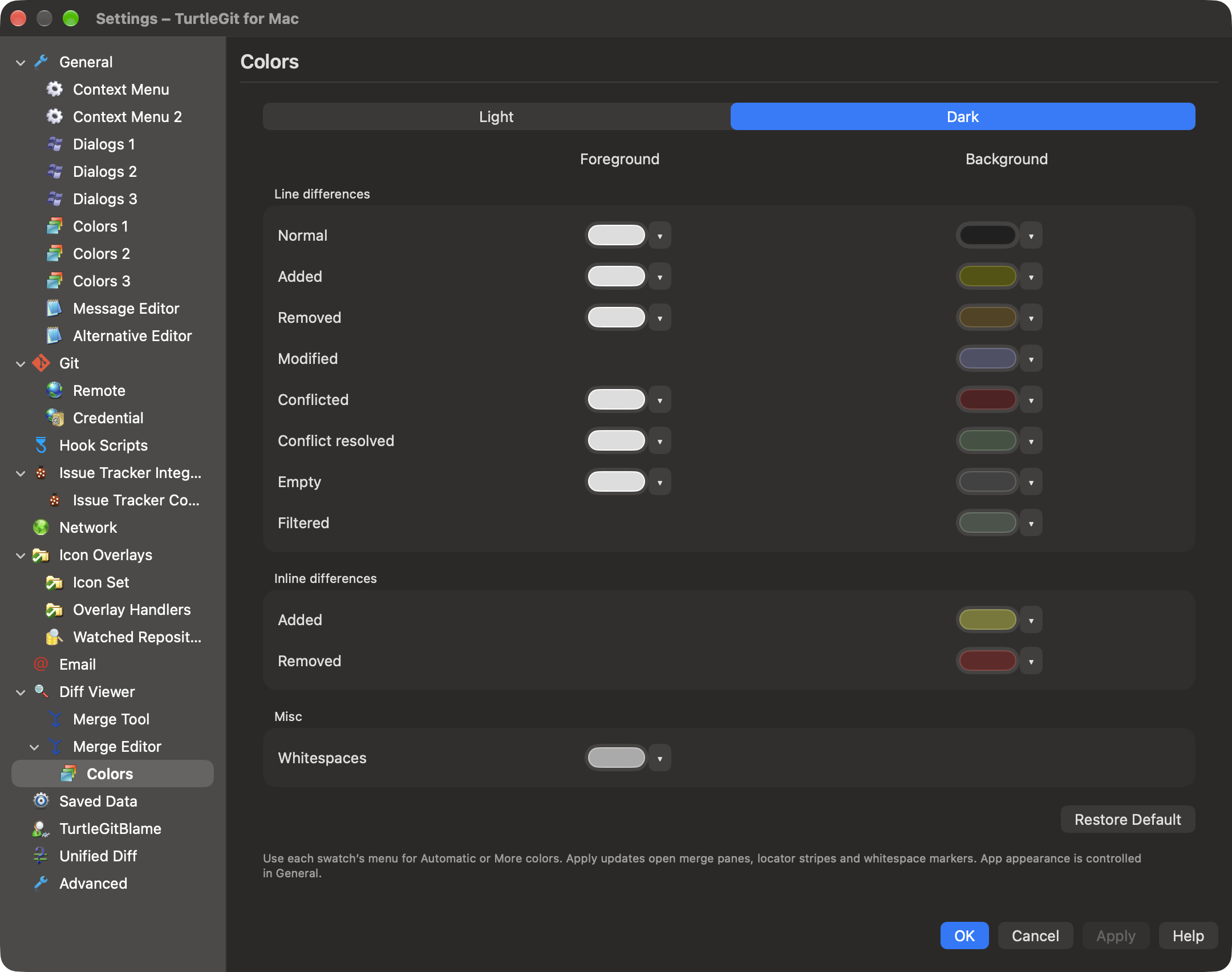
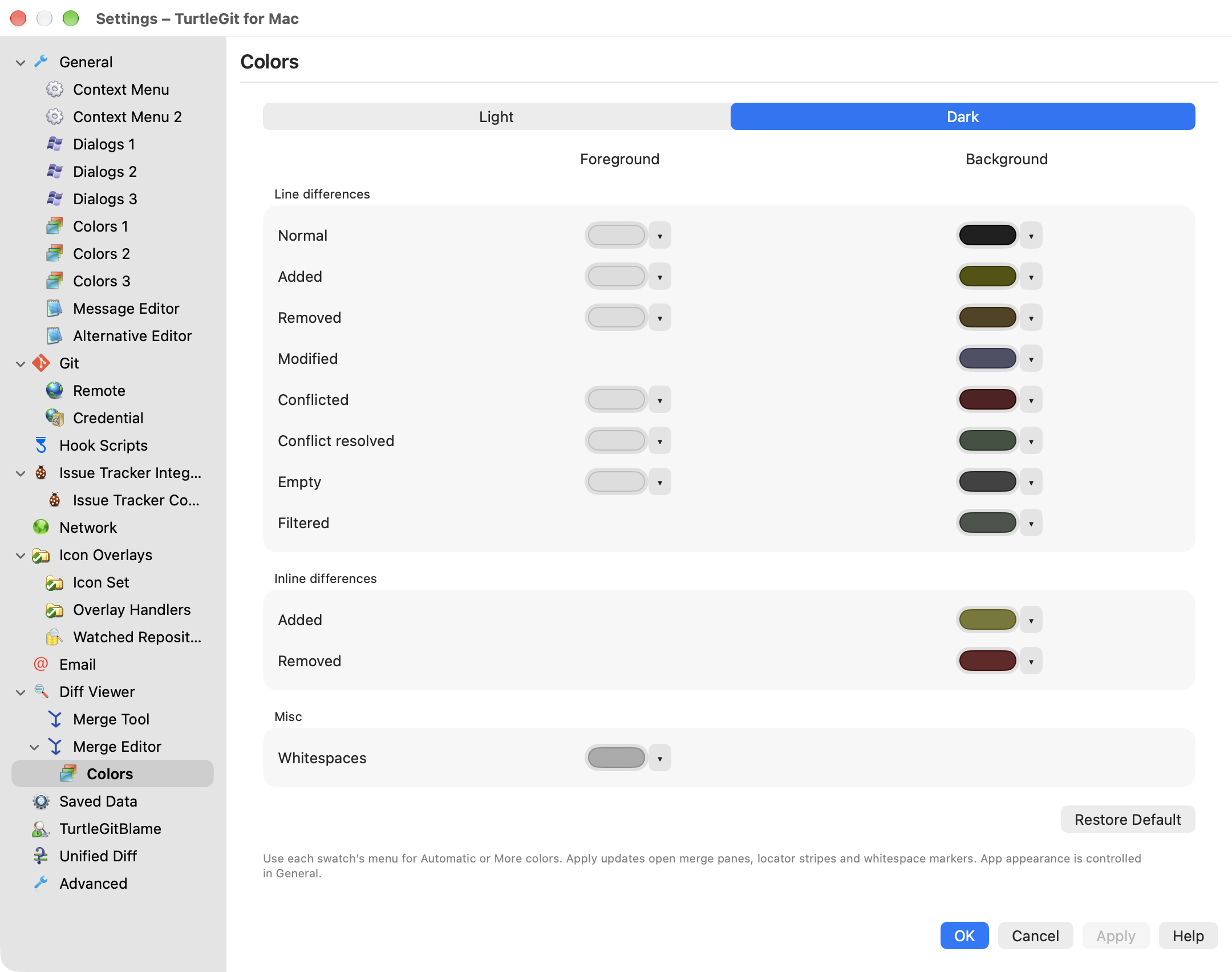
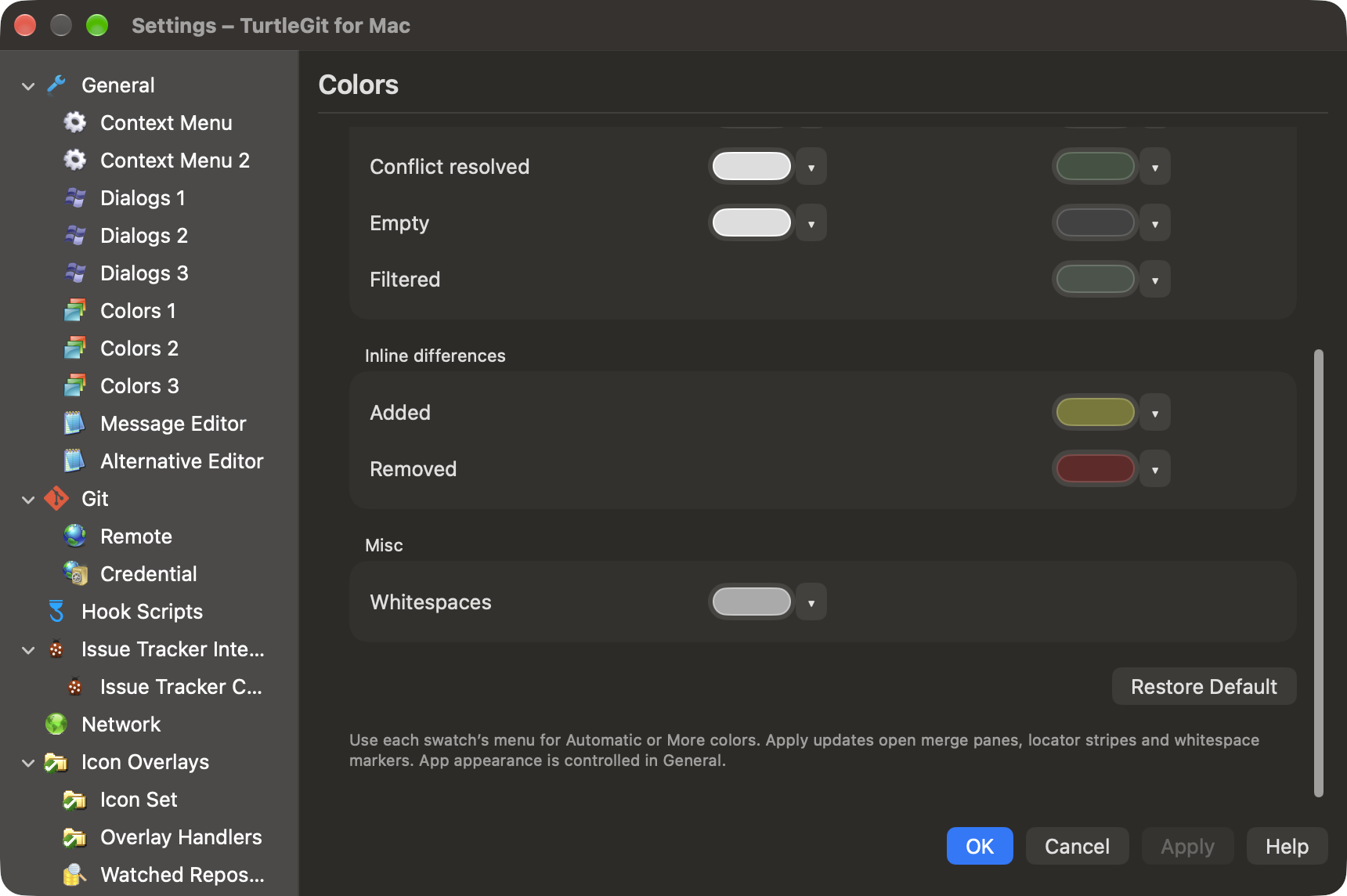
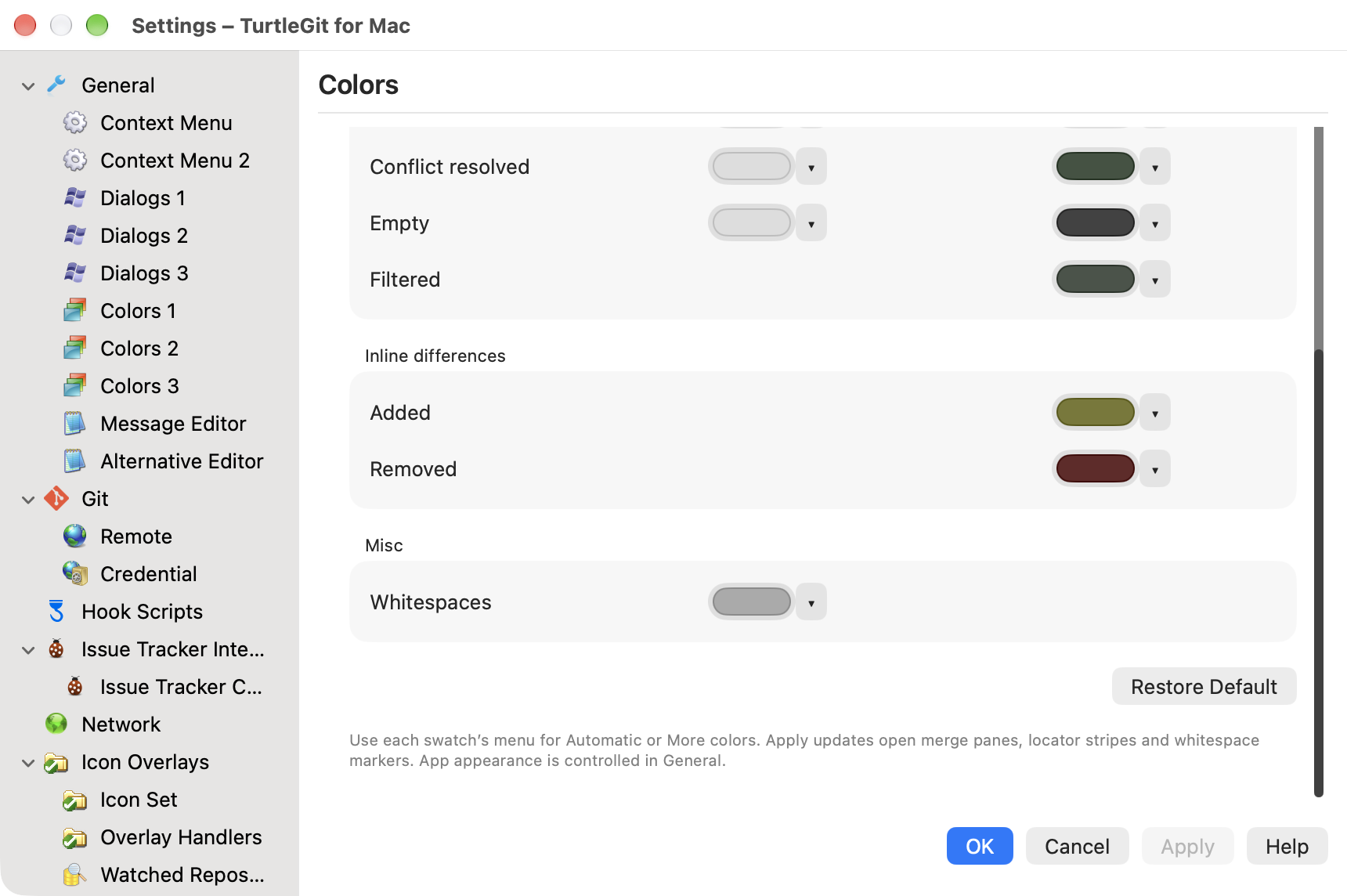
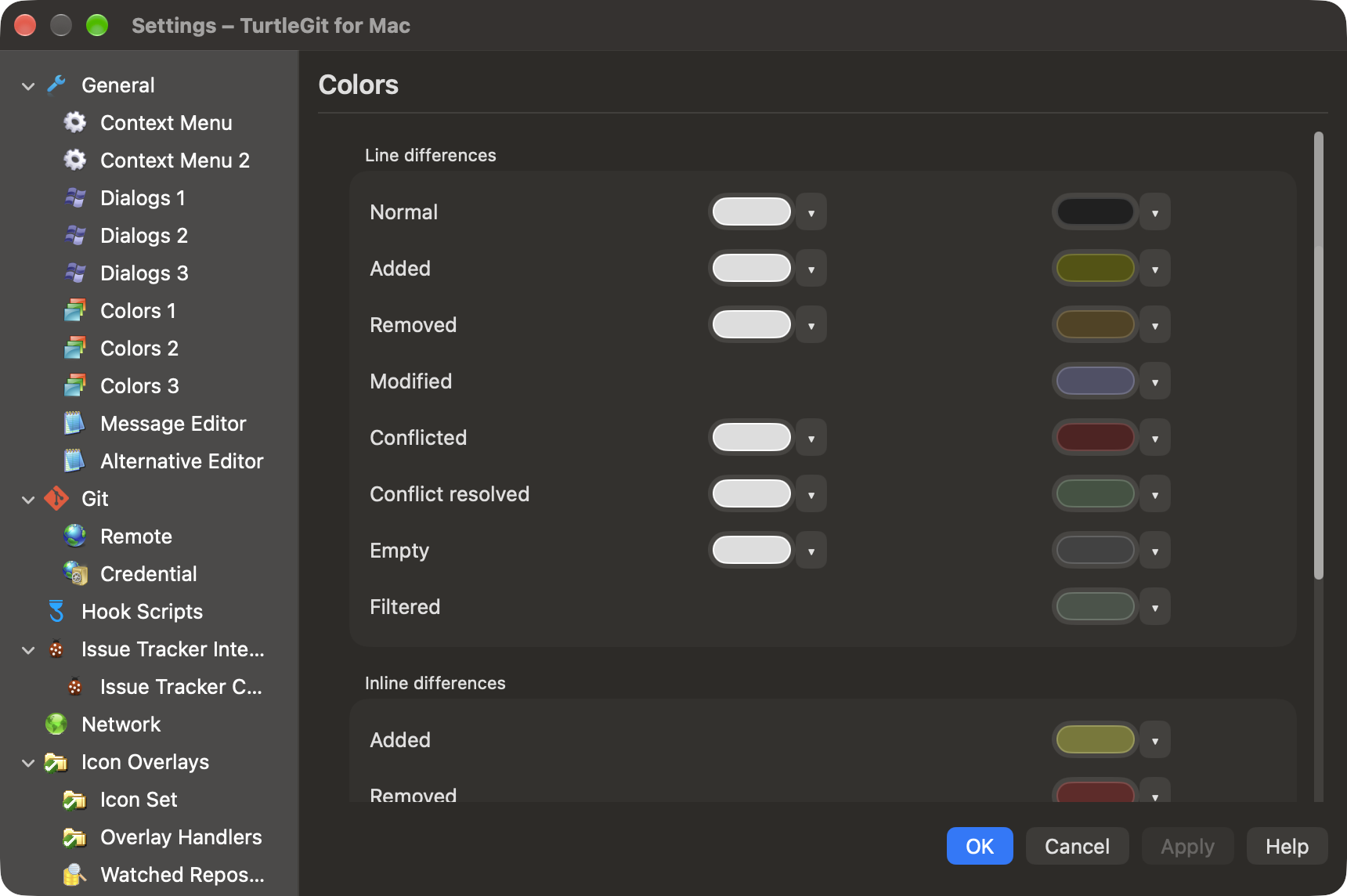
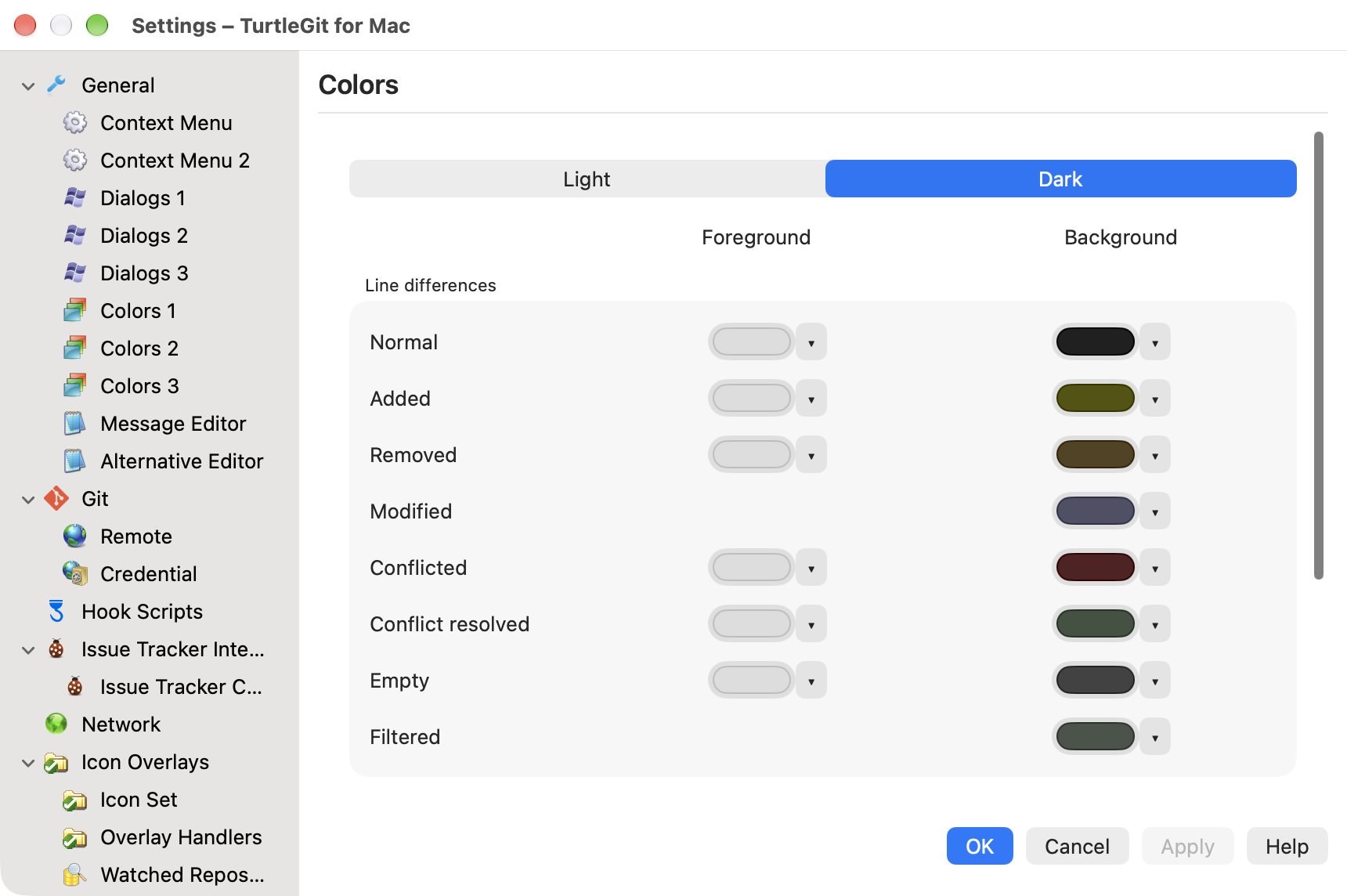
The normal-size Merge Colors frames below show the corrected nested heading and all color channels plus Restore Default. The smaller frames show different scroll positions while the heading and OK/Cancel/Apply/Help stay visible. Inner page scrolling retains its own position between appearance switches. These captures do not certify every Settings page or VoiceOver behavior.
Native footer containment after hosted failure — October 16, 2026
Hosted macOS run 38852442307 at 78bcdd06 passed its app/Finder build,
full Git integration suite and earlier native phases, then failed step 102,
Native Settings navigation and constrained layout: Footer button clipped at
small size: OK. The same original assertion passed locally before this change;
the exact hosted geometry has not been reproduced on this macOS version.
The native property-sheet stack previously had no outer insets. It now reserves 12 points around the right pane and 8 vertical points inside the footer, centers its controls and accounts for those insets in its width constraints. AppKit lays out alignment rects separately from a control's full frame; the reserved space keeps native button frames away from the sheet edges. The scrolling page keeps its existing minimum document size and cached origin. No footer control is removed.
The original full-frame containment assertion remains, with frame diagnostics and an additional four-point outer-space assertion for OK/Cancel/Apply/Help. The affected Debug build and one isolated native layout case passed. No Core, color-family or full application suite was repeated for this native layout change. The six reviewed captures above were refreshed from this run in both themes; they show normal size and different small-window scroll positions, with existing page-local scrolling retained across appearance changes. Older capture assets and QA records remain available as historical evidence.
See the hosted failure and local repair record. A new hosted pass, other macOS versions, full physical/VoiceOver and signed acceptance remain unverified. This does not certify every Settings page.
Source command pages and context ownership — October 18, 2026
settings /page:<pageName> now maps the pinned Settings.cpp source tree names
into the existing native page IDs, with case-sensitive Git-in-repository / General
outside defaults. Windows-only Win11 and repository-only unavailable pages fall
back as source selection does. The native administrator credential equivalent is
the regular Credential page. Explicit Remote entry suppresses the post-save Fetch
question and carries the owning preferences into the embedded Remote model.
Global Settings uses a bounded marker lookup before requiring Git. Repository entry authorizes source/metadata and uses captured workspace adoption/rollback. A changed context respects the existing Settings transaction guard. Idle source page jumps reuse the same window/cache and preserve modified page participants; active operations/children refuse navigation. Main-window closure cancels its preparation and adoption; transferred owners stay retained for actual drain. The common handoff now observes its supplied owner rather than a later workspace window. Utility evidence records actual checks and remaining physical/signed/complete-layout acceptance.
Ordinary workspace changes and Blame entry — October 23, 2026
Pinned SettingsCommand.cpp constructs the property sheet with its captured
repository path. The Mac workspace and modeless Settings coexist, so ordinary
Open Repository, Open Recent and Close Repository must enforce the same context
ownership already used by specialized command handoffs. A changed resolved root
now consults the existing Settings transaction before adoption. Same-root reloads,
including a selected subfolder resolving to that root, retain the current pages.
Discovery and selected-revision validation finish before publication; a refused
or failed opening restores the original workspace and monitoring without
replacing Settings drafts. A refusal uses the existing native Settings message,
not a second Git error.
Immediate Settings reopening also retains the requested initial page while the previous owner's asynchronous page cleanup drains. Page construction must retry for the current owner and context rather than leave an empty property sheet; closing or replacing that owner cancels the deferred request.
Both Blame Settings routes select the Blame page, as the pinned Blame process's
/page:blame command does. The shared action rejects retired, busy, Quit-owned or
child-blocked Blame owners. This is command/page fidelity rather than a complete
Blame or Settings certification.
The connected batch record distinguishes grouped native checks from physical acceptance. Two attempted shipping-GUI launches did not isolate the ordinary preference domain; they were closed without opening a repository or applying Settings. That attempt is not evidence of successful isolated physical acceptance. Existing preference data was preserved rather than deleted. Full physical keyboard/VoiceOver, signed entry points, minimum-version/Intel and hosted integration remain open.