 TurtleGit for Mac
Repository Browser parity audit
This is a partial native replacement, not complete TortoiseGit parity.
The pinned source is TortoiseGit 7338078f8ddd924b8cddee35f512f2286072136d.
The Git filename continuation covers
raw tree names, navigation, stored-object inspection and transfer refusal without
losing valid siblings. Its acceptance is recorded separately from older checks.
The upstream manual
and the source/resource controls were reviewed together.
Source and native mapping
| Source | Pinned blob | Native replacement |
|---|---|---|
| RepositoryBrowser.cpp | ced08d910b48b8c261fe7d131a409d4dc44875ac | RepositoryBrowser.swift, RepositoryBrowserWindow.swift |
| RepositoryBrowser.h | 7d315c6c04315e5251f5bceb1e6725f545bb67bf | Snapshot, entry, lazy directory and window models |
| Commands/RepositoryBrowserCommand.cpp | bba0566a3673b25916b9edfcadd8a6ecb7377710 | App/Finder action and Log-selected revision routing |
| Commands/RepositoryBrowserCommand.h | 6bc4baecacb22d418706bacea7024531ab73ee44 | RepositoryAction.repositoryBrowser |
| TortoiseProcENG.rc IDD_REPOSITORY_BROWSER | See upstream-files.csv resource pin | Read-only Path, revision button, folder tree, contents list, information, OK/Cancel/Help |
Original menurepobrowse, executable, symlink and external overlay icons remain unchanged; exact source blobs are recorded in the icon provenance manifest. Normal macOS file-type and folder icons replace Windows shell file-type icons. Source notices and GPL-2.0-or-later attribution are retained.
Implemented behavior
The native window follows the source tree-left/list-right arrangement. An AppKit split controller provides a draggable divider and autosave identifier. The list has Name, Extension and right-aligned Size columns. The initial 1000×650 content size was corrected after native testing exposed hidden names at the minimum size. The revision button opens a single-selection Log sheet; changing its revision retains the current directory if it exists. Return in the contents table opens one file or enters one folder; F5 refreshes without overriding an attached sheet.
Directory contents load lazily using NUL-delimited ls-tree -l, with exact blob
bytes fetched by object ID. A snapshot pins the peeled revision and root tree so
moving HEAD cannot change an already displayed directory. Annotated tags, bare
repositories, tree object IDs and unborn HEAD are handled. Executable, symlink
and submodule modes remain distinct. Binary files, Unicode, tabs, newlines,
colon-containing directories and pathspec-like filenames are tested. Size and
object hashes come from the tree, not working files.
Folders stay first in both sort directions. Numeric/case-insensitive names use native comparison. The upstream extension-sort name tie compares the right name with itself; its subsequent size/name tie order is retained explicitly. macOS locale comparison and byte-size formatting can differ from Windows.
File menus use the original command icons: Open, Open With, alternative editor, working-tree comparison, Show log, Blame, Save revision to, Revert to this revision, Mark for comparison, Compare with marked file, copy names and copy hashes. Directory menus provide navigation, Log and copying. A marked historical file retains its path and peeled revision when the browser changes revision; comparison uses the existing native two-pane editor. An existing scoped working-file mark can also be imported. The upstream source copies basenames despite the manual describing full paths; native copying preserves basenames and source CRLF records: names have a trailing CRLF, while hashes have separators without a trailing CRLF.
Opening a submodule from a working repository resolves its initialized checkout
and browses the recorded child revision, or offers the existing Update window
when unavailable. Bare/submodule Open With produces the source-style plain text
Subproject commit <hash> preview. Historical previews are read-only temporary
files retained by the app; Save writes the exact selected blob bytes. Sandbox
access checks and leases protect reads and historical comparison handoffs.
Historical drag representations
RecursivelyAdd/BeginDrag and the historical file-content/descriptors branch of
GitDataObject.cpp were audited. The pinned data-object blobs are
3ba63178f14e6f9102f87a9a7d97080c8162282c (cpp) and
2d75b20c4a079a6eb3feaaea3101ef6fd661ab87 (header). Other consumers and Windows
clipboard formats remain partial, not replaced by this one browser integration.
The native contents table now provides an item provider for each draggable row; folder-tree labels also provide pinned directory exports. The implementation uses Apple's table-row item providers and file representations with original suggested names and file/folder content types. Generation is deferred until a receiver requests a representation. This implements native drag data; it does not establish Finder drag acceptance yet.
The Core exporter reads only the snapshot's pinned blobs into a private temporary container. A selected folder retains its name and recursive relative paths, while the displayed directory can be exported for a tree drag. Gitlinks are skipped, matching the source's IsDirectory descriptor exclusion. Symlink blobs become regular files containing exact target text; no target is followed. Binary bytes and unusual names remain unchanged. Empty export selections fail instead of promising nonexistent files. Exported executable files retain executable bits as a macOS adaptation to the source's ordinary Windows file attributes.
Load callbacks retain the repository permission on the main actor, revalidate Store scope and hold exports until app cleanup. The application removes its own export containers on normal Quit, and active representation loads block Quit. Progress cancellation is checked at file boundaries; an in-flight Git read is not terminated. Failed/cancelled generation removes the private partial container. Window closure can precede completion because the provider retains its own lease and pinned snapshot. Signed transfers and cancellation/quit timing need acceptance.
Two additional Core integration tests bring RepositoryBrowserTests to nine passing
cases. They verify pinned recursive binary contents after HEAD advances, Unicode/
colon/tab/newline names, plain symlink text, skipped gitlinks, current-directory
export, exact single-file names, explicit cleanup, foreign selection rejection,
pre-cancelled export and unchanged index/working contents. The production provider
was also compiled into a native receiver check: both file and folder NSItemProvider
callbacks delivered exact pinned binary bytes while preserving HEAD/index/working
contents. This is a real Foundation transport check, not a Finder test.
Run scripts/verify-browser-item-provider.sh; it creates and cleans up its own
fixture without launching a GUI app. The same receiver check is wired into the
macOS workflow after Core tests; its remote execution is pending publication.
Final Debug/Store builds and bundle audits passed. See export evidence.
Parent and child submodule history
A single gitlink now has both source commands: Show log opens the selected path in the superproject at the displayed parent revision; Show submodule log opens the child repository at the displayed gitlink hash. The child checkout's current HEAD does not override this hash. The new Core resolution API validates that the entry belongs to the displayed snapshot, is a gitlink and resolves to the same recorded hash. Existing child-checkout containment checks remain in effect.
The native handoff shares this resolution with Open. An unavailable Open retains the Update/Cancel sheet; unavailable child Log shows an explanatory error and performs no update/fetch. The source child-Log command also does not dispatch Submodule Update automatically. Bare repositories have no child working checkout; the native command reports selection unavailability. Reads retain the parent scope lease, validate Store access and suppress the handoff if the parent browser closes. The child viewer uses the inherited Git runtime and lease.
Two additional integration tests exercise pinned history after the parent gitlink and child HEAD move, exact parent/child index and dirty-file preservation, ordinary entry rejection, missing/unrelated child repositories and bare rejection. Combined RepositoryBrowserTests/SubmoduleComparisonTests pass 17 cases, zero failures. Final Debug and Store builds and complete bundle audits passed. These are targeted checks; no new full-suite run is claimed.
Native acceptance opened Show submodule log at the recorded old gitlink and confirmed that only the pinned child commit appeared, excluding the newer child HEAD. Parent and child HEADs, raw index hashes and uncommitted child bytes remained unchanged. UI observation timed out during the subsequent close; normal Cmd-Q on the same live process succeeded, and the final process scan was empty. Further parent-Log, unavailable-Log and Open/update native acceptance remains pending. No new screenshot was captured. See submodule evidence.
Revert to the displayed revision
For one or multiple selected ordinary files in a working repository, Revert uses
git checkout --end-of-options <pinned object> -- <literal path> for each file.
It updates both the index and working file without moving HEAD. Folders, gitlinks,
bare repositories and entries from a different listing are rejected. Destination
validation rejects paths through an ancestor symlink outside the repository or
inside Git administration directories. Argument arrays and literal pathspecs
preserve unusual names. Unlike the status-dialog Revert, this historical command
does not move replaced contents to Trash; that matches RepositoryBrowser.cpp.
Files are processed in displayed selection order. A native per-file error sheet provides Continue/Cancel, and the final result reports successes, failures and unattempted files. The source increments its reported count even after a failed checkout when OK is chosen; the native adaptation reports only successful Git operations. It restores the displayed pinned object rather than re-resolving a branch/tag that may have moved while the browser was open. These adaptations preserve the selected historical content and avoid an inaccurate success message.
Closing/Quitting is blocked during the mutation; quit-confirmation disables browser actions. Leases remain held through the sequence and each file revalidates Store scope. Completion refreshes existing Working Tree/Commit/workspace views. Earlier successful files remain restored if a later file fails or is cancelled, matching the source's per-file sequence rather than an atomic batch.
Verification on 2026-10-05
The original four RepositoryBrowserTests exercise tree modes and exact bytes, pinned nested reads after HEAD moves, annotated tags/bare/tree/unborn handling, sorting and malformed records. FinderRequestTests adds action/selection URL round-trip and bare-repository eligibility. The focused browser/Finder/submodule run passed 19 tests; the complete Core suite passed 415 tests, zero failures. These are Core checks, not a claim that all native dialog behavior is covered. Final window sizing and comparison wiring were built and checked separately in the native app.
Debug and App Store configuration builds succeeded. Both bundle audits passed: 71 original icon resources, Finder extension and licenses, universal helpers; the Store bundle additionally includes the audited universal Git 2.55.0 runtime. This is unsigned build evidence, not App Store signing or acceptance.
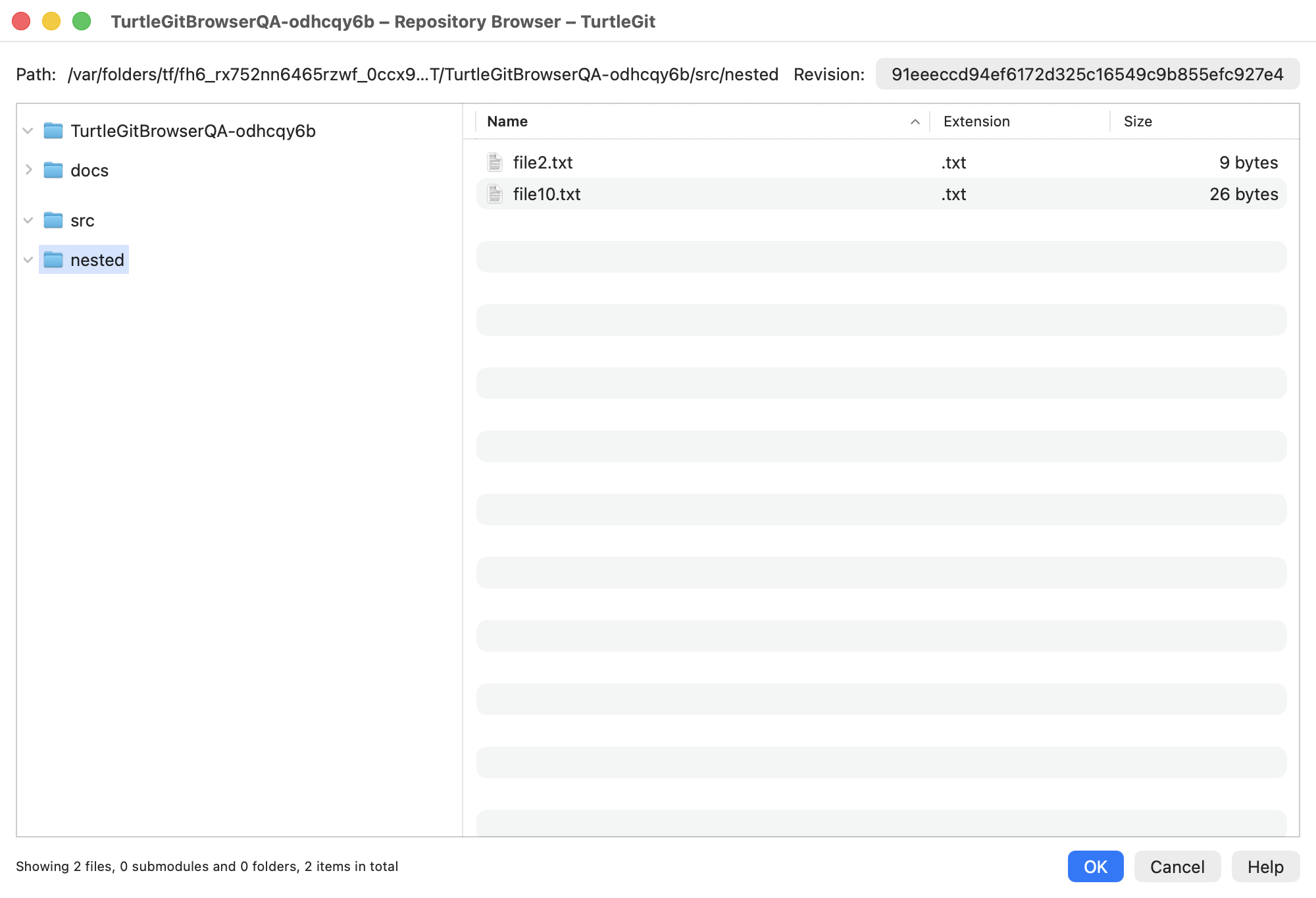
Native acceptance used an owned disposable repository with two revisions and a separate uncommitted file. Return entered src and nested directories; natural ordering showed file2 before file10. File context commands appeared. A file was marked at the latest revision, the Log picker selected the older revision by keyboard, and Compare with marked file opened exact Latest/First historical contents in the read-only two-pane editor. The mark survived revision changes. HEAD, raw index SHA-256 and working-file SHA-256 remained unchanged afterward. The initial pane-width problem was corrected and all columns became visible. Executable/symlink overlays were inspected in the root view. A real native light screenshot was saved and inspected; dark-mode acceptance remains pending. Three additional Revert integration tests now bring RepositoryBrowserTests to seven passing cases. They verify pinned annotated-tag restoration after the tag moves, binary/literal names, executable and symlink modes, exact index entries, unrelated staged preservation, folder/gitlink/foreign/bare rejection, an escaping ancestor symlink and index-lock failure/recovery. The focused seven-test run passed with zero failures; the earlier 415-test full suite predates this mutation. Final Debug/Store builds and audits passed after the new command was added.
Native Revert acceptance used a separate disposable repository with different staged/working contents. A deliberate index lock produced the expected error; Cancel yielded zero successes with raw index and both working files unchanged. After removing only the owned test lock, Revert reported one success and restored exact HEAD bytes into both index and working file. HEAD, the unselected working file and unrelated staged file remained unchanged. Continue was activated through the default error-sheet action, yielding an accurate zero-success result. Native multi-file error sequencing remains unverified because selected-row context-menu automation returned ambiguous-element errors; this is not counted as a pass. The final result screenshot attempt failed with a macOS recording-stream error; no new Revert screenshot is claimed. The earlier light browser screenshot is kept. See Revert evidence.
Every QA app was closed using normal Quit, with a final empty process scan. See structured evidence.
Remaining parity work
- Physical multi-file Revert pointer/menu acceptance; the later lifecycle batch adds grouped native real Continue/Cancel and duplicate-operation checks.
- Actual Finder and other-app drops, multi-selected row drags, tree/root drag acceptance and file-object clipboard interoperability. Native historical item representations and file/folder receivers are implemented and checked.
- Broader native parent/child Log and initialized/missing child Open/update acceptance. Separate child Log and its pinned read-only routing are now implemented.
- Historical tree-object comparisons are implemented in the October 15 tree handoff batch below. Tree objects have no commit history; Log/Blame explain that a commit or tag is needed instead of dispatching a failing history read.
- Complete Open With, alternative editor, Save, Blame and working comparison acceptance from this window, plus imported Finder comparison marks.
- Complete physical column/divider/frame acceptance, full keyboard selection, accessibility and large repositories. False disclosure arrows for loaded leaf folders and refresh ancestry are addressed by the October 13 lifecycle batch.
- Native dark appearance, signed Finder invocation and Store security scopes.
- Full signed/physical cancellation acceptance; the October 13 lifecycle batch adds Git token propagation, process reaping and closed-window request ownership.
- The earlier invalid UTF-8 path/mode policy gap is superseded by the namespace continuation: byte identity, tree-OID navigation, stored-object inspection and explicit unrepresentable filesystem-action refusal are implemented. Full raw-byte delivery remains open.
The source inventory keeps this dialog and command files partial. The complete application, all source commands and App Store distribution remain unfinished.
Pinned restore compatibility and CI receiver check
Browser file Revert now passes the pinned hexadecimal object directly to Git checkout, followed by -- and the literal path. Git 2.37 rejects checkout's newer --end-of-options syntax; the restore regression reproduced that failure before the change. Object validation rejects option-like strings, symbolic revisions and short hashes before mutation. Both 40-character SHA-1 and 64-character SHA-256 object IDs remain supported. The restore fixture covers moved-tag pinning, binary bytes, symlink/executable modes, unrelated staged content, unchanged HEAD, index locks and unsafe/foreign selections, plus a real SHA-256 repository.
The item-provider verification script also had a malformed compiler output argument joined to a duplicated Python receiver command. It now builds the receiver inside its owned temporary directory and runs it once with a bounded 60-second timeout. This is the script invoked by the macOS GitHub Actions workflow; local execution does not establish hosted CI success. No GUI app/Finder instance is launched by this receiver.
Browser navigation and operation ownership — October 13, 2026
This batch follows RepositoryBrowser.cpp Refresh, ReadTree, the Open/Save/Revert menu branches, per-file Continue/Cancel and Enter/F5/Select All routes. Upstream Refresh returns to root. The native browser deliberately retains its current folder, loaded expanded ancestors and still-present selected paths, extending its existing folder-retention behavior. Changed revisions rebuild those ancestors from the new pinned tree; removed folders fall back to the nearest surviving ancestor. Known-loaded folders without child directories no longer show a false disclosure arrow. Command-A and Command-C work in the contents table.
Root resolution, tree reads, blob Open/Save, recursive exports, per-file restore, and submodule metadata now pass cancellation into every Git process. Refresh cancels superseded reads; owner retirement cancels all owned requests. Request counts retain Quit protection until the process actually settles, including after a closed browser leaves the visible-window registry. Superseded and closed results cannot display files, errors, completion summaries or refresh callbacks. The data APIs retain default arguments for existing callers.
Submodule Open/Log reads are now owned by the browser model, with captured pinned entries. Missing-child Update offers, Open With, Save and per-file failure/result sheets are owned by the controller and ended on forced closure. Modal replies check the owner's lifetime and revision generation before writing or handing off. Completed files in a partially cancelled restore remain restored; cancellation does not claim rollback. Ordinary close remains blocked during mutations/sheets. Historical item providers can outlive the browser by design; receiver cancellation now reaches directory traversal and each blob read as well as the export loop.
Multi-file Revert retains source ordering, one Continue/Cancel question per failed
file, duplicate-operation exclusion and a summary of restored/failed/unattempted
files. Native verification exercises real index-lock failures and subsequent
success, rather than replacing Git with a successful stub. Validation is recorded
in qa/repository-browser-lifecycle-2026-10-13.json after execution.
Column-choice persistence, multi-row/tree/root drag interoperability, invalid path byte policy, tree-object Log/Blame handoffs, full visual/accessibility acceptance, physical Finder and signed sandbox/App Store acceptance remain open. This batch does not establish complete Repository Browser or application parity.
The Debug build and 22 focused Core tests passed. The grouped native browser receiver passed with system and packaged Git, including four live blocked-process phases on each engine and actual owned file/failure-sheet retirement. Both receivers were reaped and independently checked absent. Earlier compile attempts failed on an internal cancellation API and a shadowed error assignment (the latter triggered a Swift compiler assertion); both were corrected before the passing run. Physical pointer/menu acceptance and signed acceptance remain open.
The unsigned App Store build and its --require-git bundle audit passed. The
website build passed. This does not establish signed sandbox execution, App Store
review or a complete hosted CI run.
Native contents table and historical multi-row drag — October 13, 2026
RepositoryBrowser.cpp supplies three columns through ColumnManager (version 6): Name, Extension and Size. The native contents list now uses NSTableView with multiple selection, a source-ordered file menu, original context artwork, header sorting, right-aligned sizes and executable/symlink/gitlink badges. Right-clicking an unselected row targets that row; clicking an already-selected row retains the multi-selection. Double-click and the existing window Enter/Command-A/Command-C routes operate on the same selection model.
The header saves visibility, physical order and native widths independently under RepositoryBrowser.Columns. Name remains visible; missing/incompatible settings restore defaults, unknown columns and invalid widths are rejected, duplicates are normalized, and widths are bounded. Divider double-click fits content; Shift includes the heading. Reset asks No/Yes through the owned controller sheet; parallel/reset/refresh changes are blocked, and retired answers cannot rewrite preferences. Native defaults are sized for macOS controls rather than Windows DPI pixels. Full pixel/keyboard/accessibility acceptance remains separate.
Each selected ordinary row supplies a separate NSFilePromiseProvider. Folder rows deliver their hierarchy; file rows preserve pinned bytes and modes. Providers retain their immutable snapshot, item and security-scope lease independently of the browser. Native promises write only to the supplied receiver URL, stage an owned temporary sibling, refuse an existing destination and remove staging on failure. Exported temporary trees are discarded after delivery; active deliveries retain the application's existing Quit protection. Tree and root rows now use the same native file promises through an AppKit folder button, including pinned directory data and delivery after owner close. Legacy item-provider entry points remain available. Gitlink rows are not yet promised as standalone items.
The SDK delegate contract and pinned upstream multi-selection/recursive drag
implementation were reviewed. Private delegate deliveries establish historical
bytes, ownership and collision preservation, not actual Finder/other-app drag
interoperability or signed sandbox destination access. Validation and inspected
captures are recorded in qa/repository-browser-table-2026-10-13.json.
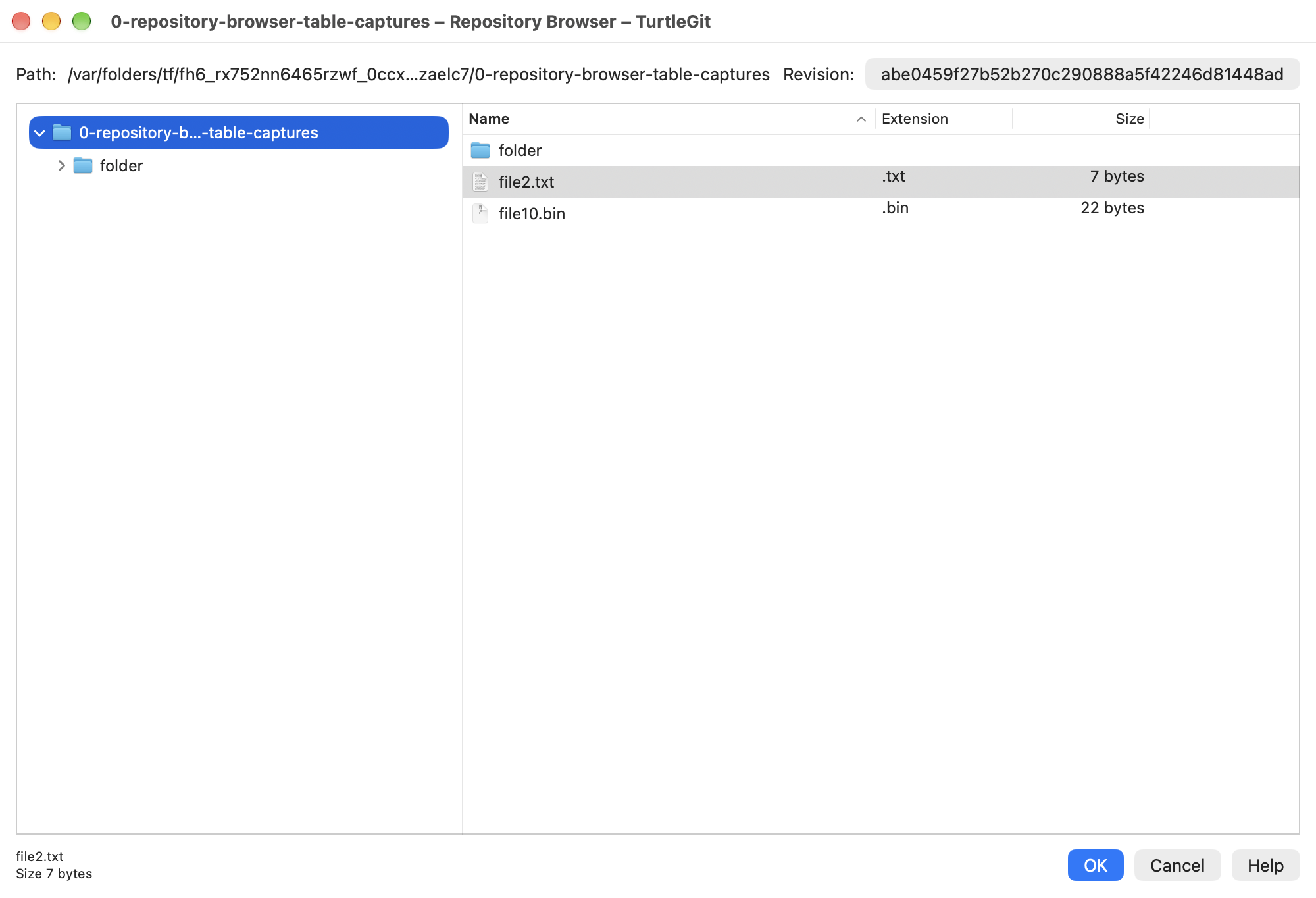
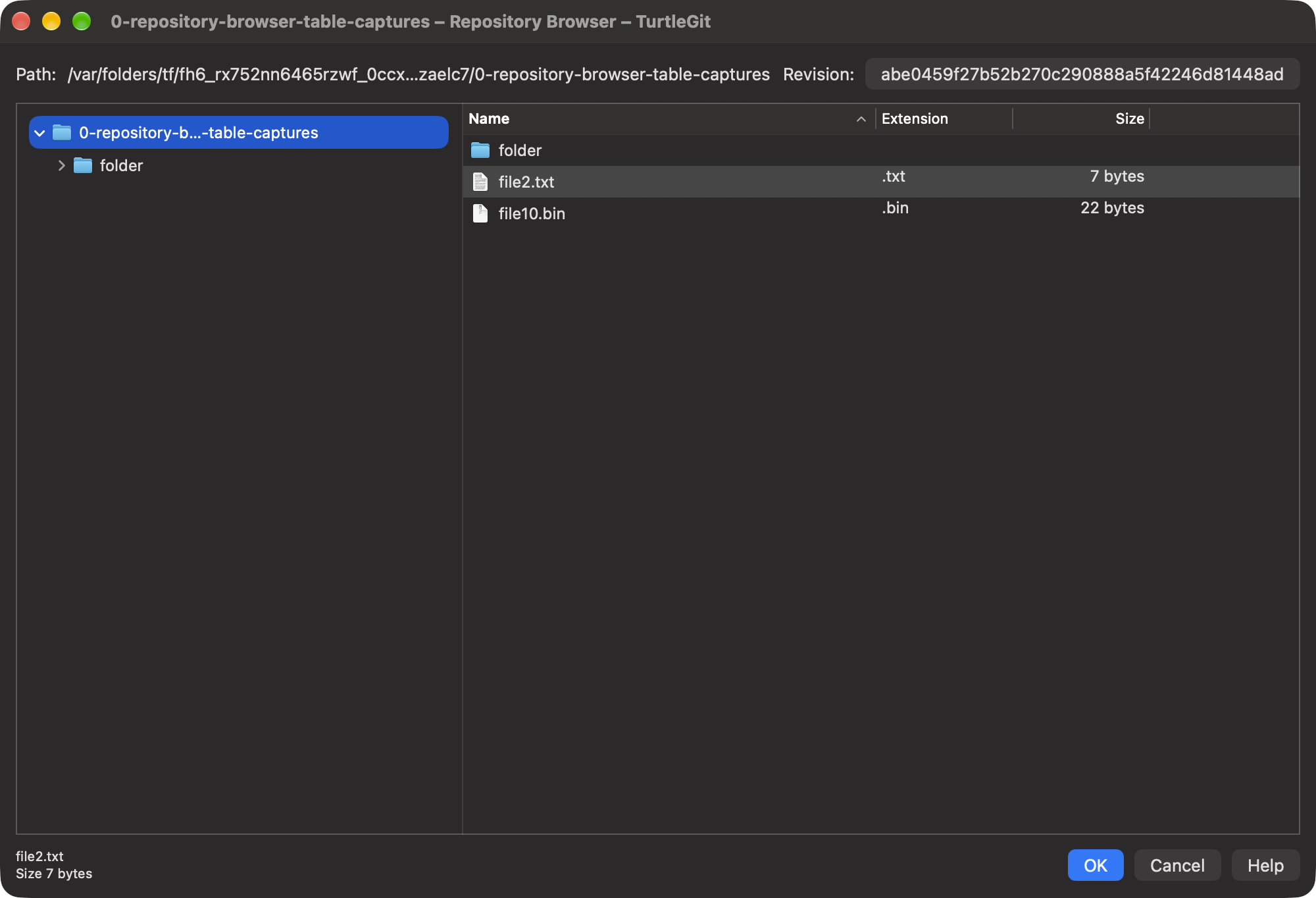
Twelve focused Core tests and four grouped native table/lifetime checks passed with system and packaged Git. Both actual 2000-by-1364 captures were individually reviewed against the pinned source screenshot: tree/list split, Path/Revision, three-column header, size alignment, selection and footer/buttons in both themes. Native menu conditions, original command artwork, persistence/reset and pinned promise deliveries were checked separately. Physical drag/session and full menu/keyboard/accessibility acceptance remain open. All owned receivers were reaped and independently verified absent.
Debug and unsigned App Store builds passed, as did the website build. The prior bundle/runtime audit was not repeated for this table/persistence/promise batch. Signed destination grants and App Store acceptance remain unverified.
Tree/list action and promise batch — October 13, 2026
Folder tree menus expose Open, Show log, Copy to clipboard and Copy hash, with the original command artwork. Folder hashes come from pinned tree entries; the root hash is the root tree, rather than the commit. Log/Blame handoffs retain the upstream revision object unchanged; full tree-object history behavior remains open.
Native list menu items retain their displayed entries and comparison mark. A later selection change cannot redirect an existing menu action. Browser refresh, navigation (including leaving and returning), closure and busy/modal state refuse retired actions. Direct keyboard and double-click operations continue to use the current selection. Empty or invalid clipboard selections preserve existing pasteboard contents.
Folder/root drag gestures use an AppKit promised-file source and share deferred pinned export, scope retention, collision refusal and cleanup with the contents list. Delegate delivery acceptance is recorded in the batch QA record; physical drag, Finder interoperability, signed scope delivery and complete keyboard/accessibility acceptance remain open.
The connected action batch passed one Debug build and four grouped native cases (table/actions and lifecycle, each with system and bundled Git). The checks cover captured menu targets after selection changes, navigation and busy refusal, exact clipboard records, folder/root tree hashes, and pinned root/folder delivery after branch movement and owner close. All four owned receivers were reaped and checked absent. Core was unchanged and was not rerun. The website build passed. See action-batch evidence.
The connected historical transfer batch separates folder-button UI from the standalone transport compiled by CI. Item-provider exports now follow provider lifetime instead of accumulating until Quit; queued/running delivery accounting, Progress cancellation and coordinated exclusive receiver writes are shared across file/folder/root handoffs. See historical transfer parity for exact ownership, the observed CI step, local results and remaining physical/ signed acceptance.
Native folder tree — October 15, 2026
The left pane now uses NSOutlineView, replacing the nested disclosure/button implementation. This restores standard native tree selection, arrow-key expansion and navigation, type-to-select, Return/double-click opening and Command-C folder name copying. The browser window's file-table shortcuts exclude the outline, so folder Return and Copy cannot accidentally operate on the contents selection.
Folder nodes keep stable path identities while directory listings load lazily. Expanding a folder requests its pinned listing; loaded leaves lose their disclosure arrow. Selection updates the right pane, and list navigation/refresh restores the matching tree row and expanded folders. The outline uses a native folder icon, selection appearance, scrolling, path tooltips and an accessible pane label.
Right-click targets the folder row without navigating the contents pane. Its Open, Show log, Copy to clipboard and Copy hash actions use the original command artwork and captured pinned menu targets. Navigation, refresh and retired owners reject old actions. Root/folder rows expose NSFilePromiseProvider through the outline's native drag delegate, retaining the existing pinned historical export, receiver collision refusal and permission lifetime. Actual Finder drag acceptance and signed destination access remain separate.
The source comparison is RepositoryBrowser.cpp's RepoTree registration, OnContextMenu_RepoTree/ShowContextMenu, ReadTree/FillListCtrlForTreeNode, refresh and historical drag behavior at the pinned commit. AppKit supplies macOS tree keyboard/selection behavior in place of Windows common controls. Full physical keyboard/VoiceOver and visual parity acceptance are not inferred from delegate tests.
The Debug build and four grouped browser table/lifecycle checks passed on system and bundled Git. After a sheet-state correction, the affected table/capture cases passed again on bundled Git. The fixture needed an explicit synchronous sheet completion signature; production code did not change for that fixture correction. Core behavior is unchanged and was not rerun. All six owned receivers were reaped. See qa/repository-browser-folder-tree-2026-10-15.json for exact scope and limits.
Both captures were inspected against the pinned upstream RepoBrowser.png. They show the native folder tree alongside the source-style path/revision, contents columns and footer layout. These private fixtures contain representative folders and files, not a claim of full physical or accessibility acceptance.
Standalone tree comparison handoffs — October 15, 2026
Repository Browser accepts commits, annotated tags and standalone trees. The comparison family now accepts the same snapshot objects: selected historical files against working bytes, marked historical paths against other historical or working paths, imported external working files, full revision comparisons, selected raw patch export, and historical Save As reads. Annotated tags peel to their underlying commit or tree. Blob objects and invalid revisions are rejected. A standalone tree stays pinned to its object ID even when references move; the code never substitutes a commit containing similar content.
Changed Files displays a tree's short hash and Tree, with a tooltip explaining that it has no commit metadata. It leaves author/date fields empty and does not claim a newer commit date. Common-ancestor mode keeps a direct comparison when one side is a tree. Forward/reverse diffs and working bytes use the existing Git diff pipeline, literal paths, raw patch data and cancellation tokens.
The pinned source's eCmd_CompareWC, eCmd_ViewLog and eCmd_Blame handlers pass
the browser revision to their downstream helpers. Git trees themselves have no
parent commits or attribution. Browser Log/Blame and Changed Files history actions
therefore explain that the user must choose a commit or tag; they do not launch
an invalid tree-as-commit request or invent history. A tag pointing to a tree has
the same limitation. Commit-backed history routes retain their existing behavior.
Grouped Core/native evidence is recorded in tree comparison QA. The native receiver exercises browser working/marked callbacks, downstream blob reads, Changed Files metadata/history guards and owned window cleanup. Assigning light and dark appearances is a host check, not visual screenshot certification. Signed Finder invocation, physical drag/drop, complete accessibility and full source-dialog visual parity remain separate acceptance work.
Exact historical Unicode path identities — October 16, 2026
Git can store precomposed and decomposed names as distinct UTF-8 paths. Swift String equality treats canonical equivalents as equal, so it cannot key browser selection, directory caches, expansion state or outline nodes. The browser now uses byte-keyed path maps/sets and opaque byte-derived entry IDs. Entry equality, folder matching and captured directory checks use the same exact identity. Names and copied path text keep the original Unicode spelling. Root/folder refresh retains both aliases and their separate pinned listings.
Historical blob reads and single-item exports keep the selected object ID and bytes. Raw tree path resolution and checkout disable Git's macOS argument precomposition for that command only. Recursive export creates each directory exclusively: if the destination volume aliases two directory names, export fails and removes its private partial container instead of merging their children. Existing exclusive file writes continue to refuse file collisions.
Working-folder comparisons, submodule resolution and Revert check the Git index's raw path prefixes. A different tracked path with the same canonical Unicode spelling refuses the action before reading a potentially different working item or changing the index/work tree. Exact ordinary paths still work. This policy covers tracked aliases; complete untracked/ignored filesystem collision handling, case-only aliases and raw invalid-UTF8 paths remain separate work. Working comparison preflight is cancellable, owns its scope/request and refuses callbacks after navigation or retirement.
This is a macOS path-identity correction rather than a new source menu. The pinned RepositoryBrowser.cpp/GitDataObject workflows pass exact tree entries to historical actions; native Unicode equivalence must not redirect those entries. Complete Finder/file-object clipboard, physical accessibility, very large trees, signed scope and App Store acceptance remain unverified.
Path identity evidence records the 15 passing Core tests, native cases on both Git engines, initial fixture API/argv failures and focused repairs, actual receiver cleanup and hosted CI gate progress.
Revision picker, labels and captured actions — October 16, 2026
The source Revision button opens a single-selection Log without a working-tree row. The native picker now receives the initial pinned object before its first load, the browser's own preferences and inherited appearance/opacity. The shared repository configuration connects its Log inspection, comparison, transport, reference and history-operation callbacks just as for other selectable Logs. The shared selectable-Log factory also now supplies previously absent Format Patch, Browse Repository, containing-reference Log, historical/marked/file-pair comparisons, file/submodule Log and Blame routes. Mutations refresh repository Logs, Working Tree, Commit and Rebase consumers. Other configured picker consumers receive those same routes; each comparison retains its owning Log window and repository lease. Callback registration is covered by the native check; every downstream route is not separately exercised by this batch. One owned picker may exist at a time. Parent navigation, refresh, file actions, columns and copying are blocked while it is open. Cancel retains the snapshot; OK refreshes at the captured commit and retains an existing folder. A generation and picker-identity fence rejects replies after forced closure or replacement.
ReadTree replaces an exact hash label with the first sorted friendly reference. The native header now displays the same metadata, including annotated-tag dereference suffixes. Symbolic input labels remain symbolic; missing references fall back to the original hash. This label does not rewrite the snapshot's pinned identity or its stored revision request. The tooltip includes the pinned object. That separation retains historical bytes if a branch/tag moves while the browser is open. Reference reads use the same cancellation/request/Quit lifetime as tree refresh; a failed read reports its error while retaining the successfully read tree.
Folder information now includes the current folder name alongside source-style file/submodule/folder totals. Tree and contents popup invocations are captured, single-use actions, retaining the displayed target even if selection changes before dispatch. Navigation/reload/closure still reject stale captures. Both clipboard routes use the owner's pasteboard, permitting private native verification without changing system clipboard contents.
Grouped evidence records the validation and any repairs. No new screenshot, physical picker/menu/keyboard/VoiceOver claim, signed scope acceptance or full Browser parity is inferred from these checks.
Scoped presentation and native command family — October 16, 2026
RepositoryBrowser's SaveDividerPosition/HandleDividerMove store the folder width in unscaled units. The native split controller now restores and saves the folder width in its supplied browser preference store, bounded by the existing native 160-point folder/300-point contents minima. Invalid stored widths fall back to the existing 28-percent initial layout. This replaces the former unconditional global AppKit autosave name; private browser domains no longer modify the user's global divider setting. Existing global AppKit divider records are left intact, but are not imported into the new explicit preference. Layout ownership/observers retire with the split controller. Busy, child/sheet and retired callbacks cannot persist new positions. Column Reset does not reset the divider.
ColumnManager's header now omits mandatory Name, presents Reset column order, Extension and Size, and uses source Yes/No with Yes default. Header invocations retain a single-use popup session, current layout revision and browser generation; another popup, changed/restored columns, refresh/navigation or Close retires them. Accepted Reset retains the existing owned question/request/Quit lifecycle, plus its captured layout revision. Native table/header callbacks detach on dismantle. Column-only changes preserve row selection and the vertical reading position.
F5, Enter, Ctrl-A/C and native Cmd-A/C route only in the owning active event window. Select All/Copy apply to the focused contents table; folder copy retains its separate selected-folder route. Editing fields keep their native key handling. F5 is unmodified, and Return keeps source Alt exclusion. Child/sheet, busy and retired owners refuse competing actions. These source aliases complement existing native activation/copy behavior; no global input monitor is installed.
Presentation evidence records grouped native divider/reopen/private-domain, production Reset sheet, stale header, keyboard and retained revision/table/lifecycle checks. Physical mouse/keyboard, minimum-size/DPI, VoiceOver, signed Finder/sandbox and complete Browser/application acceptance remain open. No whole-dialog visual certification is claimed.
Hosted compiler compatibility — October 16, 2026
The actual Xcode 16.4/Swift 6.1.2 run failed at divider restoration because the saved Double width and native CGFloat bounds made generic min/max subtraction ambiguous. The native restore now explicitly converts into CGFloat before clamping and positioning. Local Debug compilation and both retained native presentation engine cases pass, including saved width/reopen, clamps, Reset, viewport and command ownership. The newer local SDK does not prove the repaired hosted build; that confirmation remains pending. See the connected batch record.
Historical file actions and source Path — October 17, 2026
The header now follows IDC_REPOBROWSER_URL: a repository-relative path beginning
with /, in a selectable read-only native field. Its tooltip retains the absolute
macOS path and pinned object. Native field editing shortcuts remain separate from
contents-table commands. The source tree/list/info and OK/Cancel/Help arrangement
is retained; all ten static controls now have partial native mappings.
Historical Save, Open, Open With and alternative-editor dispatch now have an independent request lifetime. Save/Open With panels capture the browser revision, snapshot, folder and operation identity. Competing navigation/file actions are blocked; cancelled, changed or retired panel replies cannot write or launch. Actual window closure retires the panel immediately. A write or launch already started keeps its Quit lifetime until settlement, even when its browser closes.
Save moves its atomic exact-byte write off the UI thread and retains its selected destination scope through completion. Cancellation before writing prevents the write; an already started atomic write may finish and is not rolled back. An old completion cannot publish an error on a retired browser.
Preview creation also moves off the UI thread. Default Open and Open With share the existing native document-launch/scope adapter; alternative editor retains its own configured route. Repository/application scopes and preview inputs survive pending receiving-app callbacks. Closing the browser does not kill a receiving application. Before dispatch, failed/cancelled preparation removes its private copy. Once dispatch has been attempted, an uncertain receipt conservatively keeps the input in the existing application-lifetime preview store. Full receiving-app shutdown/temp-file acceptance remains separate from this launch boundary.
Four grouped native case/engine combinations pass with system and bundled Git after the recorded fixture URL repair. Both raw light/dark captures were individually reviewed: the native relative Path, tree/list and information/footer fit. All five owned receivers were reaped and independently absent. Core was unchanged and not repeated. See batch evidence for build diagnostics, failed-fixture details, intercepted launch scope and remaining acceptance. Physical keyboard and panels, VoiceOver, signed destination/application grants and full upstream/App Store acceptance remain open.
Live working marks, initial focus and child handoffs — October 19, 2026
The connected source comparison follows RepositoryBrowser.cpp::OnInitDialog
(initial contents focus), UpdateDiffWithFileFromReg, ShowContextMenu and the
working/submodule Open and Compare handlers. The native contents popup now
re-reads its supplied working-mark provider before capturing its actions, matching
the source's menu-time DiffLater refresh. A newly published working mark replaces
the current mark. Re-publishing the same mark leaves a subsequently chosen local
historical mark intact. Clearing the global mark removes the matching imported
working mark without discarding a historical choice. This explicit live removal
is a native extension of the pinned source's nonempty-registry import. A captured
marked-comparison command rejects a mark changed or removed before dispatch.
The real contents table registers as the window's initial responder. Its first owned key activation requests contents focus once, after table attachment. A deliberate folder/field edit, attached child, Quit or retired browser cannot lose focus to that request. Reload, sorting and later key activation do not reapply it. The source's initial list focus therefore works with asynchronous native loading without turning each refresh into a focus change.
The missing-submodule Update question inherits the browser's appearance and opacity and retains its captured snapshot, scope and operation lifetime. Accepted Update runs only after the question has physically detached; cancellation, duplicate replies, changed snapshots, Quit and forced owner closure cannot dispatch a stale child. Existing working/marked comparison and child Log/Browser/ Update routes retain their originating browser preferences and permissions. Grouped evidence is recorded after validation; physical initial-focus/menu gestures, signed child grants and complete Browser parity remain open.
Historical materialization continuation — October 19, 2026
The historical file family connects the source default GetOneFile backend to historical opening/editors, Save As and selected/recursive output. Accepted operations retain their engine choice through panels and delayed file delivery. Raw comparison and Blame readers remain distinct; source filter semantics and actual grouped evidence are recorded in that family.
Complete selected transfer representations
The historical delivery continuation connects native contents/tree gestures to captured recursive path text, gitlink-only text, root exports without an extra repository folder, and receiver-owned historical promises. Its bounded metadata collection and actual grouped checkpoint remain separate from older file/folder promise checks above.