 TurtleGit for Mac
Merge line-change margins
Baseline: TortoiseGit 7338078f8ddd924b8cddee35f512f2286072136d,
BaseView::DrawMargin, GetMarginWidth, GetWhitespaceBlock,
GetWhitespaceString, IsBlockWhitespaceOnly and FilterWhitespaces.
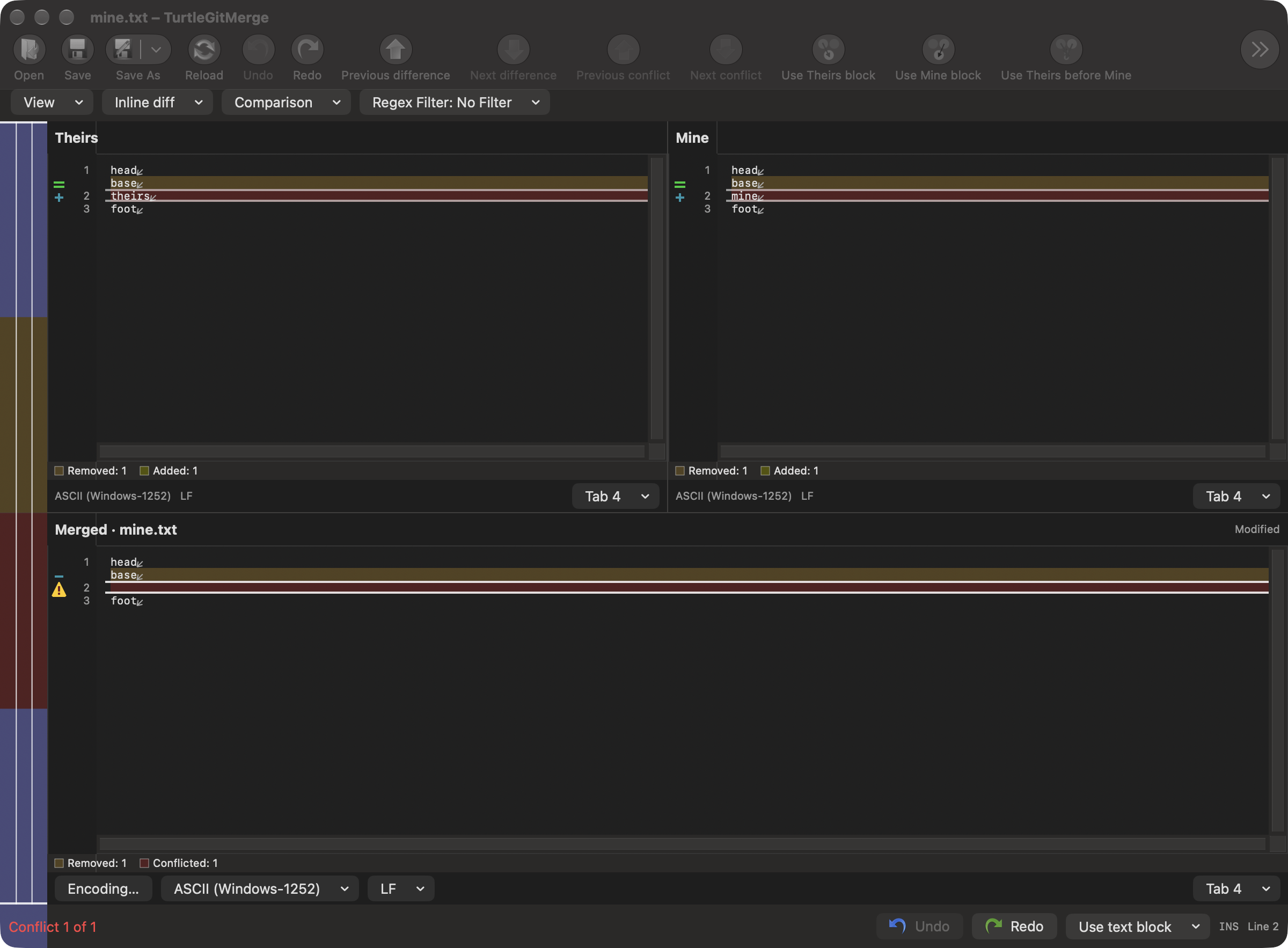
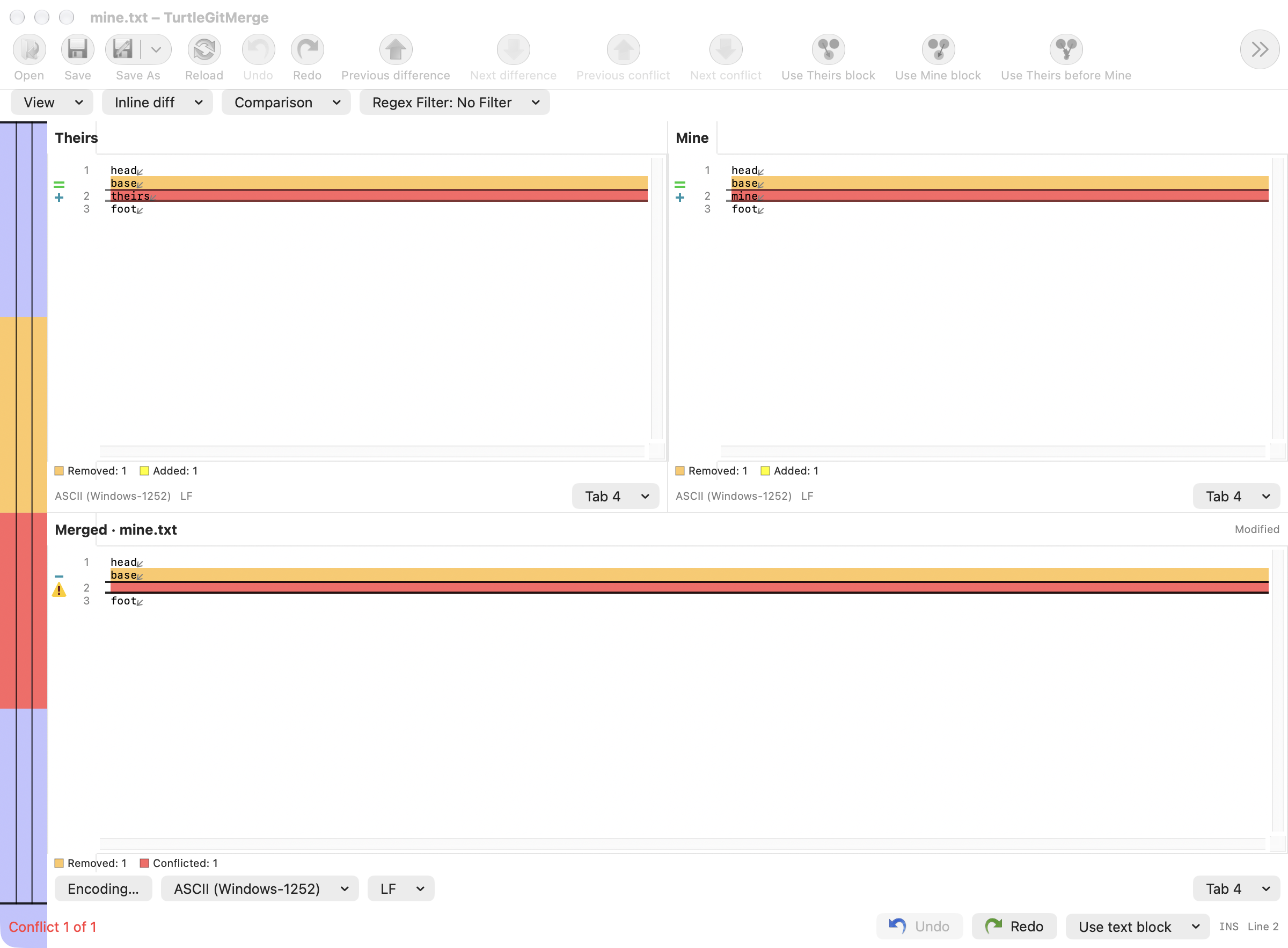
The two-pane and three-pane editors now draw the original lineadded, lineremoved, lineconflicted, lineconflictedignored, lineedited, lineequal and linewhitespace artwork, alongside the retained moved/marked icons. Each asset is copied unchanged from the pinned resources with its SHA-256 and source path in Icons/provenance.json. Colored artwork is retained in both appearances.
Addition/removal aliases share their source icons; unresolved result slots and ignored conflicts have separate icons. Edited rows retain their edit symbol. Resolved, resolved-empty and ordinary gaps have no invented status icon. The two source panes can replace their normal state symbol with Identical block or Whitespace-only changes. The combined view and result have no peer and retain their state symbols. Explicit marked blocks take priority over moved blocks; moved blocks take priority over the whitespace/state symbol. Marked words and search matches are separate text highlights, not marked blocks.
Whitespace classification uses original record payloads and endings. Normal rows with equal payloads and pairs of empty payloads have no override, even when their endings differ. Equal non-normal payloads get Identical block. Removing only space, tab, CR and LF detects single-line whitespace changes. Otherwise the source's same-state/Empty block search extends at most eight records each way; block concatenation is refused above 2048 UTF-16 units including the source's two-unit-per-row allocation allowance. Empty can inherit an adjacent non-Normal state. Identical/reflowed blocks update the bounded block's icons together. Nonbreaking space and canonically equivalent but byte-distinct Unicode are not silently normalized. This decoration does not change comparison keys, folding, Find categories, difference counts or saved bytes.
Classification is cached in the native ruler when original records/states or peers change; drawing uses cached symbols and artwork. Native hover labels describe the visible symbol; moved tooltips and double-click navigation retain their captured peer route. Hidden/fold-marker rows do not draw icons or tooltips. Hiding line numbers retains the source's 20-point icon margin in every pane; showing them restores its measured number width. Initial indentation/number defaults and later preference notifications now read the owning window’s supplied preference store in both editors; they previously mixed it with global defaults. Existing per-pane EditorConfig toggles remain independent on later Apply. Existing wrapping and linked scrolling use the resulting document width.
The source caches icons as screen rows are drawn; the native projection classifies view records in a deterministic forward pass before drawing. Exact virtual wrapped padding/icon repetition, physical margin/hover input and VoiceOver traversal, large-file performance, minimum-OS and signed installed acceptance remain open. This does not certify complete Merge or app parity.
Native captures and validation
Unedited, inactive native compositor captures in both appearances. The comparison shows the icon-only margin and whitespace/added/removed symbols; the conflict window shows equal source Base records, source additions and unresolved result slots. Inactive toolbar controls use normal macOS dimming. These captures do not certify every margin gesture or whole-window upstream geometry.
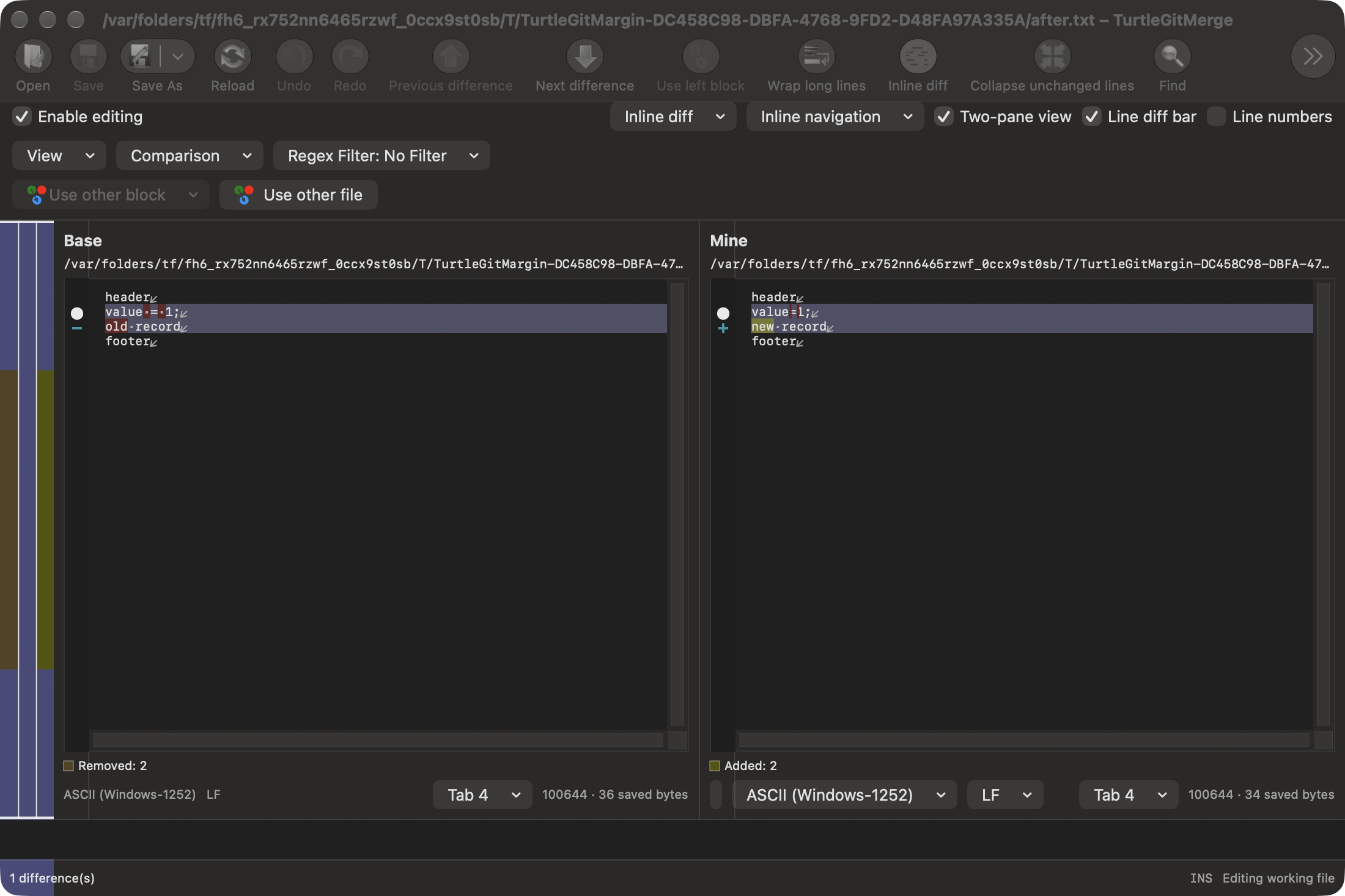
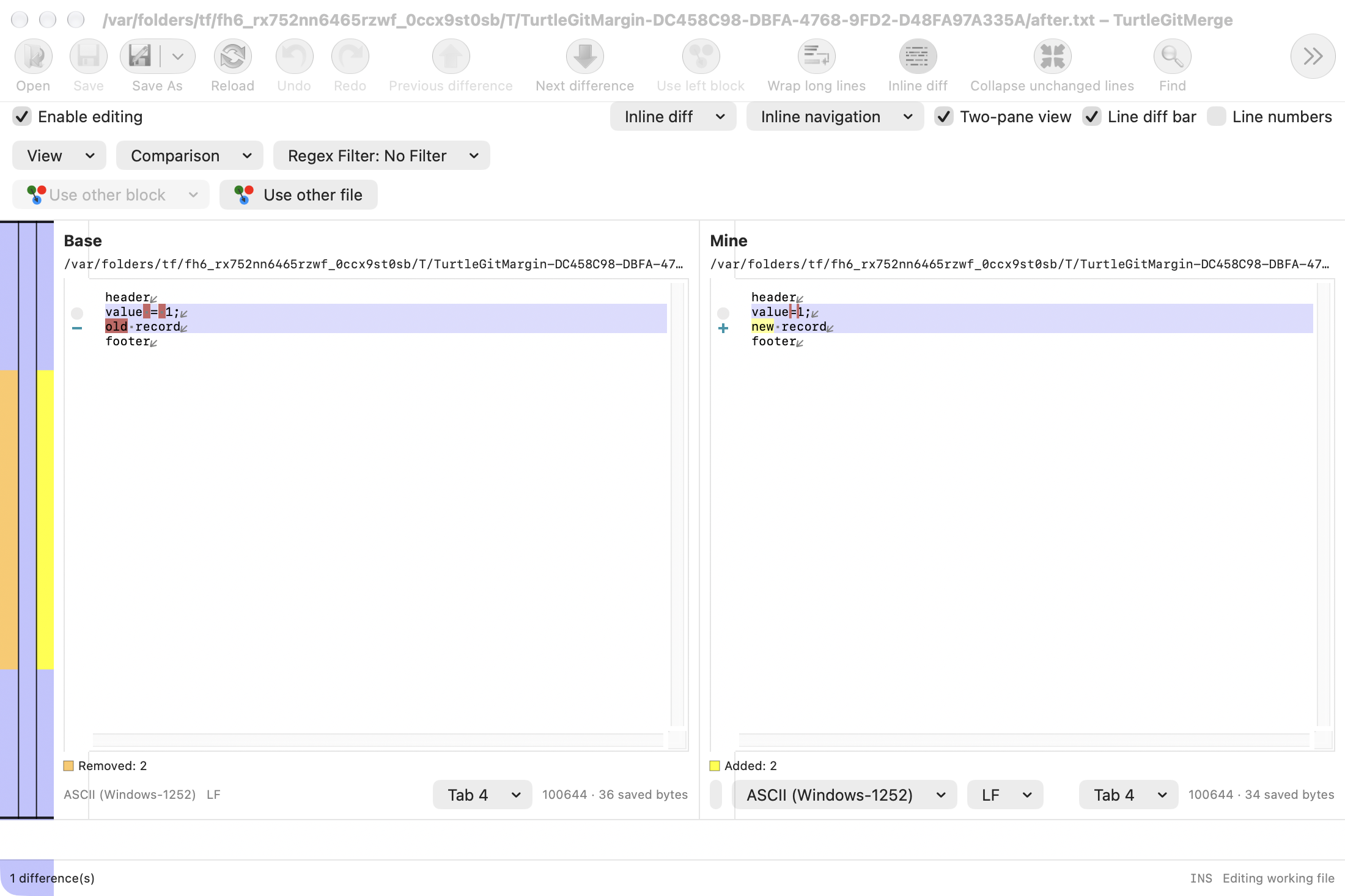
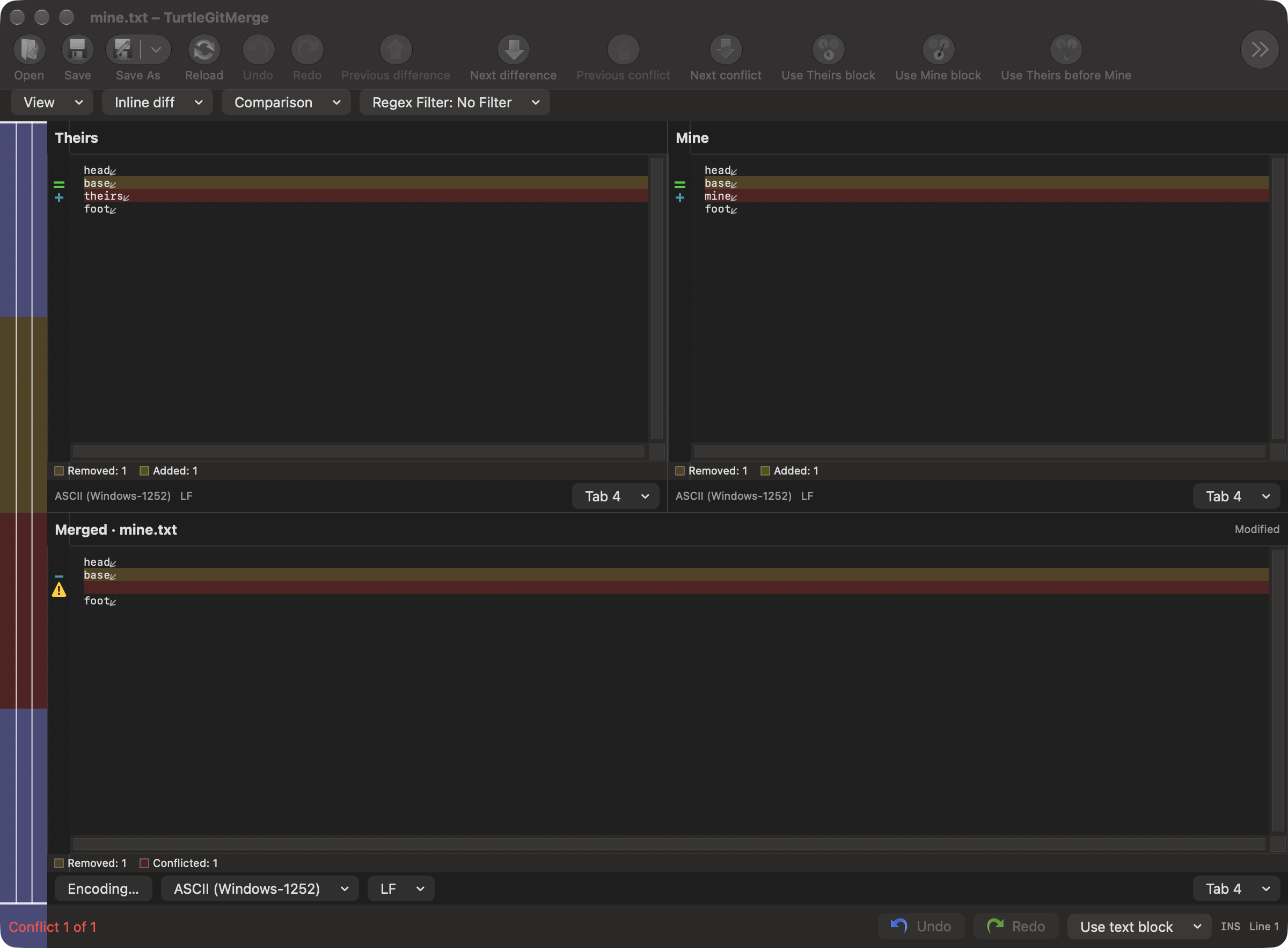
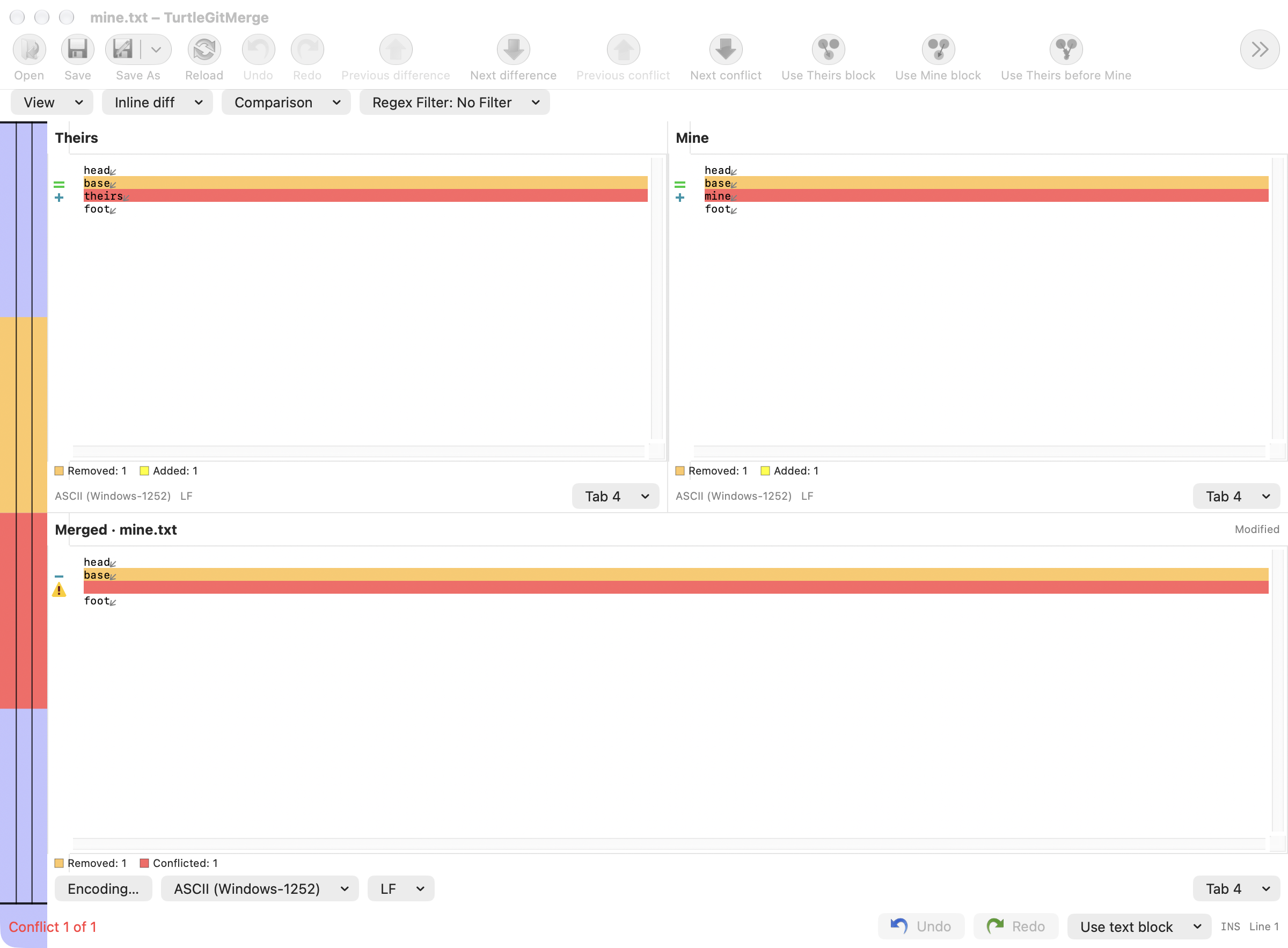
Grouped evidence records the 11 passing Core checks, four native family cases, the capture follow-up, the initial preference failure and two fixture corrections. All test-owned receivers and capture helpers were reaped. Complete physical, signed and hosted acceptance remain open.
Margin selection and capture — October 16, 2026
The gutter now handles native single-click, Shift-click and drag in the two-file, combined and three-way editors. A normal click focuses the owning pane and selects the entire logical line without its final ending. All participating panes retain matching row boundaries separately from the active text selection. Copy and Cut use explicit selected text; block choices retain the complete selected row range. Removed records and blank conflict slots keep their view coordinates rather than selecting serialized marker text. The two/three-pane mapping follows the same authoritative alignment used by existing navigation. Unmapped serialized-result fallbacks do not invent peer coordinates.
Shift and drag keep a fixed caret origin. As in BaseView::AdjustSelection, the endpoint in a margin is the beginning of the clicked screen fragment: the endpoint row remains in the block selection even when its text is not selected. Reversing direction preserves that origin. Clicking a wrapped fragment selects its whole logical line, while later extension retains the clicked fragment's origin. Native selection affinity supplies the direction when extending a pre-existing text selection. Source line endings and Unicode payloads are retained by the existing clipboard/editing paths; selection does not modify files or create Undo entries.
Double-click preserves moved-block navigation and expands a folded marker through the existing shared folding controller. An owned drag can autoscroll using AppKit while the pointer is outside its editor viewport. Mouse Up cancels its timer; owner closure explicitly retires every ruler. No global event monitor, pointer posting or other application's input is used. Timer callbacks hold only a weak owner and revalidate their captured gesture before applying.
Captured text, model/input revisions, folding revisions, viewport size and font validate later drag events. Editing, Undo/reload, changed folding/geometry, an owned sheet, busy or retired models reject stale gestures. Another native user input revokes the retained origin through the editor's existing input revision. The shared boundary renderer now supports a nonempty native text selection as well as its previous caret-only navigation blocks. Existing Copy/block navigation semantics remain available.
Sources: BaseView::OnLButtonDown/OnMouseMove/OnLButtonUp/OnTimer, OnLButtonDblClk, AdjustSelection and SetupAllViewSelection. Native autoscroll and TextKit fragment hit testing adapt Windows capture/screen coordinates. Exact Windows virtual padding/column positioning, non-move double-click word semantics, physical trackpad/drag/VoiceOver and signed/minimum-OS acceptance remain open.
Grouped selection evidence records six passing native cases plus the light/dark capture follow-up. Core was unchanged and not repeated. The build syntax repair, fixture sheet overload and actual unfolded-layout readiness correction are recorded, retaining all behavioral assertions. All eight receivers, including the failed run, were reaped and independently absent. Native event checks are distinct from physical input and signed acceptance.
Hosted hidden-pane selection repair — October 17, 2026
Hosted run 38967919455, job 117199386162, failed in the wrapped-editor
margin case. The model had completed its comparison and displayed one combined
editor, but an orphan left-pane selection (alignmentSelections=[true]) could
never settle. An outgoing split child can register after the mode switch has
removed its slot; capturing all retained scroll views queued work for that child.
Comparison registration now refuses a left pane absent from combined/single-file mode and a retired model. Engine publication captures selections only for visible sides whose native text view still belongs to the owning window. The native margin fixture injects this late left registration explicitly and retains the original settling and combined added/removed/no-whitespace assertions. No timeout increase or relaxed readiness predicate hides the failure.
The unmodified timing case passed locally before repair. After repair, the injected margin case, wrapped-navigation family and view-switching family pass. The Debug build passed; all four local receivers, including the earlier normal case, were reaped and independently absent. Core and unrelated Email checks were not repeated. See focused evidence. A new hosted workflow must still verify this repair; the failed run remains a failed run. Physical/signed and complete merge-editor acceptance remain open.