 TurtleGit for Mac
Legacy text formats in Compare and Merge
TortoiseMerge's FileTextLines.cpp uses the Windows system ANSI code page for
its source ASCII format. macOS has no equivalent Windows ACP setting.
Settings → Merge Editor → Legacy text encoding supplies that choice explicitly.
The default remains Windows-1252 for compatibility with earlier TurtleGit builds.
Supported choices are Windows-1250, 1251, 1252, 1253, 1254, 1255, 1256, 1257 and 1258; Windows-874; Shift-JIS (932), GBK (936), Korean (949) and Big5 (950). The codecs use Foundation's Windows-code-page bridge with strict round-trip validation. A conversion that loses or normalizes characters is rejected before changing the draft or file. This is not a promise that every Windows legacy mapping, malformed sequence or OEM code page has been reproduced.
The legacy preference is a native platform adaptation, not an additional pinned TortoiseMerge checkbox. The source's nine-item Encoding hierarchy remains: one configured ASCII/legacy choice and eight Unicode choices. Current legacy panes retain their actual codec in that first slot even after the default changes. Native context commands carry the chosen codec rather than reinterpreting a menu index under a newer preference.
Loading and saving
The existing source CheckUnicodeType classifier still decides Unicode versus
ASCII/legacy. UTF BOMs and valid non-ASCII UTF-8 take precedence; the saved
Use UTF-8 default continues to govern ordinary ASCII input. The legacy preference
does not force UTF-8 files through a regional codec. Strict decoding failure
remains unsupported text, without a second automatic reinterpretation.
Two-pane comparison, repository conflict loading, standalone three-way Merge and the patch comparison/merge adapters carry the selected policy into their reads. Changing the default affects subsequent loading; it does not reinterpret open panes, rewrite their text or change their saved encoding. Format changes and Save continue using the pane's retained codec. Existing EOL, missing-final-newline, mode, stale-file, backup and index guards remain in use.
Saved native pane targets retain their explicitly selected legacy codec while their bytes remain unchanged. When an external tool rewrites the bytes, reads run source detection again, so newly written UTF-8 and Unicode BOMs can take precedence. Byte/mode validation remains separate from text interpretation.
Evidence and limits
The checkpoint records 49 distinct focused Core cases across retained and affected runs. New cases cover all 14 regional codecs, exact working-file saves/reloads and modes, source choice order, preference fallback, external Unicode rewrites and a real Windows-1251 Git conflict whose Save preserves HEAD and raw index bytes.
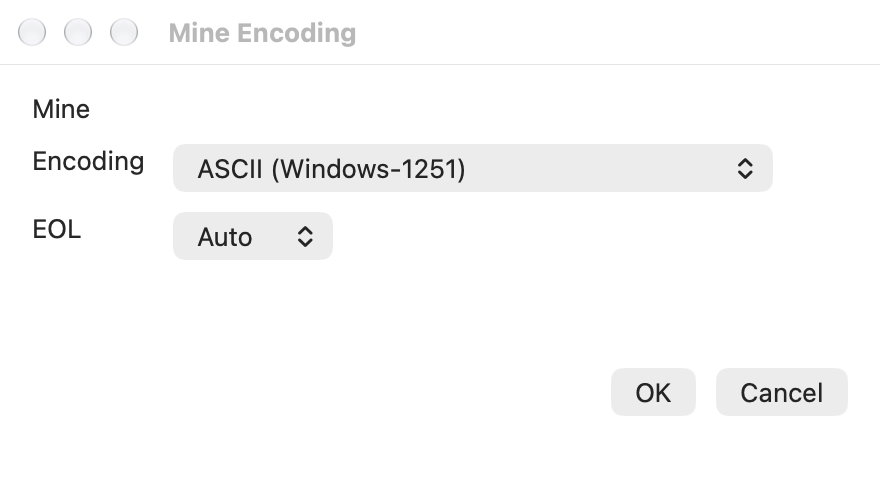
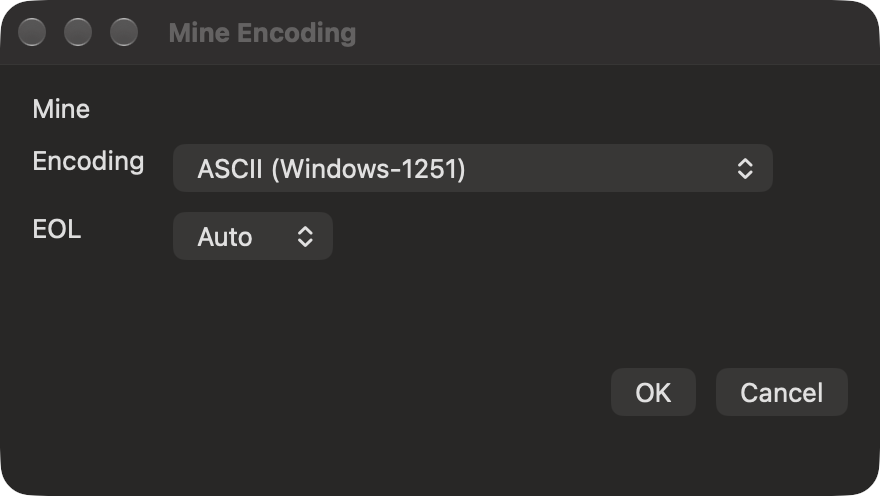
Four final native workflows cover Settings Apply/Cancel, Windows-1251 Compare, Shift-JIS standalone Merge, retained pane codec after changing defaults, conversion refusal, exact saves and the retained Encoding/format/Undo families. The legacy receiver supplies its private standalone Save As destination through the existing chooser hook. It does not prove a physical Save As interaction. The captures show the unchanged nine-choice dialog with a retained Windows-1251 selection, presented in an owned standalone QA window.
Remaining work includes exhaustive Windows mapping/codepage compatibility, legacy patch preparation/recovery and external-tool combinations, physical Settings/popup/keyboard/VoiceOver acceptance, full translated labels and signed sandbox/App Store acceptance. These results do not certify complete format or whole-app parity.
The later patch-codec workflow continuation connects legacy file preview/classification, captured recorded-base recovery and automatic application, including a manual UTF-8 continuation for unrepresentable output. Original-patch/serial-import text presentation remains a separate open family.