TurtleGit for Mac
Finder overlay settings — implementation in progress
Reference: pinned SetOverlayPage.cpp, SetOverlayHandlers.cpp, ShellCache.cpp's CPathFilter, IconOverlay.cpp and their resource dialogs at 7338078f8ddd924b8cddee35f512f2286072136d.
The native Settings tree now includes Icon Overlays and its Overlay Handlers and Icon Set children with the original Overlays.ico. Source group order is retained: overlay propagation controls, status cache, drive types, exclude/include editors and Show excluded folders as normal. Windows A:/B: drive and DLL/elevation switches have no direct Finder Sync counterpart; Finder provides the extension surface. The connected status-policy family now exposes Default, Shell Extended, Shell and None in source order. Default uses detailed cached status. None projects normal badges on known repository folders, without file-state badges. The containing app still reads full status for its own UI. Shell and Shell Extended use the pinned lightweight classifier, with different folder recursion. Only Default enables and consumes the unversioned/subrepository propagation controls.
Volume preferences cover fixed, removable, network, optical, RAM and unknown volumes. Optical/RAM filesystem names and native local/removable volume metadata supply classification. The extension classifies monitored roots on reload; mount boundaries within a repository and native RAM-disk representations need acceptance. Default source drive mask is fixed drives only. Include/exclude rules override the drive mask. More specific paths win, equally specific include rules beat excludes, and exact-only rules override recursive rules for that path. A terminal
- or no suffix applies to descendants; ? applies only to the named path. Native ~/$HOME expansion replaces Windows environment expansion without a shell. Rule matching currently follows the cached path spelling; case-insensitive volume behavior, duplicate mixed exact/recursive edge cases and symlink spelling remain open. Invalid relative/NUL paths cannot be saved.
Overlay Handlers offers working ignored, unversioned, added and deleted toggles
with original status artwork. Normal, modified and conflicted remain enabled in
the UI. Skip-worktree and assume-valid/unchanged handlers now use the original LockedIcon
and ReadOnlyIcon artwork. The containing app reads NUL-delimited ls-files -v
index flags for main repositories and scanned submodules, preserving Unicode and
newline paths. They apply only to normal files: skip-worktree has precedence over
assume-unchanged; disabling a handler allows the other active flag or normal badge.
Changed/conflicted status has precedence. Refresh removes stale child flags while
preserving independently opened repositories. The complete source page is not certified.
Finder has no Explorer overlay-slot allocation or cross-Tortoise registry control.
Icon Set offers all 16 pinned source sets, including List and Symbols previews.
All 144 ICO assets are copied without modification, with original per-set notices
and SHA-256 provenance. Apply saves the selection with the shared overlay draft;
Finder re-registers all nine images and clears/reassigns cached badge identifiers
on a set change. Live Finder refresh acceptance remains pending.
Settings pages share one draft and property-sheet Apply/Cancel participant. Apply atomically publishes overlay-settings.json in the signed App Group, saves local preferences and posts the existing distributed status notification. Unsigned builds save the draft locally and explain that signed group access is required. Application startup publishes the saved settings when that container is available. The extension reloads policy and recalculates badges, including clearing paths whose badges were hidden. It continues monitoring all cached repository roots so context menus remain available regardless of overlay policy. Finder launches no Git processes.
FinderSnapshot now optionally retains direct overlayEntries independently from its existing aggregated states. New snapshots compute parent badges from direct entries: unversioned files keep their own unversioned badges, while their parent contribution is normal or modified according to the checkbox. Ignored entries do not dirty parents. Registered subrepository roots contribute above their roots only when requested; the parent's own Git gitlink status remains meaningful. Excluded known folders project normal when requested; excluded files lose their badges. Hidden handlers suppress presentation without changing cached menu state. Older cache JSON remains decodable and falls back to legacy states until refreshed. Subtree replacement preserves direct entries for independent cached repositories.
Grouped Network/Finder validation: Debug arm64 Xcode build exited 0; 22 focused
Core tests passed, zero failures, 7.692 seconds. Coverage includes proxy URL/
credential/IPv6 round trips and invalid inputs, real global proxy writes with
local and URL-specific preservation, sanitized lock failure, SSH override/App
Store selection and real OpenSSH check/cancellation, path-policy precedence,
unversioned/handler/subrepository/None badge projection and persistence, snapshot
leaf round trips, existing Finder menu settings, child scans and subtree metadata.
No app was launched and no full suite was rerun. Xcode emitted existing warnings
and seven unusual SwiftCompile diagnostics reporting exit code 0 with no output;
this is not a clean diagnostics claim. See
qa/network-finder-settings-batch-2026-10-11.json.
Grouped icon/index/menu continuation: native Debug arm64 Xcode build exited 0;
34 focused Core tests passed with zero failures in 6.585 seconds. The native
framework contains all 144 overlay ICO assets. All nine badges in all 16 sets
decode to actual AppKit pixels at 16 and 32 points. Tests cover live Git flag
reads with Unicode/newline paths and both bits, unchanged index bytes, flag
clearing/cancellation, badge priority and disabled handlers, exclusions/None,
old/new preferences and snapshot compatibility, stale-child flag removal,
independent repository preservation and known-root menu classification.
Existing menu/icon/submodule/Network checks ran in the same grouped pass.
No app was launched and no full suite was rerun. Xcode again reported seven
exit-zero/no-output SwiftCompile diagnostics alongside existing warnings.
See qa/finder-icons-batch-2026-10-11.json.
Native Finder badge refresh, settings focus/layout/theme, mount classification, App Group notification propagation and signed sandbox acceptance remain open. Known repository roots now retain versioned menu classification even when their aggregated status is unversioned, ignored or absent. Creation-menu classification also recognizes those roots, preventing extended-menu Initialize there. Untracked files retain their Add eligibility and are not classified as versioned. Raw cached status remains unchanged; narrow tests do not prove complete context-menu parity. The full port and inventory certification remain incomplete.
Native shared Overlay pages — 2026-10-12
Compared the source main groups, six optional handler controls, and Icon Set's List/Symbols selector and Apply behavior. The native pages now scroll so the main controls remain reachable at a smaller window height. The list preview has a bounded scrolling area; Symbols retain the existing grid. Handler artwork uses the selected set rather than a fixed status icon. Path editors have named accessibility labels. All pages still share one Settings participant and draft.
The model captures a validated policy for publication/local persistence, then notifies Finder only after both succeed. Invalid input cannot invoke publication. Publication failure retains unsaved fields and leaves local settings unchanged. An unsigned local-only save has a separate informational notice; failures display as errors. Cancel clears both messages and restores all shared fields. Preferences, publication and notification adapters are injectable while production uses the existing signed App Group and distributed notification.
Debug build exited 0. One object-linked native receiver compilation/process passed and was reaped. Three private hosts at 760 × 530 were constructed in Aqua and Dark Aqua, with native scrolling surfaces present. Shared Settings Apply, Cancel and invalid-policy refusal, private atomic file publication/readback and path-rule precedence, notification-after-preferences-save, failed-publication draft retention and unsigned save/notice/no-notification behavior passed. No Finder extension was activated; user preferences and App Group data were not changed. Core projection/asset APIs were unchanged and their prior grouped checks were not rerun. No full fourteen-case group or new screenshot is claimed.
The three source resources are now partial-native-replacement. Physical controls/ keyboard/VoiceOver and complete visual matching, Symbols switching, actual Finder refresh/notification/volume boundaries, watched-root management and signed sandbox/App Store acceptance remain open. Windows registry/elevation/overlay-slot controls still require macOS adaptation; no dialog is certified complete.
Volume-aware path rules and badge aliases — October 15, 2026
The active ShellCache.cpp CPathFilter parser/merge/lookup defines terminal
*/?, include/exclude ties, exact-path overrides and ancestor precedence.
Those rules now compile into literal and case-folded lookup tables once per badge
projection, instead of reparsing every path rule for every file. The deepest
recursive ancestor applies, exact-only entries override that same path without
changing descendants, and duplicate includes win within the same rule category.
CRLF editors and native ~/$HOME expansion retain their source meanings.
Validation names the first invalid editor and line; invalid drafts cannot publish
or grant a partial include exception. The native page displays live diagnostics
and valid include/exclude entry counts, with Apply/Cancel still shared.
The Finder extension now resolves volume kind and name-case sensitivity for each containing directory rather than assuming all paths use their repository root's volume. Metadata is cached for files sharing a directory during a refresh; a mounted child directory has its own result. Deleted items fall back to an existing ancestor. Final symlink entries use their containing directory rather than the link target's volume. Unknown volume/case information remains conservative. Volume mount, unmount and rename notifications also rebuild the overlay policy. This uses native filesystem metadata and starts no Git process in Finder.
Rule spelling and badge requests now follow the target volume's case behavior. Insensitive-volume names fold case and canonical Unicode spellings. Sensitive volumes retain literal byte distinctions. An immutable badge lookup handles an alternate Finder spelling and chooses the highest-priority state for conflicting cached aliases. Refresh-time assignments use that same lookup so clearing an old spelling cannot erase its replacement alias. Path masks and optional index-flag handlers share the per-path volume/case decision; menu eligibility keeps its original cached Git status independently.
This supersedes the earlier cached-spelling/root-volume limitations for the implemented lookup and projection. Real network/RAM/optical mounts, permission failures, filesystem Unicode edge cases, mount churn during a snapshot read, physical Finder activation and signed sandbox/App Store acceptance remain open. The later status-policy checkpoint supersedes the earlier unported Shell-mode and volume-only badge-case limitations. Its native collector retains effective index capabilities and source stat/content ordering. All 16 existing icon sets, handler choices and the independent cache service retain their prior behavior.
Validation: Debug app/framework/Finder-extension build exited 0. The first grouped Core run passed 18 of 19 checks; the Unicode rule test exposed Foundation path normalization and passed after lexical normalization replaced it. All 19 grouped checks passed after that repair; the 11 affected overlay checks passed after the lazy metadata-lookup continuation. Both native shared Settings cases passed with private preferences/publication and their receivers were reaped. Thirty current controls now have explicit partial source mappings; alternate Windows engines and unmapped platform controls remain pending. See path-policy evidence.
The helper's optional cache menu now changes only cache mode in the latest valid shared overlay record. App startup and new overlay Settings owners honor that accepted shared record; private preference stores stay isolated. Corrupt records are not overwritten by menu actions. Existing Settings drafts retain their explicit Apply/Cancel semantics.
Owned Finder controls and exact overlay drafts — October 17, 2026
The three overlay pages now capture their page, owner and form generation for fields, optional handlers, drive masks, icon set and List/Symbols preview. Leaving and revisiting a page, Apply, Cancel and cache-mode changes retire retained callbacks. None mode refuses propagation changes at the model boundary as well as disabling its controls. Cross-page/foreign controls cannot edit another page or hide mandatory badges. Cached pages retain shared property-sheet Apply semantics; closing the Settings owner retires their controls and prevents further Apply. Include/exclude modified-state retains exact UTF-8 spelling, matching sensitive volume path rules; canonical String equality no longer discards a real edit.
Watched-repository controls now use their own native owner rather than the global key window. Root and additional-folder choosers, renewal and removal confirmations capture the selected root/permission IDs and registry revision. They retire once on page departure/closure; stale or duplicate replies cannot update a later selection. Accepted mutations remain owned by the application watch manager and finish independently of the page. Refresh and Remove support multiple selected repositories; the removal question lists the captured paths, uses Cancel as the first button and keeps repository files unchanged. Selection drops removed roots and grants. Existing background service and watch/cache ownership remain intact.
The grouped checkpoint passed: Debug build, 12 overlay Core tests and the full combined native family with system and bundled Git. The first native attempt used an idle predicate that could pass before an accepted renewal task started; the repaired wait requires a registry revision change. Icon captures now use the production Settings viewport, avoiding a standalone host's narrow ideal width. The grant-selection refresh was also corrected before the final native pass. Core tests were not repeated for those native/fixture changes. Eight raw captures were reviewed; all three receivers and their private paths were independently absent. See exact evidence. Physical Finder activation, actual user chooser gestures, cross-volume mounts and signed App Group/bookmark/ App Store acceptance remain open. Windows overlay-slot/registry controls and the alternate Windows cache engines are still unresolved native adaptations.
Native extension setup and installed badges — October 17, 2026
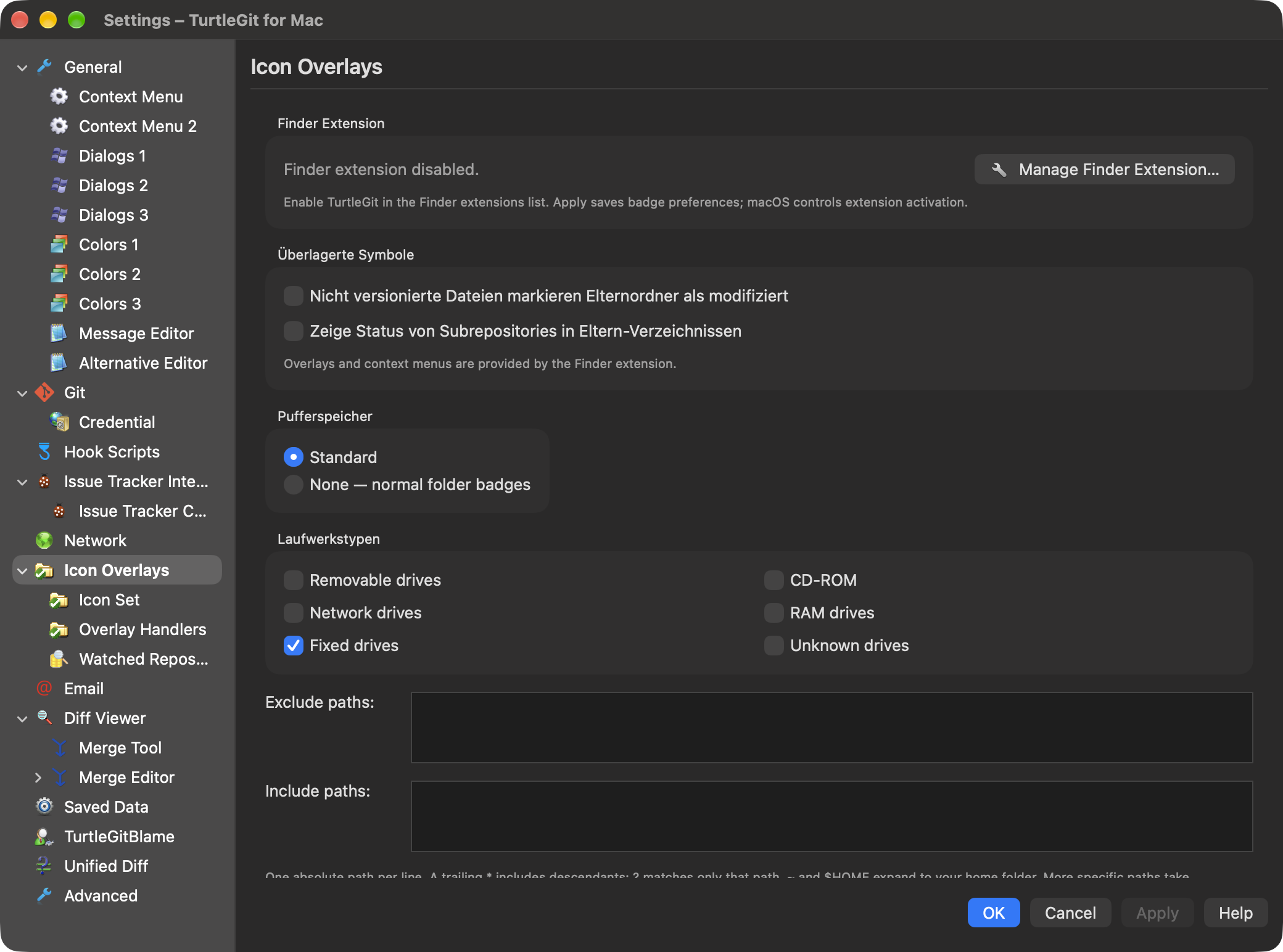
Icon Overlays now shows macOS's Finder extension activation status and a Manage Finder Extension… button using the original settings artwork. It opens Apple's extension management interface; applying badge preferences remains a separate operation. Returning to the app refreshes activation without marking the settings draft modified. Departed/closed page contexts and attached sheets refuse manager requests. Actual native control checks cover those gates and packaged versus missing background-service status with both Git engines.
The signed installed app's page was rendered and captured below. Native automation could not read this page's accessibility tree, so the new button's physical OS manager invocation remains unverified. Actual activation was separately performed through System Settings: live Finder badges showed ignored, modified and normal states, and changed after a background refresh with the app quit. That does not certify every icon-set/volume/filter combination.